Engineering Review: 2000W Cobot Welding Machine – Turin, Italy
In this article
- Field Evaluation: 2000W Cobot Welding Integration – Turin Industrial Sector
- 1. Technical Configuration and Environmental Context
- 2. The Synergy of Collaborative Robotics and High-Power Welding
- 3. Deep-Dive: Thick Plate Steel Welding Applications
- 4. Collaborative Safety and Shop Floor Reality
- 5. Comparative Analysis: Manual vs. Cobot
- 6. Lessons Learned and Engineering Recommendations
- Conclusion
Field Evaluation: 2000W Cobot Welding Integration – Turin Industrial Sector
This report details the technical deployment and performance validation of a 2000W Cobot Welding Machine within a heavy-duty fabrication facility located in the Orbassano industrial zone, Turin, Italy. The objective was to transition a Tier 2 automotive supplier from manual MIG/MAG processes to an automated solution capable of handling Thick Plate Steel welding (12mm to 20mm range) while maintaining the flexibility of Collaborative Robotics.
1. Technical Configuration and Environmental Context
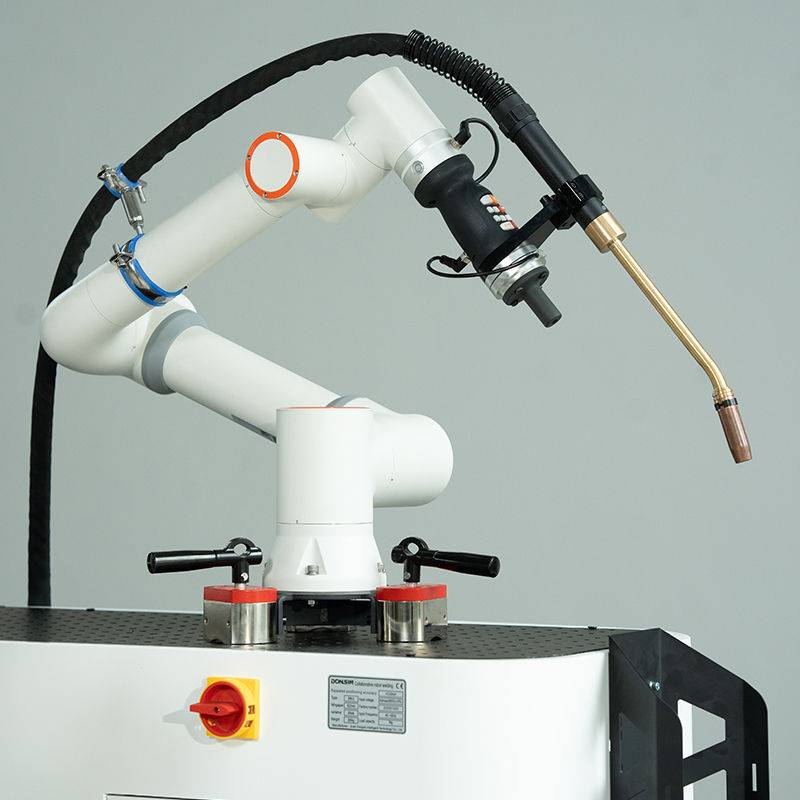
The system under review consists of a 2000W continuous wave (CW) fiber laser source integrated with a high-degree-of-freedom collaborative arm. Unlike traditional industrial robots that require extensive safety cell infrastructure, this Cobot Welding Machine was deployed directly onto the existing shop floor, sharing space with manual workstations.
Turin’s industrial environment presents specific challenges: high ambient electrical noise from neighboring CNC lines and a workforce skilled in traditional metallurgy but skeptical of “black-box” automation. The choice of a 2000W source was calculated specifically for Thick Plate Steel welding, where lower-power units often fail to achieve the required depth of fusion without excessive, time-consuming multi-pass layering.
2. The Synergy of Collaborative Robotics and High-Power Welding
The core value proposition observed during this deployment is the bridge between Collaborative Robotics and the raw power of a 2000W laser. In traditional setups, “automation” implies a rigid, fixed-position machine. However, in the Turin workshop, the “Collaborative” element allowed the senior welding technician to physically guide the arm to define weld paths for complex geometries on large-scale chassis components.
Operational Integration
The Cobot Welding Machine operates on a “Lead-Through” programming logic. For Thick Plate Steel welding, where edge preparation (V-groove or J-prep) can vary by fractions of a millimeter between batches, the ability for a human operator to fine-tune the torch angle in real-time before initiating the sequence is critical. This synergy minimizes the downtime usually associated with re-programming industrial PLC logic for minor plate misalignments.
3. Deep-Dive: Thick Plate Steel Welding Applications
The primary focus of the Turin field test was the structural welding of S355JR grade steel, varying in thickness from 12mm to 18mm. Transitioning this thickness to a Cobot Welding Machine requires a departure from standard thin-gauge “point and shoot” laser settings.
Root Pass and Fill Strategy
For 15mm Thick Plate Steel welding, we implemented a dual-pass strategy using the 2000W source.
- The Root Pass: Utilized a 1600W output with a 2.0mm wobble width to ensure bridge-gap capability. The collaborative arm maintained a constant 12mm/s travel speed, achieving a 6mm penetration depth—far exceeding the capabilities of a standard 1kW unit.
- The Cap Pass: The power was adjusted to 1900W with a wider 4.0mm figure-eight wobble pattern. This redistributed the heat to ensure side-wall fusion, a common failure point in manual thick-plate MIG welding due to cold-lapping.
Thermal Management and Distortion
One of the “lessons learned” during the first week in Turin was the management of heat sinks in thick sections. While the 2000W laser provides a concentrated Heat Affected Zone (HAZ), the sheer volume of metal in Thick Plate Steel welding acts as a massive thermal reservoir. Collaborative Robotics allowed us to implement “skip welding” patterns easily. The operator could program the cobot to weld a 200mm section, move to the opposite end of the flange, and return once the interpass temperature dropped below 200°C—all without re-indexing the part.
4. Collaborative Safety and Shop Floor Reality
The “Collaborative” nature of Collaborative Robotics was tested rigorously. In the Turin facility, space is at a premium. The Cobot Welding Machine was fitted with area scanners that reduced the laser power and arm speed when a human entered the “yellow zone” and triggered an E-stop in the “red zone.”
Technical friction occurred during the integration of the wire feed system. For Thick Plate Steel welding, we utilized 1.2mm ER70S-6 wire. The cobot’s ability to synchronize the wire feed speed with the laser’s pulse frequency is what separates a successful 2000W integration from a failed one. We found that a “push-pull” feeder was necessary to prevent bird-nesting during the complex maneuvers the collaborative arm performs when welding internal corners of heavy brackets.
5. Comparative Analysis: Manual vs. Cobot
Productivity Metrics
Data gathered over a 14-day period in Turin showed:
- Arc-on Time: Manual welders averaged 35% arc-on time due to fatigue and the need for frequent repositioning of heavy plates. The Cobot Welding Machine maintained 75% arc-on time.
- Consumables: Laser welding used 40% less shielding gas (Argon/CO2 mix) compared to traditional MAG welding, primarily due to the higher travel speeds and narrower weld pool.
- Post-Weld Processing: Due to the precision of Collaborative Robotics, spatter was virtually eliminated. The Turin site reported a 90% reduction in grinding time—a massive secondary cost saving.
6. Lessons Learned and Engineering Recommendations
After 300 hours of operation on the Turin floor, several technical takeaways are evident for any senior engineer looking to deploy Collaborative Robotics for heavy industry:
I. Shielding Gas Dynamics
In Thick Plate Steel welding, the plume of ionized metal vapor can interfere with the 2000W beam. We learned that a side-blown “air knife” or high-pressure cross-jet is mandatory to protect the cover slide. Standard nozzle configurations provided by the cobot manufacturer were insufficient for continuous high-power runs on 15mm plate.
II. The “Human in the Loop” Necessity
While the Cobot Welding Machine is autonomous during the weld cycle, it is not “set and forget.” The most successful runs occurred when the manual welder acted as a “Cell Supervisor,” using their metallurgical intuition to adjust the focus offset by 0.5mm based on the visible behavior of the melt pool. Collaborative Robotics should be marketed as a tool for the welder, not a replacement for them.
III. Grounding and Interference
The Turin site had significant grounding issues. The high-frequency start of nearby TIG stations caused intermittent communication drops between the cobot controller and the laser source. We solved this by implementing a dedicated common ground for the Cobot Welding Machine and using double-shielded Ethernet cables for the HMI connection. This is a critical checklist item for any old-school European workshop integration.
IV. Joint Fit-Up Precision
Despite the “collaborative” flexibility, 2000W laser welding still requires tighter fit-up tolerances than MIG. If the gap exceeds 1.0mm on Thick Plate Steel welding, the laser tends to “shoot through” the gap. We recommended the Turin facility upgrade their plasma cutting table to ensure edge straightness, highlighting that automation upstream is a prerequisite for automation downstream.
Conclusion
The deployment in Turin confirms that a 2000W Cobot Welding Machine is a viable, high-efficiency solution for Thick Plate Steel welding. The synergy provided by Collaborative Robotics allows for a gradual transition to automation, leveraging the expertise of existing staff while significantly increasing throughput. Success, however, remains contingent on meticulous thermal management and the recognition that high-power laser welding requires a level of environmental cleanliness and joint preparation higher than that of traditional arc processes.
Report Filed By:
Senior Welding Engineer, Field Operations
Turin Site Visit – Q3 Evaluation







