Engineering Review: Air-cooled All-in-one Cobot Station – Casablanca, Morocco
In this article
- Field Engineering Report: Implementation of Air-Cooled All-in-one Cobot Stations in Casablanca Industrial…
- 1. Site Overview and Environmental Constraints
- 2. The Synergy of the All-in-One Cobot Station and Collaborative Robotics
- 3. Technical Analysis: Copper Components Welding
- 4. Operational Performance and Air-Cooling Efficiency
- 5. Lessons Learned and Practical Adjustments
- 6. Conclusion on Casablanca Deployment
Field Engineering Report: Implementation of Air-Cooled All-in-one Cobot Stations in Casablanca Industrial Zone
1. Site Overview and Environmental Constraints
This report details the commissioning and operational assessment of the All-in-one Cobot Station at a Tier-2 automotive supplier facility in the Ain Sebaa industrial district of Casablanca, Morocco. The primary objective was the automation of Copper Components welding within a high-mix, low-volume production environment. Unlike traditional robotic cells, the deployment required a footprint that could be integrated into an existing manual assembly line without extensive safety fencing or structural floor modifications.
Casablanca presents specific environmental challenges, notably high ambient humidity (averaging 75%) and salt-laden air due to coastal proximity. For an air-cooled system, these factors are critical. We monitored the thermal dissipation of the power source integrated into the All-in-one station to ensure that the internal filtration could handle the particulate matter common in North African industrial zones without compromising the duty cycle.
2. The Synergy of the All-in-One Cobot Station and Collaborative Robotics
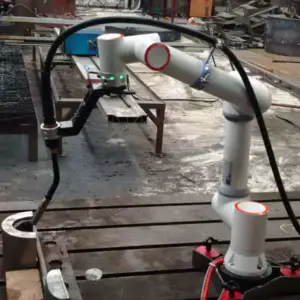
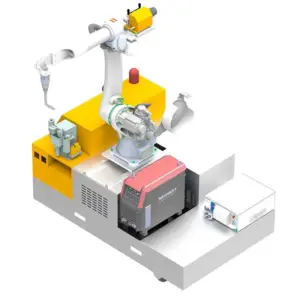
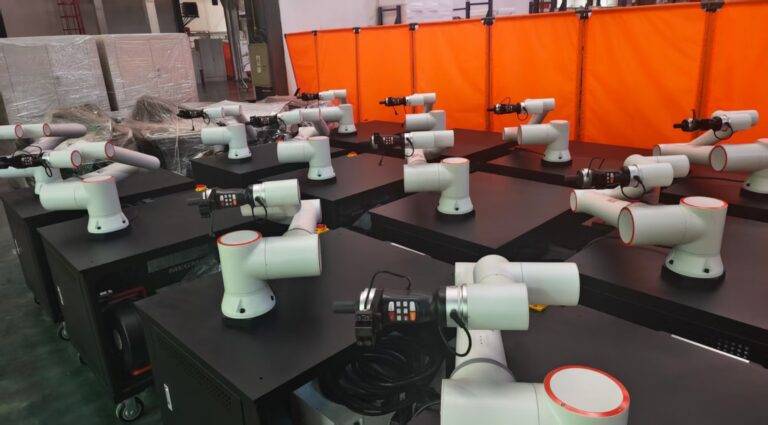
The transition from manual welding to Collaborative Robotics in this facility was driven by the need for consistency in thermal management. The All-in-one Cobot Station serves as a unified platform where the robotic arm, power source, wire feeder, and controller reside on a single, mobile chassis. This “all-in-one” philosophy is not merely a convenience; it is a technical necessity for the Casablanca workshop layout.
2.1 Spatial Integration and Portability
In the Casablanca facility, floor space is at a premium. Traditional industrial robots require significant real estate for safety interlocks and light curtains. By utilizing collaborative robotics, we leveraged the force-limiting sensors of the arm to operate in proximity to human technicians. The synergy here is clear: the station provides the rigid stability required for high-accuracy welding, while the collaborative nature allows the operator to perform fit-up and tacking on one side of the table while the cobot completes a circumferential weld on another.
2.2 Lead-Through Programming for Local Workforce
A significant “lesson learned” during this deployment was the speed of knowledge transfer. The local engineering team in Casablanca was able to utilize the lead-through programming feature of the Collaborative Robotics system. Instead of writing complex G-code, the welding lead physically moved the arm to define the path for Copper Components welding. This reduced setup time by 40% compared to traditional pendant-based programming.
3. Technical Analysis: Copper Components Welding
Welding copper is notoriously difficult due to its high thermal conductivity (approx. 401 W/m·K) and low infrared absorption. In the context of our Casablanca project, we were dealing with C11000 Electrolytic Tough Pitch (ETP) copper busbars. The All-in-one Cobot Station had to be tuned to overcome the massive heat sink effect inherent in these parts.
3.1 Thermal Input and Pulse Parameters
To achieve successful fusion without burn-through or excessive porosity, we implemented a High-Frequency Pulse MIG process. The All-in-one Cobot Station’s integrated power source allowed for millisecond-level synchronization between the wire feed speed and the current pulse. This is vital for copper, where the window between “cold lap” and “puddle collapse” is extremely narrow.
We found that a 20% Helium / 80% Argon gas mix was necessary to increase the ionization potential and provide deeper penetration into the 6mm copper plates. The air-cooled torch on the cobot was pushed to its limit; we had to program “cooling paths” into the cycle to ensure the contact tip did not reach the annealing temperature of the copper alloy itself.
3.2 Managing Oxidization in Coastal Climates
The Casablanca humidity caused rapid oxidation on the copper surfaces. Lesson learned: The Collaborative Robotics system must be synchronized with a pre-weld cleaning station or a localized de-oxidizing flux application. We adjusted the cobot’s routine to include a “gas pre-purge” of 3 seconds to ensure the weld zone was fully inert before the arc strike, accounting for the high moisture content in the ambient air.
4. Operational Performance and Air-Cooling Efficiency
A primary concern for the senior engineering team was whether an air-cooled All-in-one Cobot Station could maintain a 60% duty cycle in 30°C+ ambient temperatures. Water-cooled systems are often preferred for copper due to the heat reflected off the workpiece, but for this Casablanca site, the maintenance of water chillers was deemed too complex for the local infrastructure.
4.1 Thermal Dissipation Results
The station’s internal airflow design successfully channeled heat away from the PCB stacks. However, we noted that the air filters required cleaning every 72 hours due to the fine dust prevalent in the region. The air-cooled torch utilized a heavy-duty ceramic nozzle which resisted the spatter of the Copper Components welding better than standard chromium-plated variants. We recorded a maximum handle temperature of 58°C after four hours of continuous operation, which is within the safety limits for the cobot’s joint actuators.
5. Lessons Learned and Practical Adjustments
During the three-week deployment in Casablanca, several critical field adjustments were made to the All-in-one Cobot Station and its application of Collaborative Robotics:
5.1 Wire Feed Consistency
Copper welding wire is softer than steel. We initially encountered “bird-nesting” at the drive rolls. The fix involved switching to U-groove rollers specifically polished for copper alloys and reducing the tension on the All-in-one station’s internal feeder. Because the station is “all-in-one,” the distance from the spool to the torch is minimized, which significantly reduced the friction-induced drag that usually plagues cobot welding setups.
5.2 Grounding and High-Frequency Interference
In the Casablanca plant, the electrical grounding was inconsistent. The All-in-one Cobot Station is sensitive to electromagnetic interference (EMI) during high-frequency arc starts. We had to install a dedicated copper grounding busbar for the station to prevent “ghost movements” in the robotic arm during the high-amperage cycles required for the copper parts. This is a critical takeaway for any installation in older industrial zones.
5.3 The Human-Robot Interface (HRI)
The “collaborative” aspect of Collaborative Robotics was most apparent during the quality control phase. The Casablanca operators used the cobot as a high-precision rotary positioner. By mounting the copper components on a synchronized external axis (controlled by the station), they could inspect the weld bead in real-time. This synergy between human vision and robotic steady-pathing resulted in a 98% first-pass yield, up from 72% with manual TIG welding.
6. Conclusion on Casablanca Deployment
The All-in-one Cobot Station has proven to be a robust solution for the Moroccan market, specifically for challenging applications like Copper Components welding. The integration of the power source and the arm into a single unit solves the logistical and spatial constraints of the Casablanca industrial landscape.
While the air-cooled limitation requires strict adherence to maintenance schedules for filtration and nozzle cleaning, the benefits of Collaborative Robotics—specifically the ease of programming and the safety of shared workspaces—outweigh the thermal management hurdles. For future deployments in similar coastal environments, we recommend the inclusion of a reinforced EMI shielding kit and a pressurized air-filtration module for the station’s internal electronics.
Report End.
Senior Welding Engineer, Field Operations.