Engineering Review: Single Pulse All-in-one Cobot Station – Michigan, USA
In this article
- Field Engineering Report: Deployment of Single Pulse All-in-one Cobot Station
- Project Overview and Site Conditions
- The All-in-one Cobot Station Architecture
- Practical Application of Collaborative Robotics
- Advanced Carbon Steel Welding Parameters
- Synergy: All-in-one Station Meets Collaborative Robotics
- Lessons Learned from the Field
- Technical Performance Metrics
- Conclusion and Scaling Recommendations
Field Engineering Report: Deployment of Single Pulse All-in-one Cobot Station
Project Overview and Site Conditions
This report details the technical deployment and optimization of a Single Pulse All-in-one Cobot Station at a Tier 2 automotive component facility in Grand Rapids, Michigan. The facility primarily handles high-volume fabrication of structural brackets and frames. Historically, these components were joined using manual GMAW (Gas Metal Arc Welding). However, rising labor costs in the Michigan industrial corridor, coupled with a shortage of Level 3 certified welders, necessitated a shift toward Collaborative Robotics.
The site environment is typical of Michigan heavy manufacturing: variable ambient temperatures ranging from 55°F to 95°F depending on the season, with significant humidity fluctuations. These factors critically impact gas coverage and wire feed consistency. The objective was to integrate a system that could handle the heavy mill scale found on domestic A36 carbon steel while maintaining a footprint small enough to fit within existing manual weld cells.
The All-in-one Cobot Station Architecture
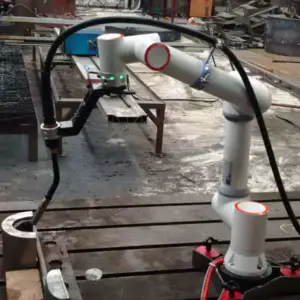
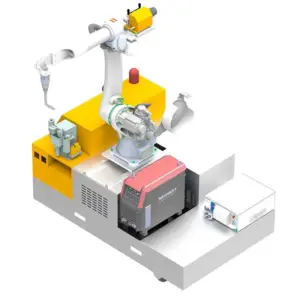
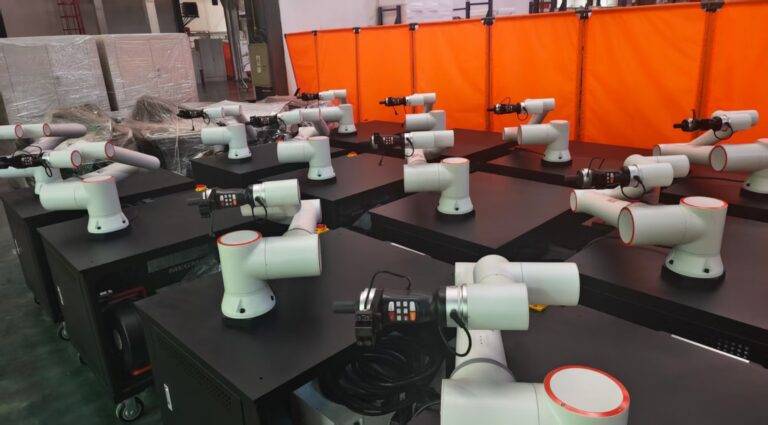
The selection of an All-in-one Cobot Station was driven by the need for rapid deployment. Unlike traditional industrial robots that require extensive perimeter fencing, external controllers, and dedicated power drops, the All-in-one unit integrates the cobot arm, the pulse-capable power source, the wire feeder, and the cooling system into a single, mobile topological unit.
Hardware Integration and Synergy
The synergy within the All-in-one Cobot Station is found in the unified communication bus. In this Michigan deployment, we utilized a system where the power source and the cobot controller share a real-time EtherCAT interface. This reduces latency between the arc start command and the motion movement, which is critical when performing stitch welds on thin-gauge carbon steel. By housing the welder within the station base, we eliminated the electromagnetic interference (EMI) issues often encountered when retrofitting older power sources to collaborative arms.
Practical Application of Collaborative Robotics
The shift to Collaborative Robotics in this facility was not just about safety; it was about floor-space optimization. Michigan OSHA (MIOSHA) standards for robotic cells are stringent. However, by utilizing the collaborative nature of the arm—specifically its power and force limiting (PFL) functions—we were able to operate without light curtains or physical hard-guarding, provided the tool center point (TCP) speeds remained within the calculated safety thresholds for carbon steel wire diameters.
Human-Machine Interface (HMI) and Operator Buy-in
A key “lesson learned” during this deployment involved the transition of manual welders to “Cobot Operators.” The collaborative robotics framework allows for “lead-through programming.” In practice, our senior welders could physically grab the arm and show the robot the desired torch angle for complex fillet welds. This removed the “black box” stigma of automation. The Michigan workforce, traditionally wary of displacement by automation, viewed the All-in-one Cobot Station as a tool that augmented their skill rather than a machine that replaced their presence.
Advanced Carbon Steel Welding Parameters
The core of the technical success in this field application lies in the Carbon Steel welding parameters, specifically the use of Single Pulse GMAW. Carbon steel, while forgiving in manual applications, presents specific challenges for robotics regarding heat input and spatter.
Single Pulse Waveform Optimization
We utilized a 90% Argon / 10% CO2 shielding gas mix. The Single Pulse regime was dialed in to provide a “one drop per pulse” metal transfer. This is essential for Michigan-sourced A36 steel, which often carries a heavy oxide layer.
- Peak Current: Adjusted to 380A to ensure deep penetration through mill scale.
- Background Current: Set at 45A to maintain the arc without adding excessive heat, preventing burn-through on 3mm wall thicknesses.
- Pulse Frequency: Modulated between 120Hz and 180Hz depending on the travel speed.
Addressing Mill Scale and Surface Contaminants
One technical hurdle identified on the Michigan floor was the inconsistency of the carbon steel surface. To counter this, we programmed a “pre-flow” gas purge and a “hot start” routine within the All-in-one Cobot Station’s software. The hot start provides a momentary surge in current to establish the puddle instantaneously, breaking through the surface impurities that usually cause “cold start” defects in robotic carbon steel applications.
Synergy: All-in-one Station Meets Collaborative Robotics
The true advantage of the All-in-one Cobot Station in a Collaborative Robotics context is the portability. During week three of the Michigan deployment, a primary line went down due to a manual welder absence. Because the station is “All-in-one,” we were able to fork-lift the entire cell to a different department, plug it into a standard 480V drop, and begin production on a completely different carbon steel part number within two hours. This level of agility is impossible with traditional robotic integration.
Lessons Learned from the Field
1. Fixturing Rigidity
A common mistake in collaborative robotics is assuming that because the robot is “gentle,” the fixturing can be light. Carbon steel has a high coefficient of thermal expansion. We found that the heat from the Single Pulse process caused significant “walking” of the parts. We had to upgrade the modular tables within the All-in-one stations to heavy-duty D16 tooling to maintain a +/- 0.5mm tolerance across the weldment.
2. Cable Management (The “Umbilical” Issue)
Even in an All-in-one station, cable management for the torch lead is a failure point. In the Michigan shop, the high cycle rate caused the torch lead to snag on the cobot’s joints. We implemented a “retractor system” that keeps the lead tensioned. For any Carbon Steel welding application involving tight radii, a 360-degree rotating torch neck is mandatory to prevent the cobot from hitting a singularity or axis limit.
3. Gas Flow Dynamics
Michigan winters result in very dry shop air. We noted that the static electricity buildup on the wire feeder was affecting the pulse consistency. Grounding the All-in-one Cobot Station directly to the building’s structural steel, rather than just the electrical ground, solved an intermittent arc-flutter issue that was plaguing our Carbon Steel welding quality.
Technical Performance Metrics
After 90 days of operation in the Michigan facility, the data from the All-in-one Cobot Station showed:
- Spatter Reduction: 85% reduction compared to manual GMAW, significantly lowering post-weld grinding labor.
- Travel Speed: Increased from 12 inches per minute (manual) to 22 inches per minute (cobot) while maintaining a Grade A fillet profile.
- Consumable Life: Contact tips lasted 40% longer due to the precise wire-feed speed (WFS) control of the integrated feeder.
Conclusion and Scaling Recommendations
The integration of the Single Pulse All-in-one Cobot Station has proven to be the most effective method for stabilizing Carbon Steel welding outputs in this Michigan-based Tier 2 environment. The synergy between the portability of the All-in-one design and the ease of use of collaborative robotics allows for a flexible manufacturing strategy that offsets the current skilled labor shortage.
For future deployments, I recommend standardizing on the Single Pulse waveform for all carbon steel thicknesses between 2mm and 6mm. Beyond 6mm, a transition to a “Stitch-Pulse” or “Spray Transfer” mode may be required, which the All-in-one station’s software can easily accommodate through a firmware update. The success of this Michigan pilot program provides a technical blueprint for the remaining five plants in the Midwest region.
Final Engineering Sign-off
The system is currently operating at 92% OEE (Overall Equipment Effectiveness). The collaborative robotics safety protocols have been vetted by site safety officers and meet all MIOSHA requirements for human-robot interaction in a Carbon Steel welding environment.