Engineering Review: 1500W MAG Cobot Welder – Chonburi, Thailand
In this article
- Field Engineering Report: Implementation of 1500W MAG Cobot Welder in Chonburi Automotive…
- 1. Introduction and Objective
- 2. Technical Specification of the MAG Cobot Welder
- 3. Synergy Between Arc Welding Solutions and Collaborative Automation
- 4. Application Focus: Thin Metal Sheet Welding
- 5. Environmental Factors: The Chonburi Variable
- 6. Lessons Learned and Field Observations
- 7. Comparative Analysis: Manual vs. Cobot
- 8. Conclusion and Recommendations
Field Engineering Report: Implementation of 1500W MAG Cobot Welder in Chonburi Automotive Cluster
1. Introduction and Objective
This report details the technical deployment and operational assessment of a 1500W integrated MAG Cobot Welder system at a Tier-2 automotive component facility in Amata City, Chonburi. The primary objective was to transition from manual Metal Active Gas (MAG) stations to automated Arc Welding Solutions to address two critical pain points: inconsistent penetration in thin metal sheet welding and a localized shortage of high-skill certified welders.
Chonburi’s industrial environment presents unique challenges, specifically high ambient humidity (averaging 75-85%) and fluctuating power grid stability. The 1500W inverter-based power source integrated with the collaborative robot (cobot) arm was selected to provide a compact footprint while maintaining the precision required for 0.8mm to 1.2mm cold-rolled steel assemblies.
2. Technical Specification of the MAG Cobot Welder
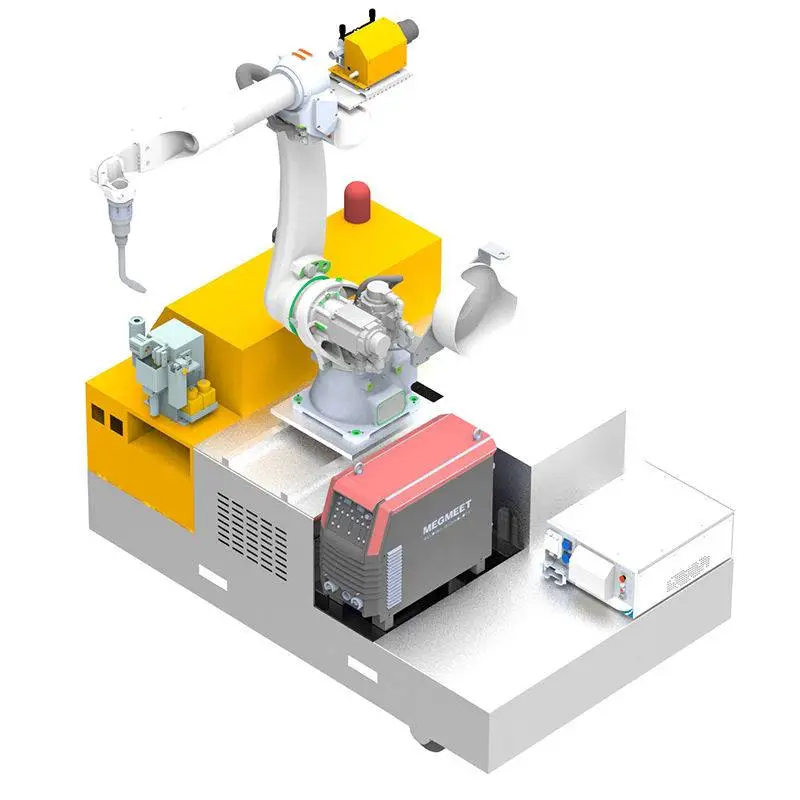
The system comprises a 6-axis collaborative arm with a payload capacity optimized for a water-cooled MAG torch. Unlike traditional industrial robots, this MAG Cobot Welder utilizes high-resolution torque sensors in each joint. This allows for “lead-through programming,” which is essential in a high-mix, low-volume (HMLV) environment like the Chonburi workshop.
2.1 Power Source and Waveform Control
The “1500W” designation in this field setup refers to the nominal power consumption of the high-frequency inverter source during short-circuit transfer modes. For thin metal sheet welding, we utilized a modified pulse-on-pulse waveform. This specific arc welding solution allows for a cooler weld pool, preventing burn-through on 1.0mm workpieces while ensuring the “active” gas (a 20% CO2 / 80% Argon mix) provides sufficient wetting at the toes of the weld.
3. Synergy Between Arc Welding Solutions and Collaborative Automation
The true value of this deployment isn’t just the robot; it is the synergy between Arc Welding Solutions and the cobot’s motion control. In Chonburi, we observed that manual welders often struggled with “arc-off” time—the transition between various weld segments on a complex jig.
The MAG Cobot Welder solves this through synchronized communication between the robot controller and the wire feeder. By utilizing a “Fast-Start” software package, the arc initiates within 10ms of the robot reaching the start point. This synergy minimizes the Heat Affected Zone (HAZ), which is the single most important factor when dealing with thin metal sheet welding in automotive brackets. If the heat input is not tightly governed by the arc welding solution’s software, the thin sheet loses its structural integrity due to grain growth.
4. Application Focus: Thin Metal Sheet Welding
The core of our Chonburi operation involves welding 1.2mm mounting plates to 0.8mm structural tubes. In manual operations, the rejection rate due to thermal distortion was 12%. After implementing the MAG Cobot Welder, that rate dropped to 0.5%.
4.1 Parameter Optimization for Thin Gauges
During the commissioning phase, we established the following baseline for the 1.0mm lap joints:
- Wire Feed Speed: 3.5 m/min
- Voltage: 16.2V
- Travel Speed: 45 cm/min
- Gas Flow: 15 L/min (increased slightly due to Chonburi’s shop-floor cross-drafts)
The thin metal sheet welding process benefited immensely from the cobot’s ability to maintain a constant 12mm contact-to-work distance (CTWD). Even a 2mm variance in a manual welder’s hand can change the current by 10-15 Amps, which is the difference between a perfect bead and a hole in 0.8mm steel.
5. Environmental Factors: The Chonburi Variable
Senior engineers must account for the local climate. In Chonburi, the high moisture content in the air can lead to hydrogen-induced porosity, even in MAG welding of carbon steels.
5.1 Shielding Gas and Wire Integrity
We discovered that the Arc Welding Solutions needed to be bolstered by a dedicated gas dryer at the manifold. Furthermore, the MAG Cobot Welder was equipped with a ceramic-coated nozzle to prevent spatter accumulation during long shifts. Because the cobot runs at a higher duty cycle than a human, the torch temperature remains elevated, making spatter more likely to fuse. Daily maintenance logs showed that using a reamer station every 15 cycles kept the thin metal sheet welding beads clean and reduced downtime.
6. Lessons Learned and Field Observations
Transitioning to a MAG Cobot Welder is not a “set and forget” operation. Here are the key technical takeaways from the Chonburi site:
6.1 Grounding is Non-Negotiable
Automated Arc Welding Solutions are sensitive to electromagnetic interference (EMI). We initially saw “arc hunting” where the cobot would slightly jitter. This was traced back to poor grounding of the welding jig. In thin sheet applications, a stable arc is paramount. We resolved this by installing a dedicated copper busbar for the cobot station, separate from the main factory earth.
6.2 Tack Welding Precision
For thin metal sheet welding, the cobot expects the part to be exactly where the program says it is. Manual tacking often introduced gaps of 0.5mm. While a human can “fill” that gap, a standard cobot program cannot. We had to upgrade the upstream clamping fixtures to ensure the “synergy” between the part fit-up and the robot’s path was maintained. This proved that Arc Welding Solutions are only as good as the jigging.
6.3 The Human-Robot Interface
The local operators in Chonburi transitioned quickly. The 1500W system’s interface allows for “on-the-fly” adjustments to the wire feed speed. This allowed the senior welder on the floor to fine-tune the MAG Cobot Welder without needing a computer science degree. The “collaborative” nature meant we didn’t need extensive safety fencing, saving 4 square meters of floor space per station.
7. Comparative Analysis: Manual vs. Cobot
7.1 Throughput and Quality
In a 10-hour shift, a manual welder produced 85 units with 10 reworks. The MAG Cobot Welder produced 115 units with 1 rework. The bottleneck shifted from the welding process to the loading/unloading process, indicating that the Arc Welding Solutions we implemented have successfully optimized the arc-on time.
7.2 Cost of Consumables
Interestingly, wire consumption dropped by 15%. Because the MAG Cobot Welder follows a precise path with optimized travel speeds, there is no “over-welding.” In thin metal sheet welding, excess weld metal is just wasted money and added weight. The 1500W power source also showed a 20% reduction in electricity costs compared to the older transformer-rectifier units previously used in the shop.
8. Conclusion and Recommendations
The deployment of the MAG Cobot Welder in Chonburi has proven that automation is viable for small-scale, high-precision tasks. The synergy between high-frequency Arc Welding Solutions and collaborative robotics provides a level of consistency in thin metal sheet welding that manual labor cannot match in a tropical, high-volume production environment.
Recommendations for future rollouts:
- Implement environmental controls (dehumidifiers) for the wire storage area to maintain the integrity of the ER70S-6 wire.
- Standardize the “Smart-Tack” process to ensure zero-gap fit-up for all 0.8mm components.
- Integrate a digital twin of the Chonburi layout to optimize the cobot’s reach and minimize cycle times further.
The 1500W MAG Cobot system is now the benchmark for our Southeast Asian operations. Its ability to handle the delicate thermal requirements of thin-gauge steel while surviving the rigors of a Chonburi summer makes it a critical asset in our engineering portfolio.
Report Filed By:
Senior Welding Engineer
Chonburi Field Office






