Engineering Review: Low-spatter MAG Robotic Arm Welder – Riyadh, Saudi Arabia
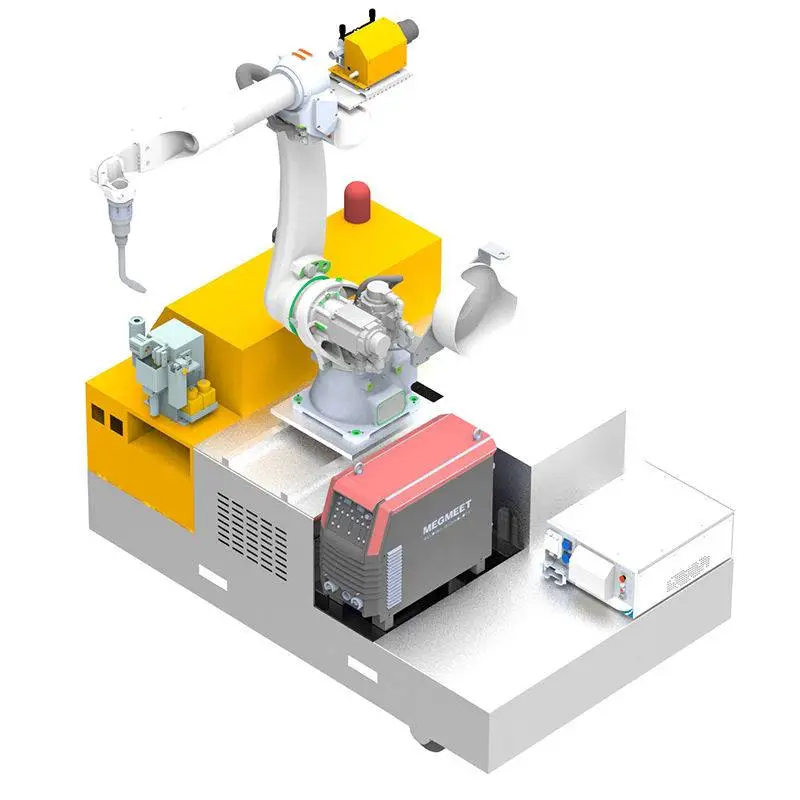
Field Engineering Report: Implementation of Low-Spatter MAG Robotic Arm Welder
Site Location: Sulay Industrial District, Riyadh, KSA
1. Introduction and Project Scope
The transition from manual metal active gas (MAG) welding to a fully integrated Robotic Arm Welder system at our Riyadh facility was driven by the necessity for higher throughput and standardized bead morphology in Carbon Steel welding. In the context of the Saudi Vision 2030 industrial localization goals, the push for Industrial Automation has moved from a luxury to a baseline requirement. This report details the technical deployment of a 6-axis robotic system equipped with a high-speed digital power source, specifically optimized for low-spatter MAG processes on A36 and S235JR carbon steel grades.
2. Equipment Configuration and Ambient Challenges
The system comprises a 20kg payload robotic arm integrated with a 500A inverter-based power source. In Riyadh, the primary environmental challenge is the ambient temperature, which frequently exceeds 45°C during summer months.
Lessons Learned: Standard air-cooled torches are insufficient for the duty cycles required by Industrial Automation in this region. We observed significant contact tip degradation and wire feeding inconsistency when the ambient temperature peaked. We pivoted to a dual-circuit water-cooled torch configuration. This maintains a stable internal temperature for the Robotic Arm Welder‘s front-end consumables, ensuring that the 1.2mm ER70S-6 wire maintains consistent electrical contact without micro-welding inside the tip.
3. The Mechanics of Low-Spatter Carbon Steel Welding
Carbon Steel welding is traditionally prone to spatter, particularly in the globular transfer zone. Spatter is not merely an aesthetic issue; in a robotic environment, it leads to sensor interference, nozzle clogging, and excessive post-weld cleaning labor—negating the benefits of Industrial Automation.
To mitigate this, we utilized a modified short-circuit waveform. This “low-spatter” technology employs a high-speed digital feedback loop that monitors the droplet bridge. Just before the short-circuit breaks, the power source drops the current, reducing the electromagnetic pinch force. The result is a controlled droplet transfer with a 90% reduction in spatter compared to traditional CV (Constant Voltage) MAG.
4. Synergy: Robotic Arm Welder and Industrial Automation
The true value of a Robotic Arm Welder is realized only when it is treated as a component of a larger Industrial Automation ecosystem. In our Riyadh workshop, we synchronized the robot controller with a central PLC (Programmable Logic Controller) via Profinet.
This synergy allows for:
- Adaptive Parameter Control: The system adjusts travel speed based on the real-time gap detected by laser sensors.
- Predictive Maintenance: Monitoring the motor torque of the wire feeder to detect “bird-nesting” or liner friction before it causes a system-wide E-stop.
- Data Logging: Every weld on the Carbon Steel chassis is logged by its heat input and deposition rate, providing a digital twin for quality assurance.
5. Technical Analysis of Carbon Steel Joint Preparation
Carbon Steel welding on heavy plate (8mm to 12mm) requires precise joint geometry. We found that the Robotic Arm Welder exposed inconsistencies in our manual tacking processes. In manual welding, a human welder compensates for a 2mm gap variation. The robot, however, follows a pre-programmed path.
Lesson Learned: We had to upgrade our upstream Industrial Automation processes—specifically the CNC plasma cutting and hydraulic clamping jigs—to ensure a tolerance of +/- 0.5mm. When the fit-up is tight, the low-spatter MAG process produces a flat, high-integrity fillet weld with deep penetration and a negligible Heat Affected Zone (HAZ), which is vital for the structural integrity of the heavy-duty oil and gas skids we are manufacturing.
6. Shielding Gas Dynamics in Arid Climates
The selection of shielding gas for the Robotic Arm Welder was a point of significant internal debate. We initially used a standard 80% Argon / 20% CO2 mix. While effective for Carbon Steel welding, the high Riyadh heat caused fluctuations in gas density within the long delivery lines from the external tank farm.
We shifted to a 90/10 Argon-CO2 mix with a precision gas mixer installed at the robot station. The higher Argon content stabilized the arc column and further reduced spatter, though it required tighter control over the arc length to prevent undercut. The Industrial Automation system’s “Arc Sensor” (which monitors current fluctuations to track the weld seam) performed 15% more accurately with the 90/10 mix due to the more stable plasma bridge.
7. Programming Logic and Path Optimization
Programming the Robotic Arm Welder for complex Carbon Steel geometries involved moving beyond “Point A to Point B” logic. We implemented a “weaving” pattern for the root pass on V-groove joints to ensure sidewall fusion.
Lesson Learned: Air-cut time (the time the robot moves without welding) is the enemy of ROI. By optimizing the robot’s motion paths and using high-speed ‘re-orientation’ moves, we reduced the cycle time for a standard frame from 14 minutes to 9 minutes. This 35% increase in efficiency is the direct result of integrating the welding parameters directly into the robot’s motion planner, rather than treating them as separate entities.
8. Quality Control and Consumable Management
In a high-output Industrial Automation environment, the “Senior Engineer” must focus on the variables that cause drift. We established a “Tip-Change Protocol” based on wire throughput (every 200kg of wire) rather than waiting for failure.
For Carbon Steel welding, we observed that even with low-spatter technology, silica islands would form on the bead surface. This is a chemical property of the ER70S-6 wire reacting with the oxygen in the CO2. We integrated an automatic torch cleaner (Reamer) into the Robotic Arm Welder cell. Every five cycles, the robot moves to the station, sprays anti-spatter fluid, and mechanically cleans the nozzle. This 15-second maintenance step prevents 99% of the porosity issues we encountered during the first week of trial.
9. The “Riyadh Factor”: Dust and Filtration
The Sulay Industrial District is prone to fine particulate dust. For Industrial Automation electronics, this is lethal. The Robotic Arm Welder‘s controller cabinet and the MAG power source were fitted with pressurized, filtered cooling units.
Technical Observation: Standard filters clogged within 72 hours. We moved to a washable, high-density electrostatic filter media. Furthermore, we ensured the wire spool was housed in a pressurized transparent cabinet. Dust on the wire surface acts as an insulator, leading to arc instability and “micro-pops” that mimic spatter. Since sealing the wire delivery path, our arc start reliability has increased to 99.8%.
10. Conclusion and Forward Strategy
The deployment of the Robotic Arm Welder in Riyadh has proven that Carbon Steel welding can be elevated to high-precision standards when supported by robust Industrial Automation protocols. The key to success was not the robot itself, but the management of the environment—water cooling for the torch, gas stability, and dust mitigation for the consumables.
Our next phase involves integrating an AI-based vision system for real-time defect detection. By analyzing the arc light frequency and the molten pool topology, we aim to eliminate post-weld NDT (Non-Destructive Testing) for non-critical joints, further cementing our facility as a leader in Saudi Arabia’s industrial sector.
End of Report.
Signed,
Senior Welding Engineer







