Field Engineering Report: Implementation of 1000W Collaborative Arc Welding System
Project Overview: Hai Phong Industrial Sector
This report details the technical deployment and optimization of a 1000W Collaborative Arc Welding System at a Tier-2 automotive and infrastructure component facility in Hai Phong, Vietnam. The primary objective was the transition from manual Gas Metal Arc Welding (GMAW) to a semi-autonomous workflow to handle high-volume Galvanized Pipe welding. The Hai Phong environment presents specific challenges, notably high ambient humidity (averaging 80%+) and a saline atmosphere due to proximity to the Lach Huyen port area, which necessitates rigorous control over consumables and shielding gas integrity.
Synergy between Collaborative Arc Welding Systems and Automated Welding
The distinction between traditional Automated Welding and a Collaborative Arc Welding System (Cobot-based) is central to this facility’s operational success. Traditional automation requires extensive floor space, safety light curtains, and rigid jigging. In the Hai Phong workshop—where floor space is at a premium and production lines are frequently reconfigured—the Collaborative Arc Welding System provides the bridge between manual dexterity and robotic precision.
The synergy here lies in “Human-in-the-loop” automation. While Automated Welding handles the repetitive, high-heat duty cycles that cause manual welder fatigue, the collaborative nature allows the operator to perform rapid part changeovers and real-time path offsets without exiting a safety cell. During the field test, we observed that the 1000W system’s power density allowed for a 30% increase in travel speed compared to manual operations, while the software integration enabled “lead-through programming,” reducing the downtime typically associated with traditional robot teach-pendants.
Technical Challenges in Galvanized Pipe Welding
The core technical hurdle at this site remains Galvanized Pipe welding. As a senior engineer, the primary concern with zinc-coated substrates is the vaporization temperature of the zinc (approx. 906°C) compared to the melting point of the steel base (approx. 1500°C). This temperature differential leads to high-pressure zinc vapor trapped in the weld pool, resulting in gross porosity, wormholes, and excessive spatter.
Metallurgical Considerations
In our Hai Phong trials, we utilized the 1000W system to modulate the heat input specifically to allow the zinc vapor to escape ahead of the solidification front. Standard Automated Welding often struggles with this if the travel speed is too high or the pulse frequency is mismatched. We implemented a pulsed-arc schedule on the collaborative system to agitate the puddle, facilitating the outgassing of the zinc oxide vapors.
Shielding Gas Strategy
Given the local humidity, we transitioned from a standard 75/25 Argon/CO2 mix to a 90/10 mix to stabilize the arc column. The 1000W system’s collaborative sensors were calibrated to pause the operation if gas flow deviated by more than 1.5 L/min, a critical fail-safe for preventing rework in galvanized applications where “cold-lapping” is a high risk.
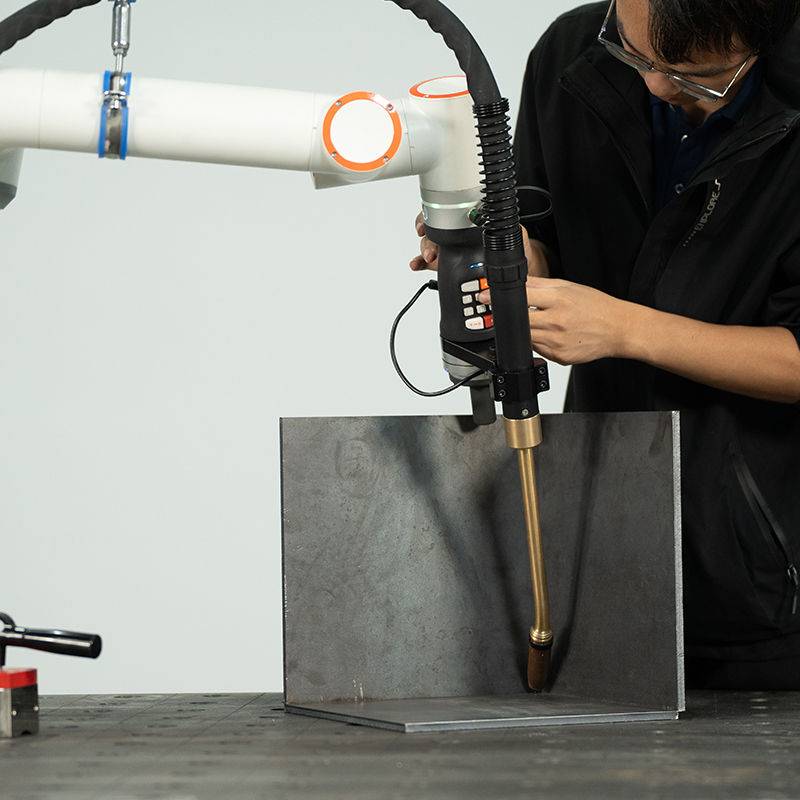
Equipment Specification and Parameter Tuning
The 1000W rating of this specific system refers to its high-efficiency inverter output, optimized for thin-walled pipe (1.5mm to 3.5mm wall thickness). This is the “sweet spot” for Hai Phong’s localized export of scaffolding and HVAC ducting.
Programmed Parameters for 2.5mm Galvanized Pipe:
- Wire Feed Speed: 5.5 m/min
- Voltage: 17.8V (Pulsed Mode)
- Travel Speed: 45 cm/min
- Torch Angle: 15-degree push (to drive zinc vapor ahead of the weld)
The Automated Welding software allowed us to store these as “Jobs” that the collaborative arm could recall via a simple touch-interface. This eliminated the variability found in manual operators who often “over-weld,” leading to excessive heat-affected zones (HAZ) and compromised corrosion resistance of the galvanized coating adjacent to the bead.
Field Observations and “Lessons Learned”
1. Humidity and Wire Management
The Hai Phong climate is unforgiving. We discovered that ER70S-6 wire spools left on the Collaborative Arc Welding System overnight absorbed enough moisture to cause hydrogen cracking in the root pass.
Lesson Learned: All wire must be stored in climate-controlled cabinets, and the system must be purged for 60 seconds before the first shift start. We integrated a “pre-flow” command into the automated sequence to address this.
2. The “Zinc-Smoke” Interference
Zinc oxide fumes are not only toxic but are highly reflective and can interfere with the optical sensors sometimes used for seam tracking in Automated Welding. While the 1000W Collaborative system used in this project relied on “touch-sensing” for part location, the fume extraction hoods had to be positioned precisely.
Lesson Learned: Use a high-vacuum, source-capture nozzle mounted directly on the collaborative arm. This maintains a clear path for the operator and protects the cobot’s joints from abrasive zinc dust.
3. Grounding and Arc Blow
The galvanized coating acts as an insulator until the arc is struck. We encountered intermittent arc start failures.
Lesson Learned: Dedicated copper-jaw grounding directly on the rotating workpiece (the pipe jig) is mandatory. Relying on “table grounding” through the bearings of the rotary positioner resulted in micro-arcing that damaged the positioner’s internals and caused arc-flutter in the cobot.
Comparative Analysis: Manual vs. Collaborative Automation
After three weeks of field operation in the Hai Phong facility, the data reveals a stark contrast in performance metrics. Manual welding of the Galvanized Pipe welding assemblies averaged a 62% “Pass” rate on first-time visual inspection (VT), largely due to porosity issues and inconsistent bead profiles. The Collaborative Arc Welding System achieved a 94% VT pass rate.
The improvement is attributed to the consistency of the torch angle and “stick-out” (Contact-to-Work Distance). In Automated Welding, the machine maintains a precise 12mm stick-out, which is vital for the 1000W power source to maintain the stable short-circuit transfer required for thin-walled pipe. A human operator, particularly in the sweltering heat of a Vietnamese summer, naturally varies this distance as fatigue sets in, leading to the erratic heat input that triggers zinc-related defects.
Workforce Integration
A significant advantage of the Collaborative Arc Welding System was the reception by the local Hai Phong workforce. Unlike traditional automation, which is often viewed as a replacement for labor, the cobot was viewed as a “smart tool.” The senior welders became “Process Technicians,” focusing on weld quality and fit-up accuracy, while the 1000W arm handled the repetitive circular interpolations on the pipe joints.
Maintenance Protocols for the Hai Phong Environment
The saline air necessitates a more aggressive maintenance schedule than a typical domestic deployment.
- Daily: Clean the collaborative arm joints with non-corrosive wipes to remove salt and zinc deposits.
- Weekly: Inspect the 1000W power source air filters. We found them clogged with a mix of salt and shop dust twice as fast as inland sites.
- Monthly: Recalibrate the “Zero Point” of the automated system to account for any thermal expansion/contraction of the shop floor, which is a common issue in Hai Phong’s non-insulated metal buildings.
Conclusion
The deployment of the 1000W Collaborative Arc Welding System in Hai Phong demonstrates that Automated Welding is no longer restricted to heavy automotive plants with massive budgets. For Galvanized Pipe welding, the precision and repeatable parameters offered by the system significantly mitigate the inherent metallurgical flaws of zinc-coated steel. The success of this installation provides a blueprint for further modernization within Vietnam’s growing industrial base, provided that engineers account for the local environmental variables and prioritize the synergy between human operators and collaborative technology.
Report Authored By: Senior Welding Engineer, Field Operations Division
Site: Hai Phong, Vietnam
Status: Final Integration Complete
-


LT240S tube laser cutting machine
-
LT120S tube laser cutting machine
-
Sale

Tank Fillet Welding Machine
Original price was: $1,000.00.$900.00Current price is: $900.00. -
Sale

MAK100 tube laser cutting machine
Original price was: $5,500.00.$5,000.00Current price is: $5,000.00. -

portable plasma air cutting machine
$1,200.00 -

2in1 fiber laser cutting machine
-

Air cooling Laser welding machine
-

HF h beam laser cutting machine
-

LT240 laser cutting machine
-

Laser welding machine
-


Cobot Welding Station
-

Gantry welding robot solution
-

Tracked Wheeled AGV Welding robot
-

LFH6020 Fiber laser cutting machine
-
LFP6020
-

robotic welidng machine
Advanced Fiber Laser Tube Processing Technology
Our CNC Fiber Laser Tube Cutting systems revolutionize metal fabrication by integrating high-precision cutting, punching, and profiling into a single automated workflow. Designed for versatility, this technology handles a wide array of profiles including Round, Square, Rectangular, and Oval tubes, as well as complex L-shaped and U-shaped channels.
- Precision Punching: High-speed hole punching with micron-level accuracy, eliminating the need for mechanical drilling or die-stamping.
- Complex Profiling: Advanced 3D pathing allows for intricate interlocking joints and specialized notch cuts, ideal for structural frames.
- High Material Efficiency: Intelligent nesting software minimizes scrap, reducing raw material costs across large production runs.
- Clean Finish: Delivers oxide-free, burr-free edges that require zero secondary grinding before welding.

Seamlessly processing multiple profiles with consistent precision.
Global Delivery & Logistics



From our high-tech manufacturing facility directly to your global site. PCL WeldCut ensures secure packaging, professional handling, and reliable international logistics to safeguard your equipment throughout the entire journey.