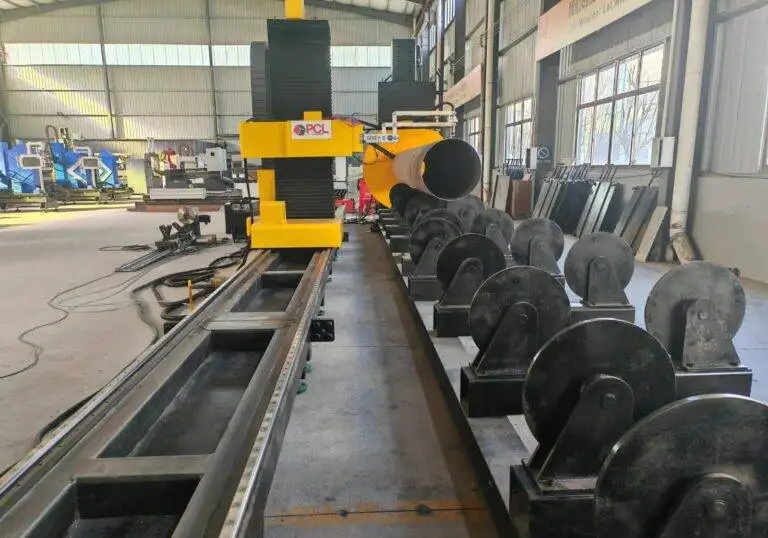
Beam Processing Center with Narrow Gap welding for for Wind Tower fabrication

In this article
Optimization of Wind Tower Internal Structures
The fabrication of wind towers demands extreme precision in both the primary shell and the internal support structures. Internal platforms, ladder supports, and cable tray brackets are typically constructed from heavy H-beams and structural channels. To maintain the structural integrity required for decades of service in harsh environments, these components must be processed with high repeatability. A Plasma Cutting System integrated into a dedicated Beam Processing Center provides the necessary thermal energy and motion control to handle these heavy sections.
Industrial engineers focus on the beam processing center as the foundational stage for downstream efficiency. Unlike traditional mechanical drilling or sawing, a plasma-based center allows for complex geometries to be cut in a single pass. This is particularly relevant for wind tower internals where beams often require intricate coping and slotting to fit the curvature of the tower’s interior. The goal is to minimize the total labor hours per ton of steel by consolidating multiple fabrication steps into one automated station.
Maximizing Intersection Accuracy for Complex Fit-Ups
In wind tower construction, structural beams often intersect at non-orthogonal angles. Achieving high Intersection Accuracy is not merely a matter of aesthetic quality; it is a prerequisite for high-strength welding. When an H-beam meets a curved shell or another structural member, the cut profile must account for the radius and the thickness of the mating part. Plasma beam processors utilize advanced CNC algorithms to calculate the exact path of the torch, compensating for the kerf width and the arc voltage characteristics.

If the intersection is inaccurate, gaps are created that require excessive filler metal or manual bridge-welding, both of which introduce unnecessary heat into the part and increase the risk of deformation. By utilizing 3D modeling data directly in the plasma controller, the machine executes precise coping cuts that allow for “metal-to-metal” fit-up. This precision ensures that the structural load is transferred correctly across the joint, meeting the stringent fatigue resistance standards required for onshore and offshore wind applications.
H-Beam Processing and Maintenance Efficiency
The selection of plasma for H-beam Processing is driven by the balance between cutting speed and operational uptime. Industrial environments in wind tower shops are demanding, with high levels of dust and heavy material handling. Plasma systems are inherently robust. Unlike mechanical cutting tools that suffer from blade wear, breakage, and the need for constant lubrication, plasma torches are non-contact. This significantly reduces the mechanical stress on the machine’s gantry and drive systems.
Low maintenance is a primary KPI for industrial engineers. A plasma-based beam center utilizes long-life consumables and automated gas consoles that monitor pressure and flow in real-time. This predictive capability allows maintenance teams to schedule consumable changes during natural breaks in production rather than dealing with unplanned stoppages. Furthermore, the absence of physical cutting forces means the clamping systems for the H-beams can be simpler and less prone to hydraulic failure, leading to a higher Mean Time Between Failures (MTBF) for the entire processing line.
Advanced Beveling for Narrow Gap Welding Preparation
One of the most critical functions of a modern beam processing center is the ability to perform multi-axis beveling. Wind tower components are increasingly relying on Narrow Gap Welding to join thick structural sections. This welding technique requires a specific groove geometry—often a very tight V or J-prep—to minimize the volume of filler metal and reduce the total heat input. The plasma torch must be capable of tilting and rotating (typically via a 5-axis or 6-axis robotic arm) to create these bevels directly on the beam ends.
The accuracy of the bevel angle is paramount. In narrow gap preparations, a deviation of even two degrees can result in lack of fusion or slag inclusion. Plasma beam processors solve this by using height sensors that maintain a constant distance from the workpiece, regardless of material surface irregularities or beam camber. This ensures that the bevel face is uniform along the entire length of the cut. By producing a weld-ready edge directly from the cutting table, the facility eliminates the need for secondary beveling with hand-held grinders, which is both labor-intensive and inconsistent.
Thermal Management and Edge Quality
Industrial engineers must also consider the Heat Affected Zone (HAZ) when using plasma for structural components. Modern high-definition plasma systems use constrained arcs and specific gas mixtures (such as Oxygen/Air or Argon/Hydrogen) to narrow the HAZ. This is essential for wind tower components where the material properties of the steel must remain within specific tolerances to resist brittle fracture at low temperatures.
The edge quality produced by these systems is characterized by low dross and high perpendicularity. By optimizing the cutting speed and amperage based on the flange thickness of the H-beam, the system ensures that the resulting surface is smooth enough for immediate assembly. The reduction in dross means less cleanup, which directly impacts the throughput of the fabrication line. When the beam leaves the plasma processing center, it is ready for the assembly jig, significantly shortening the lead time for internal tower kits.
Throughput Analysis and Economic Impact
From a cost-per-part perspective, the integration of plasma cutting in a beam processing center offers a superior ROI in wind tower fabrication. The high cutting speeds—often exceeding 100 inches per minute on medium-thickness flanges—allow a single machine to feed multiple welding stations. This eliminates bottlenecks that occur when using mechanical sawing or manual layout and cutting.
Furthermore, the software integration of these centers allows for nesting optimization. By nesting multiple parts within a single length of H-beam, material scrap is minimized. In an industry where steel prices fluctuate, reducing scrap by even 5% can result in significant annual savings. The combination of high-speed processing, minimal secondary operations, and high-precision prep for narrow gap welding creates a lean manufacturing environment.
Conclusion
The deployment of a Beam Processing Center equipped with plasma technology is a strategic necessity for modern wind tower fabrication. By prioritizing intersection accuracy and the specific bevel geometries required for narrow gap welding, manufacturers can achieve a level of quality that manual processes cannot replicate. The inherent low-maintenance nature of plasma systems ensures that production targets are met without the frequent interruptions associated with mechanical tooling. Ultimately, the synergy between precise thermal cutting and advanced welding preparation defines the efficiency of the contemporary wind energy supply chain.