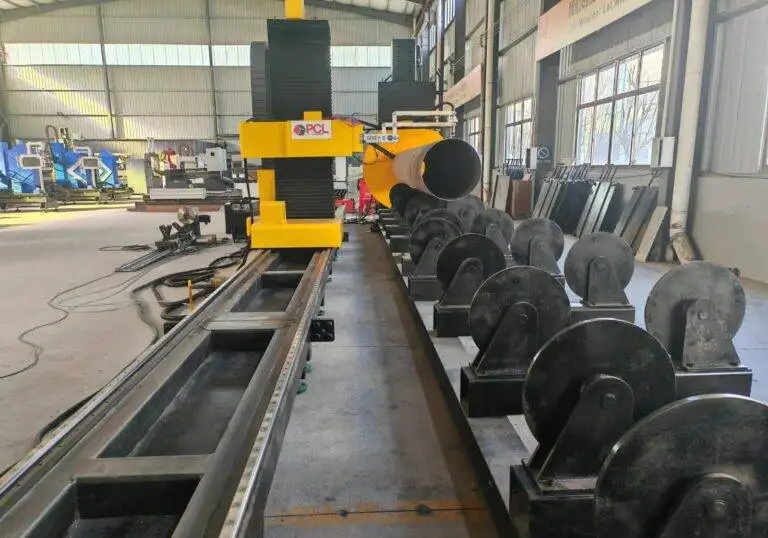
Beam Processing Center with Narrow Gap welding for for Construction Machinery

In this article
- Optimizing Heavy Section Fabrication via Integrated Beam Processing
- Enhancing Intersection Accuracy in Multi-Axis Plasma Cutting
- Advanced Beveling Strategies for Narrow Gap Welding Preparation
- Industrial Durability and Low Maintenance for H-Beam Handling
- Eliminating Thermal Distortion through Parameter Control
- System Integration and Data-Driven Fabrication
Optimizing Heavy Section Fabrication via Integrated Beam Processing
The manufacturing of construction machinery—such as excavators, cranes, and heavy-duty chassis—demands structural components capable of withstanding extreme cyclic loading. Traditional fabrication methods involving manual layout, mechanical sawing, and standalone drilling often introduce cumulative tolerances that compromise the final assembly. The implementation of a dedicated Beam Processing Center equipped with Plasma Cutting technology addresses these inefficiencies by consolidating multiple operations into a single automated workflow. In this industrial environment, the primary objective is to prepare H-beams, I-beams, and channels for the subsequent narrow gap welding stage with surgical precision.
Enhancing Intersection Accuracy in Multi-Axis Plasma Cutting
In the context of heavy-duty machinery, the intersection of structural members must be seamless to ensure uniform load distribution. Plasma cutting systems within modern beam centers utilize sophisticated 6-axis or 7-axis robotic manipulators. This allows the plasma torch to navigate the complex geometry of an H-beam, including the web and the inner and outer surfaces of the flanges. Intersection accuracy is not merely a function of the robot’s repeatability; it depends on real-time compensation for material deviations.
H-beams often arrive from the mill with slight twists, cambers, or flange non-parallelism. An industrial-grade beam center utilizes laser probing or physical touch-sensing to map the actual profile of the workpiece before the first arc is struck. By feeding this coordinate data back into the CNC system, the plasma trajectory is adjusted dynamically. This ensures that copes, notches, and pass-through holes align perfectly with mating parts. When the gap variance is held below 0.5mm across a complex intersection, the volume of filler metal required during the narrow gap welding process is minimized, directly reducing the heat input and potential for distortion.

Advanced Beveling Strategies for Narrow Gap Welding Preparation
Narrow gap welding (NGW) is the preferred method for joining thick-walled sections in construction machinery due to its high efficiency and reduced weld-metal consumption. However, NGW is notoriously sensitive to joint preparation. A beam processing center must produce consistent, high-quality bevels that exceed the capabilities of manual oxy-fuel torches. The plasma cutting head must perform compound miter cuts and complex bevel geometries—such as V, Y, and X-preparations—in a single pass.
The technical advantage of plasma in this scenario is its ability to maintain a stable arc at varying torch angles. Industrial engineers prioritize the control of the Heat Affected Zone (HAZ) and the smoothness of the cut surface. By optimizing the gas mixture—often utilizing oxygen for carbon steel or H35 for stainless applications—the system achieves a dross-free finish that requires zero secondary grinding. This “ready-to-weld” state is critical for maintaining high throughput in a continuous production line. The precision of the bevel angle directly dictates the stability of the narrow gap arc; even a two-degree deviation can result in sidewall lack-of-fusion defects.
Industrial Durability and Low Maintenance for H-Beam Handling
Operational uptime is the primary metric for any beam processing facility. The environment of an H-beam cutting center is inherently harsh, characterized by high temperatures, metallic dust, and the physical impact of heavy structural steel. To ensure low maintenance, the machine architecture must isolate critical drive components from the cutting zone. High-end centers utilize a “shuttle” or “gripper” feed system that minimizes contact with the bed, reducing wear on the mechanical guides.
Effective slag management is another pillar of low-maintenance design. In heavy section plasma cutting, the volume of molten metal expelled is significant. Integrated beam centers employ automated dross extraction conveyors and high-capacity downdraft filtration systems. These systems prevent the accumulation of metallic particulates on the linear rails and rack-and-pinion drives. Furthermore, the use of quick-change consumable kits and automated torch height control (THC) reduces the frequency of manual interventions. For the industrial engineer, the goal is to extend the Mean Time Between Failures (MTBF) by selecting components that withstand the high duty cycles common in construction equipment manufacturing.
Eliminating Thermal Distortion through Parameter Control
One of the challenges in plasma-based beam processing is managing the thermal energy injected into the H-beam. Excessive heat can lead to longitudinal bowing or flange warping, which complicates the fit-up for narrow gap welding. Advanced beam centers mitigate this through optimized nesting and sequencing algorithms. By strategically timing the cuts and managing the kerf width, the system distributes the thermal load more evenly across the workpiece.
Modern high-definition plasma power sources allow for fine-tuning of the current and gas flow during the lead-in and lead-out phases of the cut. This level of control ensures that the corners of copes and the edges of bolt holes remain sharp and dimensionally accurate. for Construction Machinery, where bolt hole alignment is critical for modular assembly, the ability of the plasma center to produce “true-hole” quality without secondary drilling is a significant cost-saving measure.
System Integration and Data-Driven Fabrication
The modern beam processing center does not operate in isolation. It is a node within a larger digital ecosystem. CAD/CAM software translates 3D models of excavator frames or crane booms directly into machine code, including all beveling and intersection instructions. This digital thread ensures that the “as-built” component matches the “as-designed” specification with zero manual translation errors. The integration of intersection accuracy checks and automated toolpath generation allows for a “just-in-time” manufacturing flow, reducing the need for large inventories of semi-finished beams.
From an industrial engineering perspective, the transition to automated plasma-based beam processing represents a shift from labor-intensive craftsmanship to precision-engineered manufacturing. By focusing on the specific requirements of narrow gap welding—namely edge preparation and geometric consistency—manufacturers of construction machinery can significantly increase their output while simultaneously improving the fatigue life of their products.
Technical Conclusion on Throughput and Quality
In summary, the deployment of a plasma-centric beam processing center offers a decisive advantage in the fabrication of heavy structural components. Through the precise control of intersection geometries, the delivery of weld-ready bevels, and the implementation of heavy-duty, low-maintenance hardware, facilities can achieve the rigorous standards required for modern construction equipment. The synergy between high-definition plasma cutting and narrow gap welding remains the most efficient path for processing thick-section H-beams in high-volume industrial environments.