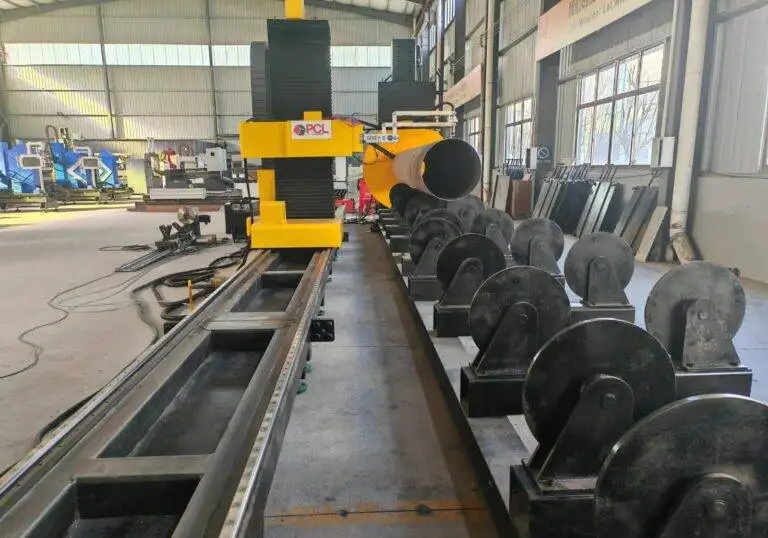
Beam Processing Center with Narrow Gap welding for for Steel Structure

In this article
Optimizing Structural Throughput via Advanced Plasma Cutting
In the current landscape of structural steel fabrication, the transition toward automated Beam Processing Centers has redefined the parameters of workshop efficiency. The primary driver of this shift is the integration of multi-axis plasma cutting units designed to handle heavy H-beams, I-beams, and hollow structural sections. Unlike traditional mechanical drilling or sawing, a plasma cutting center provides a non-contact thermal process that executes complex geometries in a single pass. This capability is critical when preparing members for heavy-duty assembly where volumetric integrity and fit-up precision dictate the success of the subsequent welding phases.
High-Definition Intersection Accuracy and Kinematics
Intersection accuracy is the most significant bottleneck in structural assembly. When beams intersect at non-orthogonal angles or when complex pipe-to-beam cope cuts are required, the tolerance for error is minimal. High-definition plasma systems utilize sophisticated CNC algorithms to compensate for the plasma arc’s natural kerf and bevel angle. In a 3D beam processing environment, the torch head often operates on a six-axis or seven-axis robotic arm. This allows for precise pathing around the flanges and web of an H-beam.
The accuracy of these intersections is governed by the synchronized movement of the longitudinal feed (the beam’s movement) and the lateral/rotational movement of the plasma head. Modern systems employ laser scanning sensors to map the actual dimensions of the beam before the first cut. Since structural steel often deviates from theoretical mill specifications—exhibiting slight twists, camber, or flange out-of-squareness—the plasma system adjusts its cutting path in real-time. This ensures that the “cope” or “mouse hole” cut perfectly matches the mating part, reducing the gap variability that often plagues manual assembly.

H-Beam Processing: Low Maintenance and Operational Longevity
From an industrial engineering perspective, the Total Cost of Ownership (TCO) of a plasma cutting center is heavily influenced by maintenance cycles. Plasma systems are inherently robust for the rugged environment of a steel mill. Unlike mechanical tools, there is no physical force exerted on the beam, which eliminates the need for massive clamping pressures and reduces wear on the machine’s structural frame.
The primary maintenance focus in these centers is the management of consumables and dross. Advanced plasma power supplies now feature “long-life” oxygen and nitrogen cycles, extending the utility of electrodes and nozzles. Furthermore, automated dross removal systems and integrated fume extraction tables prevent the accumulation of particulate matter on the linear guides and rack-and-pinion drives. By minimizing moving parts within the high-heat zone and utilizing pressurized cooling systems for the torch head, these centers achieve high uptime rates. The absence of blade sharpening or drill bit replacement further streamlines the operational workflow, allowing for continuous 24/7 production cycles without the variance associated with tool dulling.
Precision Beveling for Narrow Gap Welding Preparation
The most demanding application for a beam processing center is the preparation of thick-walled sections for narrow gap welding. Narrow gap techniques require a specific groove geometry—often characterized by a very small included angle (usually between 1 and 5 degrees) and a highly consistent root face. Conventional oxy-fuel cutting often lacks the thermal focus required for these tight tolerances, and mechanical milling is prohibitively slow for large-scale structural members.
Plasma beveling addresses this by providing a highly concentrated energy source that can be tilted precisely during the cut. To achieve a successful narrow gap preparation on a heavy H-beam flange, the plasma system must maintain a constant standoff distance. This is managed through Arc Voltage Control (AVC), which senses changes in the electrical arc to adjust the torch height dynamically.
When preparing a “J” or “V” groove for narrow gap applications, the smoothness of the cut surface is paramount. Plasma systems using high-definition gas mixtures (such as Ar-H2 or specialized O2-N2 blends) produce a surface finish that often requires no secondary grinding. The geometric precision of these bevels ensures that when two beams are brought together, the narrow gap is uniform across the entire depth of the joint. This uniformity is the prerequisite for automated welding processes, as it prevents fluctuations in arc length and wire stick-out, which are common causes of lack-of-fusion defects in deep-groove welds.
Thermal Management and the Heat Affected Zone
A common concern in structural engineering is the Heat Affected Zone (HAZ) created during thermal cutting. Industrial plasma systems mitigate this through high travel speeds. Because the plasma arc moves significantly faster than oxy-fuel, the total heat input into the beam is lower. This reduces the risk of local metallurgical changes that could embrittle the steel. In the context of H-beam processing, rapid cutting speeds also prevent global thermal distortion, ensuring that the beam remains straight and true for the duration of the fabrication process.
Integrating Software and CAD/CAM Workflows
The intelligence of a beam processing center resides in its software integration. The ability to import 3D models directly from BIM software (like Tekla or Revit) ensures that the plasma torch follows the exact design intent. The software automatically calculates the necessary lead-ins, lead-outs, and corner deceleration speeds to maintain constant kerf width. This digital thread from design to cut is what enables the high-accuracy intersections required for modern skyscrapers, bridges, and industrial complexes.
By focusing on the synergies between robotic kinematics and plasma physics, industrial engineers can significantly reduce the “floor-to-floor” time of steel members. The elimination of manual layout, the reduction in secondary processing, and the precise preparation for narrow gap welding collectively elevate the standard of structural steel fabrication. The result is a more resilient structure, produced at a lower cost per ton with superior repeatable accuracy.