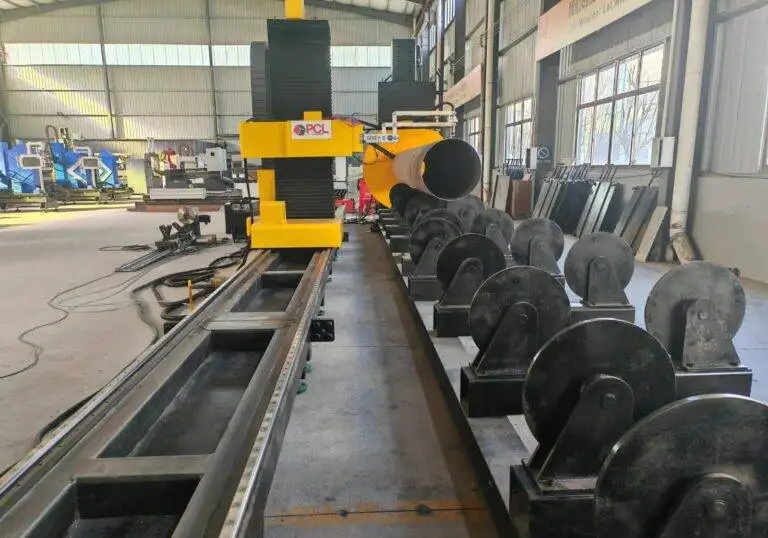
Beam Processing Center with Narrow Gap welding for for Steel Structure

In this article
In the contemporary landscape of structural steel fabrication, the drive toward automation is dictated by the need for higher volumetric efficiency and tighter geometric tolerances. For heavy-duty steel structures, particularly those utilizing large-scale H-beams and box columns, the preparation phase is the most critical determinant of welding quality. The emergence of Narrow Gap Welding (NGW) as a preferred method for thick-section joining has placed unprecedented demands on the upstream cutting process. To meet these demands, the modern Beam Processing Center must leverage advanced Plasma Cutting technologies capable of executing complex geometries with surgical precision.
The Engineering Necessity of Intersection Accuracy
The structural integrity of a steel framework relies heavily on the fit-up between intersecting members. In traditional fabrication, manual layout and cutting often resulted in gaps that required excessive filler metal and increased heat input, leading to thermal distortion. In a high-end beam processing center, Intersection Accuracy is achieved through 6-axis robotic plasma systems that synchronize motion with real-time sensor feedback.
Industrial engineers prioritize these systems because they eliminate the cumulative error inherent in manual handling. When an H-beam is processed for a moment connection or a complex truss node, the plasma torch must navigate the flanges and the web with a constant standoff distance. By utilizing sophisticated kinematic algorithms, the system compensates for beam deviations such as camber, sweep, and flange tilt. This level of accuracy ensures that when the secondary member is placed against the primary beam, the root opening is uniform. For NGW, where the groove angle is significantly reduced to minimize weld passes, even a 1mm deviation in the cut profile can lead to lack of fusion or slag inclusion. Therefore, the plasma system’s ability to maintain a tight tolerance on the intersection profile is not merely a feature—it is a foundational requirement for automated welding success.

Optimizing H-Beam Processing with Low Maintenance Workflows
From an operational standpoint, the total cost of ownership (TCO) of a beam line is heavily influenced by maintenance intervals and consumable longevity. Plasma systems are specifically engineered for the rugged environment of a steel mill or fabrication shop. Unlike other thermal cutting methods that may be sensitive to the dust and vibrations common in heavy industry, modern plasma power sources are housed in reinforced, filtered enclosures designed for high duty cycles.
A key advantage in H-beam Processing is the “low maintenance” profile of plasma torches. The latest generation of high-definition plasma systems features “cool-to-the-touch” consumable technology and quick-change torch heads. For an industrial engineer, this translates to minimal downtime. Furthermore, the absence of complex optical paths or delicate alignment components means that the system remains resilient despite the heavy mechanical shocks associated with loading and unloading multi-ton steel sections. The maintenance focus shifts from corrective repairs to simple, scheduled consumable replacements, ensuring that the production line maintains its scheduled throughput without unexpected stoppages.
Precision Beveling for Narrow Gap Preparation
The transition to narrow gap welding protocols requires a fundamental shift in how edge preparations are executed. Traditional wide-angle V-grooves consume vast amounts of energy and filler material. In contrast, NGW utilizes nearly parallel side walls or very small bevel angles (typically between 1 and 5 degrees). Achieving these precise angles on thick-walled H-beams requires a plasma system with high angular repeatability.
Modern beam processing centers utilize 3D plasma heads that can tilt and rotate dynamically. This capability allows for the creation of complex bevel profiles—including V, Y, X, and K cuts—in a single pass. The plasma arc’s energy density is modulated via CNC control to ensure that the kerf width remains consistent, regardless of the torch angle. This precision is vital because the NGW process is highly sensitive to the groove geometry. If the bevel angle fluctuates, the automated welding torch may not achieve proper side-wall penetration, leading to structural vulnerabilities. By integrating high-definition plasma beveling, engineers can guarantee that the groove geometry is optimized for deep penetration welds, thereby reducing the number of weld passes and the overall heat-affected zone (HAZ).
Kinematics and Path Planning in 3D Profiling
The technical sophistication of a beam processing center lies in its software’s ability to translate BIM (Building Information Modeling) data into accurate torch paths. When cutting an H-beam, the software must account for the thickness of the material at every point of the arc’s trajectory. This is particularly challenging at the junction where the flange meets the web (the k-area). High-performance plasma systems utilize advanced path planning to slow the travel speed and adjust the gas flow as the torch transitions through varying material thicknesses.
This dynamic adjustment ensures that the cut surface remains square and free of excessive dross. For narrow gap applications, the smoothness of the cut surface is just as important as the angle. A rough or serrated surface can cause turbulence in the shielding gas during the welding phase or trap contaminants. The synergy between high-frequency inverter power sources and precision robotic motion results in a “weld-ready” finish that requires little to no post-cut grinding, directly contributing to lean manufacturing objectives.
Conclusion: Synchronizing Cutting and Joining for Maximum Efficiency
The integration of precision plasma cutting within a beam processing center represents a strategic investment in structural quality and operational speed. By focusing on the critical metrics of intersection accuracy and bevel precision, industrial engineers provide the necessary groundwork for the successful implementation of narrow gap welding. The robustness of plasma technology ensures that these results are achieved with high uptime and low maintenance requirements, making it the superior choice for heavy steel H-beam fabrication.
Ultimately, the goal of the modern fabrication facility is to move material through the shop with minimal intervention. When the plasma system delivers perfectly beveled, accurately profiled beam sections, the subsequent welding stages become faster, more predictable, and more cost-effective. In the high-stakes world of steel infrastructure, the precision of the cut is the heartbeat of the entire production flow.