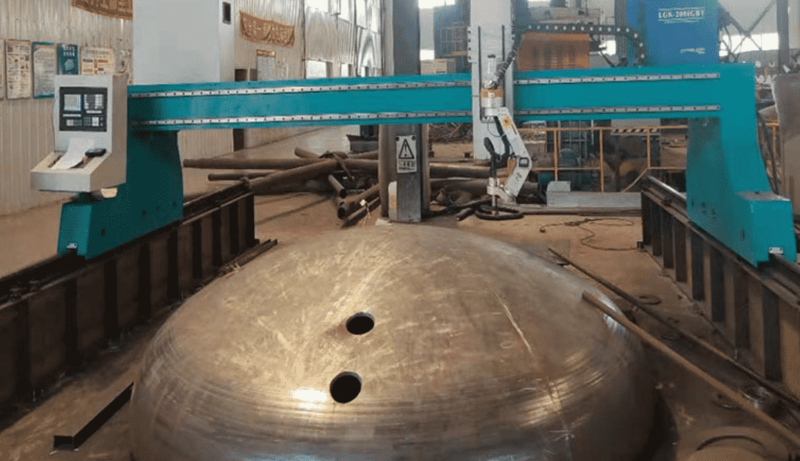
Beam Processing Center with Arc Voltage Control for for LNG Projects
In this article
- Optimizing LNG Structural Fabrication: The Role of Plasma Beam Processing
- Mechanical Dynamics of Arc Voltage Control (AVC)
- Real-Time Height Compensation
- Surface Irregularity Management
- Enhancing Intersection Accuracy for Complex Geometry
- Robotic Path Optimization
- Elimination of Cumulative Error
- Beveling Precision for Weld Preparation
- Multi-Axis Bevel Execution
- Thermal Control and Edge Quality
- Maintenance and Operational Efficiency for H-Beams
- Low Maintenance Profile
- Slag and Dust Management
- Conclusion
Optimizing LNG Structural Fabrication: The Role of Plasma Beam Processing
Liquefied Natural Gas (LNG) infrastructure projects demand unprecedented levels of structural integrity and geometric precision. The construction of modular pipe racks, cryogenic storage support systems, and process modules requires the processing of massive volumes of heavy-section H-beams and structural profiles. In this industrial context, the transition from manual layout and mechanical drilling to automated plasma Beam Processing Centers has become a necessity for meeting project timelines and stringent safety codes. Central to this evolution is the implementation of Arc Voltage Control (AVC), a technology that ensures consistency across long-span beams where material irregularities are common.
The primary challenge in LNG structural fabrication is the scale of the material versus the tightness of the tolerances. Structural steel used in these environments often exhibits surface deviations, mill scale, or slight camber over the length of the beam. A standard fixed-height cutting head would fail to maintain the necessary kerf quality or could suffer physical damage from collisions. By utilizing a plasma system integrated with AVC, the machine dynamically adjusts the torch height in real-time, maintaining a constant distance from the workpiece to ensure uniform energy density and edge quality.
Mechanical Dynamics of Arc Voltage Control (AVC)
Real-Time Height Compensation
AVC operates by monitoring the electrical potential between the plasma torch electrode and the structural steel beam. As the distance between the torch and the flange or web changes due to beam warping or positioning errors, the arc voltage fluctuates. The control system processes these fluctuations at millisecond intervals, signaling the Z-axis servo drive to raise or lower the torch. This maintains a precise standoff distance, which is critical for preventing bevel angle deviation and dross accumulation. In LNG projects, where beams can exceed 12 meters in length, this automated compensation is the difference between a clean cut and a rejected component.

Surface Irregularity Management
Structural profiles for heavy industry are rarely perfectly flat. Hot-rolled H-beams often possess internal stresses that cause them to “spring” or twist when the outer fibers are cut. The Arc Voltage Control (AVC) system tracks these physical shifts during the cutting process. By neutralizing the effect of material movement, the system ensures that the plasma arc remains in its optimal focal point, thereby preserving the metallurgical properties of the cut edge—a vital factor for steel subjected to cryogenic temperature cycles.
Enhancing Intersection Accuracy for Complex Geometry
The complexity of LNG module design often requires intricate “cope” cuts, rat holes, and slotting where beams intersect at various angles. Achieving high intersection accuracy is paramount for the “fit-up” stage of assembly. When components are fabricated at disparate sites and brought together for modular assembly, a deviation of even 2 millimeters can result in significant field rework and cost overruns.
Robotic Path Optimization
Modern beam processing centers utilize 6-axis or 7-axis robotic manipulators to move the plasma torch around the stationary beam. This allows for the cutting of web openings and flange notches in a single pass. The integration of high-definition plasma power sources allows for narrow kerf widths, which enables the machine to produce tight-tolerance intersections that mimic the precision of machined parts. This is especially critical for pipe rack supports where the beam must accommodate heavy-wall piping with specific clearance requirements.
Elimination of Cumulative Error
Manual layout is prone to cumulative error, particularly on multi-sided cuts. An automated plasma center utilizes laser probing or physical touch-sensing to establish the exact “zero point” of the beam before cutting begins. By referencing the actual dimensions of the beam rather than the theoretical mill dimensions, the system calculates the optimal tool path to ensure that every intersection point aligns perfectly with the master 3D CAD model. This digital-to-physical synchronization is the cornerstone of modern industrial engineering in large-scale energy projects.
Beveling Precision for Weld Preparation
In LNG construction, structural joints are often subjected to high static and dynamic loads. This necessitates full-penetration welds, which require complex bevel profiles. Automated plasma beveling allows for the creation of V, Y, X, and K-cuts directly on the beam processing line, eliminating the need for secondary grinding or manual torch work.
Multi-Axis Bevel Execution
The ability to bevel the edges of H-beam flanges and webs during the primary cutting cycle significantly reduces material handling. Using the AVC to maintain torch-to-plate distance during a beveled cut is more complex than a straight vertical cut because the arc voltage characteristics change at an angle. Sophisticated software algorithms compensate for these changes, allowing the robotic head to maintain a consistent bevel angle across the entire thickness of the material. This ensures that when two beams meet, the root gap is uniform, facilitating a higher quality weld with less filler material.
Thermal Control and Edge Quality
High-definition plasma systems are tuned to minimize the Heat Affected Zone (HAZ). For the high-strength steels used in LNG terminals, maintaining the base metal’s grain structure is essential for long-term durability. By optimizing the cutting speed and gas flow in conjunction with the AVC, the beam processing center produces an edge that is virtually ready for assembly without further mechanical treatment.
Maintenance and Operational Efficiency for H-Beams
From an industrial engineering perspective, the H-beam processing line must maximize uptime. Plasma systems offer a distinct maintenance advantage over mechanical cutting methods like sawing or drilling. Mechanical tools suffer from tool wear, breakage, and the requirement for constant lubrication/cooling, which creates a messy work environment and necessitates frequent consumable replacement.
Low Maintenance Profile
A plasma-based center has fewer moving parts in contact with the material. The “cutting tool” is an ionized gas stream, meaning there is no mechanical force exerted on the machine structure. This reduces the wear and tear on the gantry and rail systems. The consumables in a plasma torch—nozzles and electrodes—are designed for quick change-overs, often taking less than two minutes to replace. For an LNG project running 24/7 shifts, this high availability is critical for meeting throughput targets.
Slag and Dust Management
Advanced beam processing centers are equipped with integrated downdraft tables or high-vacuum extraction systems located directly at the cutting head. Since Plasma Cutting generates fine particulate matter and slag, efficient recovery systems are essential for maintaining the longevity of the machine’s electronic and mechanical components. This proactive approach to debris management ensures that the precision of the Arc Voltage Control (AVC) sensors remains uncompromised by environmental contaminants.
Conclusion
The implementation of a plasma-based beam processing center equipped with Arc Voltage Control (AVC) represents a significant leap in fabrication capability for LNG Projects. By prioritizing intersection accuracy and leveraging the speed and versatility of plasma beveling, engineers can ensure that structural components meet the highest standards of geometric precision. Furthermore, the H-beam processing efficiency gained through low-maintenance plasma technology allows for a streamlined workflow, reducing the total cost of ownership and accelerating the construction of critical energy infrastructure. In an industry where safety and precision are non-negotiable, the automated plasma center stands as the definitive solution for modern structural steel fabrication.







