Beam Processing Center with Arc Voltage Control for for Oil & Gas Tanks
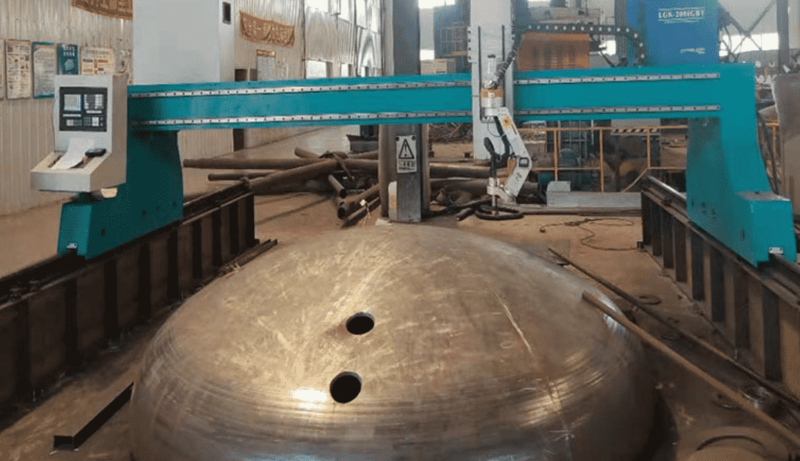
In this article
- Optimizing Oil & Gas Tank Fabrication via Automated Beam Processing
- The Engineering Mechanics of Arc Voltage Control (AVC)
- Intersection Accuracy in Complex Tank Structures
- Automated Beveling for High-Pressure Weld Preparation
- Software Integration and the Digital Twin
- Conclusion: Enhancing Throughput and Safety
Optimizing Oil & Gas Tank Fabrication via Automated Beam Processing
The construction of heavy-duty storage tanks and pressure vessels in the oil and gas sector requires an unprecedented level of structural precision. At the heart of this infrastructure are the H-beams, channels, and structural profiles that form the support skeletons and access platforms for massive storage units. The transition from manual layout and cutting to an automated Beam Processing Center has become a fundamental requirement for facilities aiming to meet international safety and quality standards while maintaining a competitive edge.
In this industrial environment, Plasma Cutting remains the dominant thermal process due to its versatility across material thicknesses and its ability to handle the conductive steels typically used in structural engineering. However, the efficacy of these systems is not merely a function of raw power; it is defined by the integration of advanced control logic, specifically Arc Voltage Control (AVC), which ensures that the torch maintains an optimal distance from the workpiece regardless of material irregularities.
The Engineering Mechanics of Arc Voltage Control (AVC)
In plasma cutting, the distance between the torch nozzle and the steel beam—the standoff distance—is the most critical variable affecting cut quality and kerf consistency. As a beam moves through a processing center, mechanical stresses, heat-induced warping, or minor manufacturing tolerances in the H-beam itself can cause the surface height to fluctuate. Without a dynamic adjustment system, these fluctuations lead to dross accumulation, inconsistent bevel angles, and potential torch collisions.

Arc Voltage Control functions as a high-speed closed-loop feedback system. By measuring the voltage of the plasma arc in real-time, the system can determine the exact distance between the electrode and the metal. If the voltage increases, the system detects an increase in the arc gap and immediately signals the Z-axis motor to lower the torch. Conversely, a drop in voltage triggers an immediate retraction. For oil and gas applications, where beams are often large and prone to slight longitudinal bowing, AVC ensures that every cut remains uniform across the entire length of the profile.
Intersection Accuracy in Complex Tank Structures
Oil and gas tanks are rarely simple cylinders; they feature complex interlocking support structures, manways, and piping intersections. The structural integrity of these intersections depends on the “fit-up” accuracy of the H-beams and channel sections that buttress the tank walls. Traditional methods often resulted in gaps that required excessive filler material during the joining process, compromising the heat-affected zone (HAZ) and increasing the risk of structural fatigue.
Modern beam processing centers utilize multi-axis plasma heads to execute complex coping and saddle cuts with sub-millimeter precision. When a vertical support beam must intersect with a curved tank wall or a secondary horizontal brace, the plasma system calculates the 3D geometry and executes a contoured cut. This intersection accuracy minimizes the need for secondary grinding or manual fitting. For industrial engineers, this translates to a significant reduction in labor hours and a more predictable assembly timeline on the job site.
Automated Beveling for High-Pressure Weld Preparation
In the oil and gas industry, structural welds are frequently subjected to radiographic testing. To pass these inspections, full-penetration welds are often required, which necessitates precise beveling of the beam flanges and webs. A beam processing center equipped with a robotic plasma torch can perform V, Y, X, and K-style bevels in a single pass.
The integration of AVC is particularly vital during beveling operations. As the torch tilts to create an angle, the effective distance to the material changes. The control software must account for this trigonometric shift while the AVC maintains the physical gap. This ensures that the bevel face is smooth and the “land” (the flat portion of the joint) is consistent. Consistent bevels lead to more stable arcs during the subsequent joining process, reducing the likelihood of inclusions or porosity in the finished structure.
H-Beam Processing: A Low Maintenance Paradigm
From a maintenance management perspective, plasma-based beam centers offer a distinct advantage over mechanical drilling or sawing lines. Mechanical systems involve high-wear consumables like drill bits and saw blades, which require frequent replacement and coolant management. In contrast, the primary wear components in a plasma system are the nozzle and electrode.
The H-beam low maintenance profile of these centers is further enhanced by the non-contact nature of plasma cutting. Because there is no physical force exerted on the beam during the cutting process, the mechanical drive systems (racks, pinions, and linear guides) experience significantly less vibration and stress compared to traditional machining. This longevity is crucial for facilities operating in harsh environments or remote oil field locations where spare parts logistics can be challenging.
Software Integration and the Digital Twin
To achieve the high standards required for tank fabrication, the beam processing center must be tightly integrated with BIM (Building Information Modeling) and CAD/CAM software. Engineers can import DSTV or IFC files directly into the cutting controller. The software then optimizes the nesting of parts on the beam to minimize scrap—a critical factor when working with expensive high-grade alloys or heavy-wall structural sections.
This digital workflow allows for the “marking” of part numbers, weld symbols, and layout lines directly onto the beam using the plasma torch in a low-power marking mode. This eliminates the need for manual measuring and chalking, which are frequent sources of human error in large-scale tank projects. The precision of the plasma cutting system ensures that the physical part is a perfect replica of the digital model, facilitating a seamless assembly process.
Conclusion: Enhancing Throughput and Safety
For the industrial engineer tasked with overseeing oil and gas infrastructure projects, the implementation of a beam processing center with Arc Voltage Control represents a strategic shift toward data-driven manufacturing. By prioritizing intersection accuracy and automated beveling, facilities can produce structural components that meet the highest safety ratings for pressure vessels and storage tanks.
The combination of high-speed thermal cutting and low-maintenance hardware ensures that the production line remains consistent, even under high-capacity demands. As the industry moves toward more complex tank designs and more stringent regulatory oversight, the role of automated plasma processing will only continue to grow. By removing the variables of manual measurement and torch height adjustment, these systems provide the reliability necessary for the world’s most demanding energy projects.






