High-Precision Structural Fabrication in LNG Modules
The global surge in Liquefied Natural Gas (LNG) infrastructure development necessitates a shift from manual fabrication to automated structural steel processing. LNG modules are characterized by dense piping networks integrated with heavy structural steel frames. To maintain structural integrity under cryogenic loads and environmental stress, the primary framework—composed of H-beams, channels, and hollow sections—requires extreme precision. The implementation of a Beam Processing Center equipped with robotic plasma technology has emerged as the industrial standard for achieving these requirements. Unlike traditional methods, these centers consolidate multiple operations into a single workstation, eliminating material handling bottlenecks and ensuring that every cut meets the stringent tolerances required for modular assembly.
Laser Seam Tracking for Real-Time Material Compensation
Structural steel members, particularly large-scale H-beams used in LNG racks, are rarely perfectly straight. Mill tolerances often result in camber, sweep, and flange tilt that can compromise automated cutting paths. Laser Seam Tracking serves as the corrective “eyes” of the robotic system. By projecting a laser line onto the surface of the beam, the system captures a real-time profile of the material’s actual geometry.
This data is fed back into the motion controller, which dynamically adjusts the plasma torch’s trajectory. This capability is critical when processing long-span beams. Without seam tracking, a pre-programmed cut might deviate by several millimeters over the length of the web, leading to fit-up gaps. In the context of LNG projects, where material costs are high and safety margins are thin, the ability to compensate for physical material variations ensures that every bolt hole and cope is positioned with sub-millimeter accuracy relative to the actual centerline of the beam.
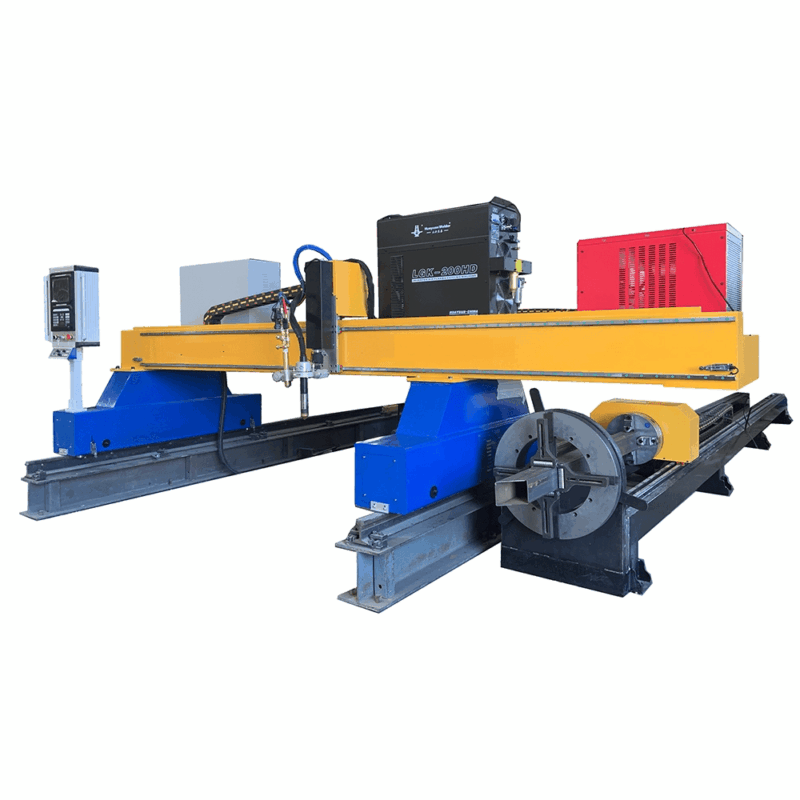
Plasma Cutting Performance and Thermal Efficiency
For heavy-walled structural sections, Plasma Cutting remains the most efficient thermal process for LNG fabrication. Industrial-grade high-definition plasma systems offer a superior balance between cutting speed and edge quality. In LNG modular yards, throughput is measured by the number of processed tons per shift. Plasma systems facilitate high-speed piercing and rapid travel speeds across varying thicknesses of carbon and stainless steel.
The plasma arc, reaching temperatures over 20,000°C, creates a narrow kerf and a localized heat-affected zone (HAZ). This localization is vital for maintaining the metallurgical properties of the steel, preventing the distortion that often plagues oxygen-fuel cutting. By utilizing specialized gas mixtures, such as oxygen-air or nitrogen-water injection, the beam processing center can produce dross-free edges that require zero secondary grinding. This “cut-to-fit” capability streamlines the entire production flow.
Achieving Critical Intersection Accuracy
One of the most complex aspects of LNG structural design is the requirement for intricate intersections. Pipes, secondary beams, and bracing often penetrate the main H-beam webs at various angles. Achieving high Intersection Accuracy is paramount to avoid structural weaknesses. Automated plasma centers utilize multi-axis robotic arms—often with six or seven degrees of freedom—to execute complex 3D paths.
These robots can cut non-linear shapes, such as “rat holes” for drainage, elliptical penetrations for piping, and precise notches for interlocking beams. Because the laser tracking system has already mapped the beam’s surface, the robot can orient the plasma torch perpendicular to the surface at all times, or at a specific angle for complex geometries. This ensures that the internal perimeter of the cutout perfectly matches the profile of the intersecting member, facilitating a tight mechanical fit that distributes loads evenly across the structure.
Low Maintenance Advantages for H-Beam Processing
In harsh industrial environments like shipyard-adjacent LNG yards, equipment reliability is a core metric for Industrial Engineers. Plasma-based beam processing centers are designed for high duty cycles with low maintenance requirements. Unlike mechanical drilling and sawing lines, which involve significant tool wear, consumable breakage, and lubrication management, plasma cutting is a non-contact process.
The primary maintenance involves the periodic replacement of electrodes and nozzles, which can be performed in minutes. The absence of high-torque mechanical forces on the machine frame reduces the frequency of calibration and prevents structural fatigue of the processing center itself. For H-beam processing, this means the system can run continuously across multiple shifts with minimal downtime, providing a predictable output that is essential for meeting project milestones.
Advanced Beveling for Structural Integrity
The preparation of structural joints for high-load LNG modules requires sophisticated bevel profiles. Plasma beam processing centers excel in creating V, Y, X, and K-bevels on the flanges and webs of H-beams. Utilizing the robotic head’s articulation, the system can apply a constant bevel angle even along curved or notched edges.
This automated beveling is superior to manual oxy-fuel or mechanical beveling in terms of consistency and speed. When the beams are moved to the assembly area, the uniform bevel profiles ensure that the volume of the joint is consistent. This consistency is critical for automated welding processes that will follow, as it allows for standardized parameters and reduces the risk of defects like lack of fusion or inclusions. By precisely controlling the root face and bevel angle, the plasma center directly contributes to the long-term fatigue resistance of the LNG module’s structural frame.
Optimizing Material Yield and Workflow Logic
An integrated beam processing center does more than just cut; it optimizes the entire material lifecycle. Advanced nesting software works in tandem with the plasma system to minimize scrap. for LNG Projects involving thousands of tons of steel, a 2-3% increase in material utilization translates to significant cost savings.
The workflow logic of these centers involves automated loading, 4-side scanning, multi-axis plasma processing, and automated discharge. By removing the need for manual layout and marking, the potential for human error is virtually eliminated. The data-driven nature of the system allows for real-time tracking of every part, providing project managers with accurate status updates on fabrication progress.
Conclusion on Industrial Efficiency
The integration of a beam processing center with Laser Seam Tracking represents a significant advancement in structural engineering for the energy sector. By prioritizing plasma cutting for its speed, intersection accuracy, and low maintenance profile, LNG fabricators can achieve a level of precision that was previously unattainable with manual or semi-automated methods. The result is a robust, modular infrastructure capable of withstanding the extreme demands of the global gas supply chain, delivered with optimized labor costs and accelerated timelines.
-


LT240S tube laser cutting machine
-
LT120S tube laser cutting machine
-
Sale

Tank Fillet Welding Machine
Original price was: $1,000.00.$900.00Current price is: $900.00. -
Sale

MAK100 tube laser cutting machine
Original price was: $5,500.00.$5,000.00Current price is: $5,000.00. -

portable plasma air cutting machine
$1,200.00 -

2in1 fiber laser cutting machine
-

Air cooling Laser welding machine
-

HF h beam laser cutting machine
-

LT240 laser cutting machine
-

Laser welding machine
-


Cobot Welding Station
-

Gantry welding robot solution
-

Tracked Wheeled AGV Welding robot
-

LFH6020 Fiber laser cutting machine
-
LFP6020
-

robotic welidng machine
Advanced Fiber Laser Tube Processing Technology
Our CNC Fiber Laser Tube Cutting systems revolutionize metal fabrication by integrating high-precision cutting, punching, and profiling into a single automated workflow. Designed for versatility, this technology handles a wide array of profiles including Round, Square, Rectangular, and Oval tubes, as well as complex L-shaped and U-shaped channels.
- Precision Punching: High-speed hole punching with micron-level accuracy, eliminating the need for mechanical drilling or die-stamping.
- Complex Profiling: Advanced 3D pathing allows for intricate interlocking joints and specialized notch cuts, ideal for structural frames.
- High Material Efficiency: Intelligent nesting software minimizes scrap, reducing raw material costs across large production runs.
- Clean Finish: Delivers oxide-free, burr-free edges that require zero secondary grinding before welding.

Seamlessly processing multiple profiles with consistent precision.
Global Delivery & Logistics



From our high-tech manufacturing facility directly to your global site. PCL WeldCut ensures secure packaging, professional handling, and reliable international logistics to safeguard your equipment throughout the entire journey.