Precision Plasma Cutting in Heavy-Duty H-Beam Production
In the realm of heavy construction machinery—encompassing excavators, crawler cranes, and high-capacity loaders—the structural backbone often consists of specialized H-beams. These components must withstand extreme cyclic loading and torsional stress. To achieve the required structural integrity while maintaining cost-efficiency, manufacturers have increasingly turned to Narrow Gap welding techniques. However, the success of a narrow gap joint is entirely dependent on the quality of the initial cut. This is where high-definition plasma cutting becomes the primary driver of the production line.
The H-Beam Production Line must be engineered to handle thick-plate steel with a focus on geometric repeatability. Unlike general structural steelwork, construction machinery requires tighter tolerances to facilitate automated welding processes. Plasma cutting systems integrated into these lines are not merely separation tools; they are precision machining instruments capable of establishing the foundational geometry of the entire assembly.
Achieving Superior Intersection Accuracy
Intersection accuracy refers to the precision with which the web and flange of an H-beam are prepared to meet. In a Narrow Gap configuration, the tolerance for the root opening is significantly reduced. Even a deviation of one millimeter can lead to welding defects or excessive filler metal consumption. High-definition plasma systems utilize advanced CNC algorithms to compensate for arc kerf and torch angle, ensuring that the intersection points are perfectly square and consistent across the entire length of the beam.
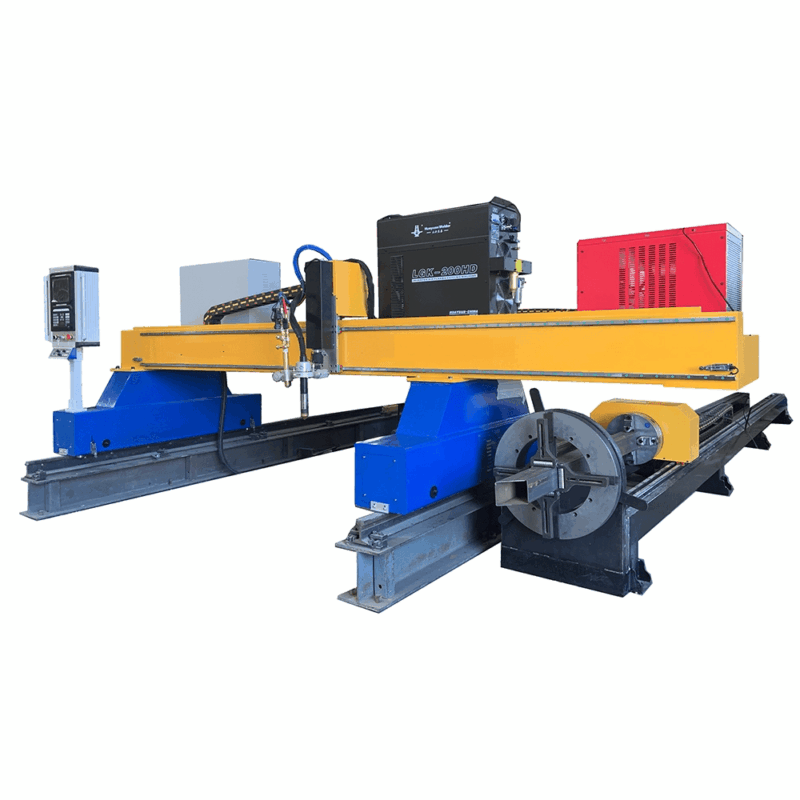
Modern plasma cutting intersection technology employs real-time height control and laser-based material sensing. Before the torch is ignited, the system scans the actual surface of the steel plate or beam profile. Since rolled steel often has slight camber or sweep, the CNC system adjusts the cutting path dynamically. This ensures that the bevel angle and the depth of the cut remain constant relative to the material surface, providing a perfect fit-up for the subsequent welding stages. This level of accuracy eliminates the need for manual grinding or “fitting” on the assembly floor, directly increasing the linear meters of H-beam produced per shift.
The Role of Multi-Axis Plasma Beveling Technology
Narrow Gap welding requires specific groove profiles, often involving deep V-grooves or U-grooves with very small included angles. Traditional straight-line cutting is insufficient for these requirements. Advanced H-beam lines incorporate multi-axis plasma heads capable of complex tilting and rotation. This plasma beveling technology allows for the creation of compound bevels in a single pass.
The ability to bevel the edges of the web and flanges simultaneously ensures that the joint geometry is optimized for deep penetration. By maintaining a narrow groove, the volume of weld metal required is reduced by up to 40% compared to standard wide-angle bevels. The plasma torch must maintain arc stability at extreme angles—sometimes up to 45 or 50 degrees—while ensuring the heat-affected zone (HAZ) remains within metallurgical limits. Precise gas flow control, using oxygen or nitrogen-water injection, produces a clean, dross-free surface that is ready for welding without additional mechanical cleaning.
Low Maintenance Design for Industrial Uptime
In a high-volume industrial environment, equipment downtime is the primary enemy of profitability. Industrial engineers prioritize H-beam low maintenance features when selecting plasma cutting hardware. Unlike older air-plasma systems, high-definition systems are designed with robust cooling circuits and long-life consumables. The use of liquid-cooled torches significantly extends the lifespan of electrodes and nozzles, even when operating at high duty cycles required for thick-walled construction machinery components.
Maintenance optimization also extends to the motion system of the cutting gantry. In an H-beam line, the environment is often contaminated with metallic dust and slag. Leading-edge plasma systems utilize pressurized, sealed bellows for linear bearings and rack-and-pinion drives. This prevents abrasive particles from entering the motion components. Furthermore, integrated fume extraction and slag collection systems reduce the manual labor required to clean the machine bed, allowing the operator to focus on production rather than facility maintenance. Quick-change torch heads and automated calibration routines further ensure that the system returns to its precision baseline with minimal human intervention.
Thermal Management and Material Integrity
A critical concern in construction machinery is the potential for thermal distortion. When cutting long H-beam sections, the heat input from the plasma arc must be carefully managed to prevent “bowing.” Modern plasma power sources feature pulsed current capabilities that allow for high cutting speeds with localized heat concentration. By moving the torch at optimal velocities, the total heat energy transferred to the H-beam is minimized.
This thermal control is essential for maintaining the mechanical properties of high-strength, low-alloy (HSLA) steels commonly used in cranes and earthmovers. By preserving the grain structure near the cut edge, the plasma process ensures that the subsequent Narrow Gap weld forms a metallurgical bond that meets or exceeds the strength of the base material. The resulting H-beam exhibits superior fatigue resistance, a mandatory requirement for machinery operating in harsh environments like mines or heavy construction sites.
Data Integration and Process Synchronization
The modern H-beam production line operates as a synchronized ecosystem. The plasma cutting station is digitally linked to the upstream CAD/CAM software. This integration ensures that the exact dimensions required for Narrow Gap preparation are transmitted without manual data entry errors. As the beam moves through the cutting station, sensors verify the material grade and thickness, automatically adjusting the gas pressures and cutting speeds.
This digital thread allows for comprehensive traceability. Each cut performed by the plasma system can be logged, including the parameters used and the resulting tolerances. For manufacturers of construction machinery, this data is invaluable for quality assurance and for optimizing future production runs. The synergy between high-precision plasma cutting and Narrow Gap welding represents the pinnacle of current H-beam fabrication technology, delivering structures that are lighter, stronger, and more cost-effective to produce.
Concluding Technical Outlook
As the demand for larger and more powerful construction machinery grows, the pressure on H-beam production lines to deliver precision components will continue to increase. Plasma cutting technology remains the most versatile and efficient method for preparing these heavy-duty profiles. By focusing on intersection accuracy, leveraging multi-axis beveling, and demanding low-maintenance hardware, industrial engineers can ensure their production lines remain competitive. The transition to Narrow Gap welding is made possible only through the foundational precision of the plasma cutting process, marking it as a non-negotiable asset in modern heavy fabrication.
-


LT240S tube laser cutting machine
-
LT120S tube laser cutting machine
-
Sale

Tank Fillet Welding Machine
Original price was: $1,000.00.$900.00Current price is: $900.00. -
Sale

MAK100 tube laser cutting machine
Original price was: $5,500.00.$5,000.00Current price is: $5,000.00. -

portable plasma air cutting machine
$1,200.00 -

2in1 fiber laser cutting machine
-

Air cooling Laser welding machine
-

HF h beam laser cutting machine
-

LT240 laser cutting machine
-

Laser welding machine
-


Cobot Welding Station
-

Gantry welding robot solution
-

Tracked Wheeled AGV Welding robot
-

LFH6020 Fiber laser cutting machine
-
LFP6020
-

robotic welidng machine
Advanced Fiber Laser Tube Processing Technology
Our CNC Fiber Laser Tube Cutting systems revolutionize metal fabrication by integrating high-precision cutting, punching, and profiling into a single automated workflow. Designed for versatility, this technology handles a wide array of profiles including Round, Square, Rectangular, and Oval tubes, as well as complex L-shaped and U-shaped channels.
- Precision Punching: High-speed hole punching with micron-level accuracy, eliminating the need for mechanical drilling or die-stamping.
- Complex Profiling: Advanced 3D pathing allows for intricate interlocking joints and specialized notch cuts, ideal for structural frames.
- High Material Efficiency: Intelligent nesting software minimizes scrap, reducing raw material costs across large production runs.
- Clean Finish: Delivers oxide-free, burr-free edges that require zero secondary grinding before welding.

Seamlessly processing multiple profiles with consistent precision.
Global Delivery & Logistics



From our high-tech manufacturing facility directly to your global site. PCL WeldCut ensures secure packaging, professional handling, and reliable international logistics to safeguard your equipment throughout the entire journey.