Optimizing H-Beam Production for Pressure Vessel Integrity
In the fabrication of pressure vessels and their associated heavy-duty support skids, the structural integrity of H-beams serves as the primary foundation for load distribution and vibration dampening. For industrial engineers, the challenge lies in transitioning from raw structural sections to precision-engineered components that can accommodate advanced narrow gap welding (NGW) techniques. The pivot point of this transition is the Plasma Cutting stage. Unlike general structural steelwork, pressure vessel components require plasma arc precision to ensure that every thermal cut facilitates a hermetic, high-strength bond during subsequent assembly phases.
The selection of plasma technology over traditional mechanical methods or other thermal processes is driven by the need for volumetric throughput combined with the ability to handle varying material thicknesses. H-beams used in these applications often feature heavy flanges and thick webs to resist high-pressure cyclical loading. Plasma cutting systems integrated into the production line provide the necessary energy density to penetrate these sections rapidly while maintaining a tight heat-affected zone (HAZ).
Kinematic Intersection Accuracy in H-Beam Processing
One of the most critical metrics in an H-Beam Production Line is intersection accuracy—the precision with which the web and flange are processed to meet at specified coordinates. For pressure vessel skids, where tolerances are often measured in sub-millimeter increments to avoid stress concentrations, the plasma torch must maintain a consistent standoff distance and angle relative to the beam’s profile.
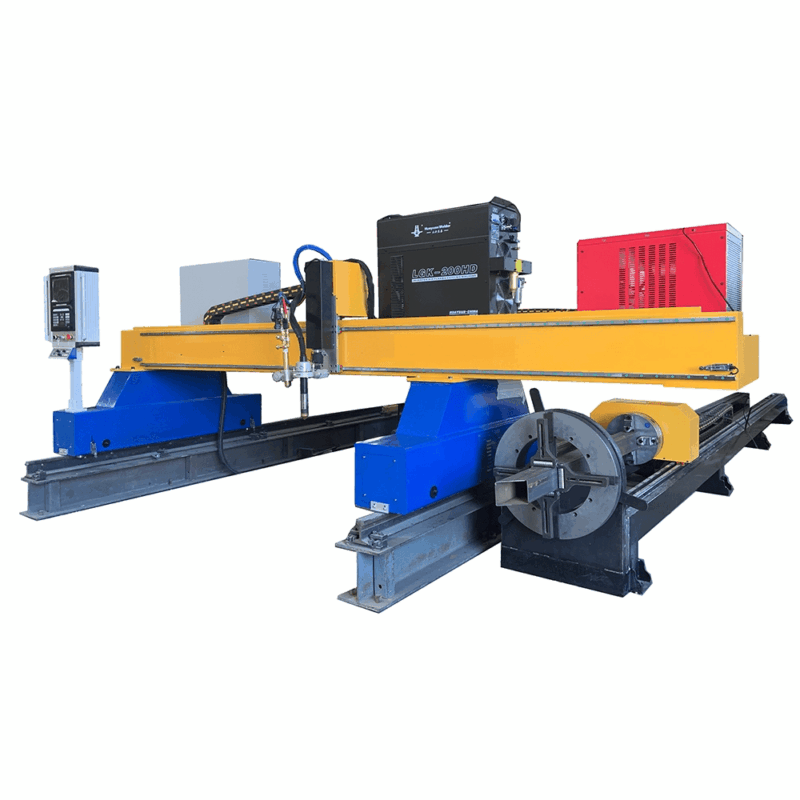
Dynamic Torch Height Control (THC)
Advanced plasma systems utilize high-speed voltage sensing to adjust the torch height dynamically. As H-beams often possess slight metallurgical deviations or “mill camber,” the plasma system must compensate for these irregularities in real-time. By maintaining a constant arc voltage, the system ensures that the kerf width remains uniform across the entire length of the cut. This uniformity is vital for the fit-up phase; any deviation in the intersection leads to gaps that would compromise the narrow gap welding process, requiring excessive filler metal and increasing the risk of porosity.
CNC Integration and Mapping
Modern production lines employ sophisticated CNC algorithms that map the actual dimensions of the H-beam before the first cut is made. By using laser probes or tactile sensors, the system creates a digital twin of the physical beam. This allows the plasma torch to execute complex intersection geometries, such as cope cuts or rat holes, with surgical accuracy. This level of thermal cutting efficiency reduces the need for manual grinding or secondary fit-up adjustments, directly impacting the overall equipment effectiveness (OEE) of the fabrication facility.
Ensuring Operational Continuity: H-Beam Low Maintenance Strategies
From an industrial engineering perspective, the lifecycle cost of a production line is as significant as its initial throughput capacity. Plasma cutting systems are favored in H-beam lines due to their inherent ruggedness and the relative simplicity of their consumable ecosystems. In a high-duty cycle environment such as pressure vessel fabrication, downtime is the primary enemy of profitability.
Consumable Longevity and Gas Management
The move toward high-definition plasma has introduced long-life consumable technologies. By utilizing oxygen-based plasma for carbon steel or specialized gas mixtures (Ar/H2/N2) for stainless steel components, engineers can achieve thousands of pierces before requiring a torch rebuild. Automated gas consoles manage flow rates and pressures with precision, preventing the “snuffing” of the arc which can lead to catastrophic nozzle damage. This stability is essential when processing thick-walled H-beams where a mid-cut failure can result in the scrapping of an expensive structural section.
Simplified Mechanical Maintenance
The mechanical architecture of a plasma-based H-beam line is designed for the harsh environment of a heavy fabrication shop. Unlike systems that require pristine cleanroom-like conditions, plasma gantries are built with hardened rails, pressurized bellows to protect drive components from metallic dust, and robust rack-and-pinion systems. The maintenance schedule is typically focused on filter replacements and rail lubrication, allowing the line to operate across multiple shifts with minimal intervention. This reliability ensures that the structural integrity of the production schedule remains intact.
Advanced Beveling for Narrow Gap Preparation
The transition to narrow gap welding for pressure vessel components necessitates a paradigm shift in edge preparation. Traditional wide-angle grooves are inefficient and prone to distortion. Plasma cutting systems equipped with 5-axis or 6-axis robotic heads enable the creation of complex bevel geometries directly on the H-beam flanges and webs.
Bevel Angle Precision and Geometry
Narrow gap welding requires a specific groove geometry—often a very tight V or U-prep with angles as low as 5 to 7 degrees. Achieving this with a plasma torch requires precise control over the arc’s angular deflection. Modern plasma power supplies can adjust the arc’s swirl and velocity to compensate for the “natural” bevel of a plasma cut, resulting in a perfectly square or precisely angled edge. This capability is the cornerstone of narrow gap preparation, as it provides the consistent root opening required for mechanized welding torches to penetrate deep into the joint without interference.
Reducing Post-Process Handling
By integrating beveling into the primary cutting station, the H-beam production line eliminates the need for secondary beveling machines or manual torch work. The 3D plasma head can execute various bevel types (V, X, Y, or K-cuts) in a single pass. For pressure vessel supports, this means that the transition from the flange to the web can be prepped for full-penetration welds with no manual intervention. This integration not only improves safety by reducing material handling but also ensures that the bevel angles are mathematically consistent with the CNC-designed weld procedures.
Technical Conclusion: The Plasma Advantage in High-Spec Fabrication
The engineering logic for utilizing plasma cutting in H-beam lines for pressure vessel applications is multifaceted. It bridges the gap between raw structural steel and high-precision mechanical components. By focusing on intersection accuracy, the system ensures that the complex geometries of support skids are met with exacting tolerances. The low maintenance requirements of the plasma power source and gantry hardware ensure that the production line remains a consistent contributor to the plant’s output.
Finally, the ability to perform high-precision beveling directly on the line prepares the H-beams for the specialized requirements of narrow gap welding. This synergy between cutting accuracy and welding preparation is what allows modern facilities to produce pressure vessel components that meet the highest standards of safety and performance. The industrial engineer’s focus on plasma technology is therefore not just a choice of cutting method, but a strategic decision to prioritize process stability, cost-efficiency, and technical excellence in heavy manufacturing.
-


LT240S tube laser cutting machine
-
LT120S tube laser cutting machine
-
Sale

Tank Fillet Welding Machine
Original price was: $1,000.00.$900.00Current price is: $900.00. -
Sale

MAK100 tube laser cutting machine
Original price was: $5,500.00.$5,000.00Current price is: $5,000.00. -

portable plasma air cutting machine
$1,200.00 -

2in1 fiber laser cutting machine
-

Air cooling Laser welding machine
-

HF h beam laser cutting machine
-

LT240 laser cutting machine
-

Laser welding machine
-


Cobot Welding Station
-

Gantry welding robot solution
-

Tracked Wheeled AGV Welding robot
-

LFH6020 Fiber laser cutting machine
-
LFP6020
-

robotic welidng machine
Advanced Fiber Laser Tube Processing Technology
Our CNC Fiber Laser Tube Cutting systems revolutionize metal fabrication by integrating high-precision cutting, punching, and profiling into a single automated workflow. Designed for versatility, this technology handles a wide array of profiles including Round, Square, Rectangular, and Oval tubes, as well as complex L-shaped and U-shaped channels.
- Precision Punching: High-speed hole punching with micron-level accuracy, eliminating the need for mechanical drilling or die-stamping.
- Complex Profiling: Advanced 3D pathing allows for intricate interlocking joints and specialized notch cuts, ideal for structural frames.
- High Material Efficiency: Intelligent nesting software minimizes scrap, reducing raw material costs across large production runs.
- Clean Finish: Delivers oxide-free, burr-free edges that require zero secondary grinding before welding.

Seamlessly processing multiple profiles with consistent precision.
Global Delivery & Logistics



From our high-tech manufacturing facility directly to your global site. PCL WeldCut ensures secure packaging, professional handling, and reliable international logistics to safeguard your equipment throughout the entire journey.