Optimizing H-Beam Fabrication via Arc Voltage Control
In the domain of structural steel fabrication, the efficiency of an H-Beam Production Line is dictated by the precision of its primary cutting phase. Industrial engineers prioritize arc voltage control (AVC) as the foundational technology for maintaining consistent torch-to-workpiece distance. Unlike manual or fixed-height systems, AVC monitors the electrical potential between the plasma electrode and the H-beam surface. As the torch navigates the uneven topography of hot-rolled steel, the system adjusts the Z-axis in milliseconds. This real-time correction is vital for preventing torch collisions and ensuring that the plasma arc remains at its optimal focal point, directly influencing the kerf width and the linearity of the cut.
Achieving High-Level Intersection Accuracy
The complexity of modern steel structures requires intricate 3D profiling, where H-beams must be notched, coped, or slotted to facilitate seamless assembly. Intersection accuracy is the metric that determines the success of these connections. When an H-beam undergoes Plasma Cutting, the system must account for the transition between the flange and the web. Without precise height sensing, the arc length fluctuates at these transition points, leading to dross accumulation or dimensional deviations.
By utilizing multi-axis gantry systems equipped with AVC, the production line can execute complex geometries—such as bolt holes, rat holes, and interlocking joints—with tolerances exceeding industry standards. This accuracy eliminates the need for secondary manual fitting on the shop floor. The integration of CNC software allows for the compensation of the plasma arc’s natural taper, ensuring that the internal surfaces of a cut remain square, which is critical for the structural integrity of the final assembly.
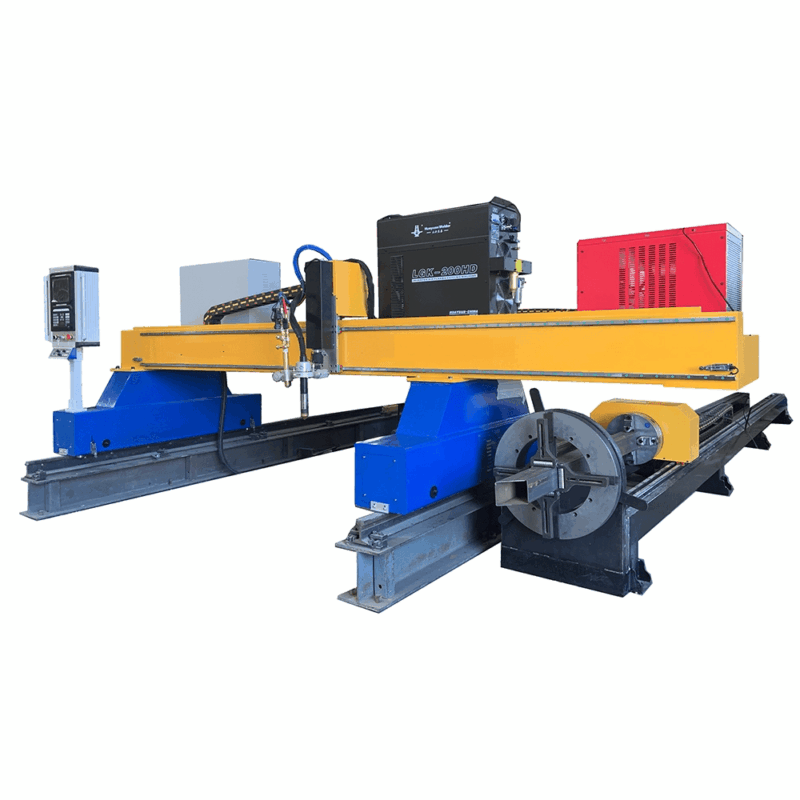
H-Beam Production Efficiency and Low Maintenance
From a lifecycle cost perspective, the H-beam low maintenance profile of plasma-based systems offers a significant advantage over alternative thermal cutting methods. Plasma power supplies and torch assemblies are engineered for high duty cycles in environments characterized by conductive dust and metallic particulate. The primary wear components—nozzles and electrodes—are designed for rapid replacement, minimizing scheduled downtime.
Ruggedness of Plasma Hardware
The mechanical components of a plasma cutting station are built to withstand the kinetic energy of heavy beam handling. Unlike delicate optical systems, plasma torches are resilient against the vibrations inherent in moving 12-meter H-beams. Furthermore, modern air filtration and cooling systems integrated into the production line protect the internal circuitry of the AVC, ensuring that the electronic feedback loop remains stable over years of operation. By reducing the frequency of calibration and mechanical repair, manufacturers can maintain a higher “green light” time, optimizing the overall equipment effectiveness (OEE).
Advanced Beveling for Structural Preparation
The requirement for full-penetration or partial-penetration joints in steel structures necessitates precise edge preparation. Automated plasma cutting technology allows for the execution of V, Y, X, and K-shaped bevels directly on the H-beam flanges and webs. This is achieved through a tilting torch head, often referred to as a “bevel head,” which rotates and swivels to maintain the programmed angle relative to the beam’s surface.
Thermal Management during Beveling
Beveling involves longer dwell times and higher heat input than straight vertical cutting. The AVC plays a critical role here by maintaining a constant standoff even as the torch tilts. Variations in height during a bevel cut would result in an inconsistent land thickness, which complicates the subsequent fitting process. Automated plasma beveling replaces the labor-intensive process of manual grinding, ensuring that every edge is prepped to the exact specifications required by the engineering design, thereby streamlining the workflow toward the assembly phase.
Digital Integration and Workflow Optimization
The modern H-beam production line is a data-driven environment. The interface between the CNC controller and the plasma power source allows for the storage of “cutting charts”—predefined parameters for different material thicknesses and grades. When a beam enters the cutting zone, the system automatically selects the optimal voltage, gas flow, and travel speed.
This digital continuity ensures that the intersection accuracy achieved on the first beam is identical to the thousandth. Industrial engineers can leverage this consistency to predict throughput and allocate resources more effectively. The reduction in scrap material, caused by the elimination of cutting errors, contributes directly to the bottom-line profitability of the project. Furthermore, the ability of plasma systems to pierce thick-walled H-beams rapidly ensures that the bottleneck in production is not the cutting speed, but rather the logistics of material movement.
Conclusion: The Engineering Rationale for Plasma AVC
The selection of an H-beam cutting solution must be predicated on the balance of precision, durability, and operational cost. Plasma cutting, bolstered by sophisticated Arc Voltage Control, addresses these requirements by providing a rugged yet highly accurate platform for structural fabrication. By focusing on the mechanics of the arc and the automation of the Z-axis, manufacturers can achieve the tight tolerances necessary for complex intersections while benefiting from the low maintenance overhead of plasma hardware. As structural designs become more ambitious, the reliance on automated, high-accuracy beveling and profiling will remain the standard for high-output industrial environments.
-


LT240S tube laser cutting machine
-
LT120S tube laser cutting machine
-
Sale

Tank Fillet Welding Machine
Original price was: $1,000.00.$900.00Current price is: $900.00. -
Sale

MAK100 tube laser cutting machine
Original price was: $5,500.00.$5,000.00Current price is: $5,000.00. -

portable plasma air cutting machine
$1,200.00 -

2in1 fiber laser cutting machine
-

Air cooling Laser welding machine
-

HF h beam laser cutting machine
-

LT240 laser cutting machine
-

Laser welding machine
-


Cobot Welding Station
-

Gantry welding robot solution
-

Tracked Wheeled AGV Welding robot
-

LFH6020 Fiber laser cutting machine
-
LFP6020
-

robotic welidng machine
Advanced Fiber Laser Tube Processing Technology
Our CNC Fiber Laser Tube Cutting systems revolutionize metal fabrication by integrating high-precision cutting, punching, and profiling into a single automated workflow. Designed for versatility, this technology handles a wide array of profiles including Round, Square, Rectangular, and Oval tubes, as well as complex L-shaped and U-shaped channels.
- Precision Punching: High-speed hole punching with micron-level accuracy, eliminating the need for mechanical drilling or die-stamping.
- Complex Profiling: Advanced 3D pathing allows for intricate interlocking joints and specialized notch cuts, ideal for structural frames.
- High Material Efficiency: Intelligent nesting software minimizes scrap, reducing raw material costs across large production runs.
- Clean Finish: Delivers oxide-free, burr-free edges that require zero secondary grinding before welding.

Seamlessly processing multiple profiles with consistent precision.
Global Delivery & Logistics



From our high-tech manufacturing facility directly to your global site. PCL WeldCut ensures secure packaging, professional handling, and reliable international logistics to safeguard your equipment throughout the entire journey.