Technical Integration of Arc Voltage Control in H-Beam Fabrication
The structural demands of LNG liquefaction plants and regasification terminals necessitate the use of heavy-duty H-beams capable of supporting massive cryogenic tanks and modular piping systems. Within the H-Beam Production Line, the primary bottleneck often lies in the precision of the thermal cutting process. Unlike standard construction, LNG projects require stringent tolerances to account for thermal contraction and high-stress loading. The implementation of Arc Voltage Control (AVC) represents a critical leap in maintaining these tolerances during the Plasma Cutting phase.
AVC technology operates on the principle of monitoring the electrical potential between the plasma electrode and the workpiece. As the H-beam moves through the production line, inherent material deviations—such as flange warpage or web undulations—can alter the distance between the torch and the metal surface. The AVC system detects these minute voltage fluctuations and triggers a high-speed Z-axis motor to adjust the torch height in real-time. This ensures a consistent standoff distance, which is the foundational requirement for kerf stability and edge perpendicularity.
Precision Intersection Accuracy for Modular LNG Frames
LNG infrastructure is frequently constructed using modular techniques, where steel frames must interlock with millimeter precision at the project site. The intersection of the H-beam web and flange is a high-stress zone where accuracy is non-negotiable. Traditional mechanical cutting or manual plasma methods often struggle with the “coping” or “notching” required for these intersections. An automated plasma line utilizing AVC ensures that the arc remains stable even when transitioning across the complex geometry of the H-beam profile.
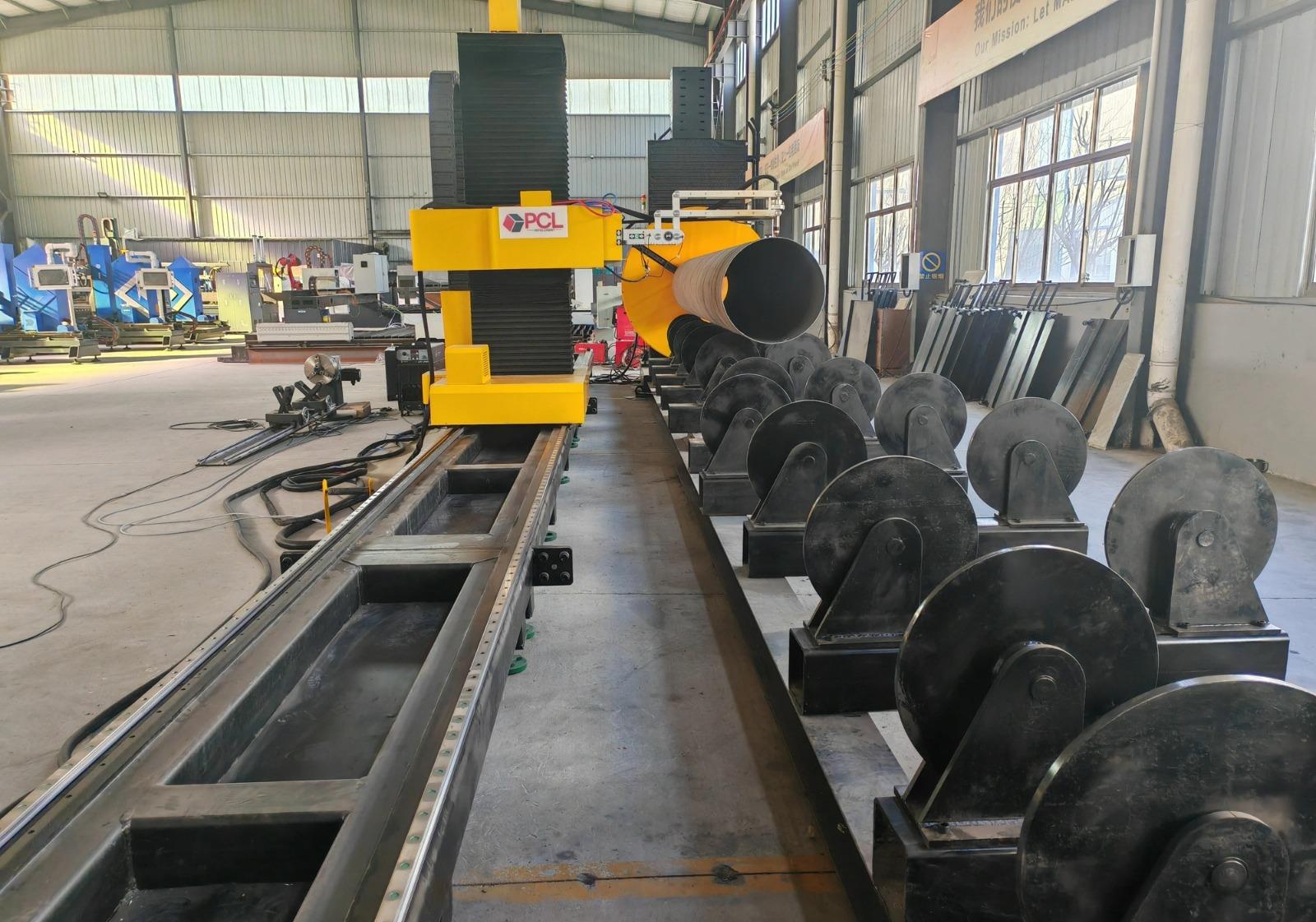
When the plasma torch maneuvers around the radii of the H-beam, the intersection accuracy is maintained by integrated CNC software that synchronizes the torch’s rotational axis with its vertical displacement. By maintaining a constant arc length, the system prevents “rounding” of sharp corners and minimizes the Heat Affected Zone (HAZ). For LNG engineers, this means the structural integrity of the steel is preserved at the molecular level, reducing the risk of brittle fracture in sub-zero operational environments.
Dynamics of High-Definition Plasma in Heavy Section Cutting
The use of high-definition plasma power sources within the H-beam line allows for the processing of thick-walled sections commonly used in LNG modules. These power sources, when coupled with oxygen or nitrogen-water injection systems, produce a constricted arc with higher energy density. The AVC system is vital here because even a 0.5mm deviation in torch height can lead to a significant change in the bevel angle or the introduction of dross on the bottom edge. By stabilizing the voltage, the production line achieves a “bolt-ready” finish directly from the machine, eliminating the need for secondary grinding or corrective machining.
Maximizing Uptime through Low Maintenance Design
In the context of large-scale energy projects, equipment downtime translates directly into exponential logistical costs. Plasma cutting systems designed for H-beam lines emphasize low maintenance through several engineering innovations. First, the torch lead sets and internal components are shielded from the high-radiant heat of the plasma plume and the abrasive metallic dust generated during the piercing process. The Z-axis lifter units are typically enclosed with bellows to prevent the ingress of slag, which is a common cause of mechanical failure in traditional rack-and-pinion systems.
Furthermore, modern plasma systems utilize “long-life” consumable technology. By controlling the ramp-up and ramp-down of gas pressure and current (often referred to as “soft start” technology), the wear on the electrode and nozzle is significantly reduced. In an H-beam production environment, this means fewer consumable changes per shift. The AVC system also contributes to longevity; by preventing “torch crashes” against the workpiece—a common occurrence when cutting warped beams—the system protects the most expensive components of the cutting head from physical damage.
Multi-Axis Beveling for High-Integrity Structural Joints
The transition from simple straight cuts to complex beveling is perhaps the most significant advantage of using plasma in LNG H-beam production. Many structural connections in LNG modules require full-penetration welds to handle dynamic loads and vibration from compressors and pumps. Preparing these beams requires V, Y, or K-shaped bevels along the flanges and web notches. A 5-axis or 6-axis robotic plasma head can execute these bevels in a single pass.
Without precise arc voltage control, beveling becomes highly inconsistent. As the torch tilts to an angle (e.g., 45 degrees), the effective distance the arc travels increases. The AVC system must be programmed with sophisticated algorithms to compensate for this angular offset, maintaining the correct “tip-to-work” distance regardless of the torch orientation. This precision ensures that the root gap and bevel face are uniform across the entire length of the H-beam, which is essential for the automated welding processes that typically follow the cutting stage.
Optimization of Gas Consoles for LNG Grade Steel
The metallurgical properties of the steel used in LNG projects—often high-strength low-alloy (HSLA) or specialized cryogenic steels—require specific gas mixtures to prevent oxidation and nitrogen absorption. Automated gas consoles integrated into the plasma line allow for the seamless switching between Ar/H2 mixtures for stainless steel components and O2/Air for carbon steel H-beams. This adaptability, coordinated with the AVC’s height precision, results in a chemically stable cut surface that is optimal for subsequent coating or galvanizing processes required in maritime LNG environments.
Conclusion: Engineering the Future of Energy Infrastructure
The integration of plasma cutting with advanced Arc Voltage Control is not merely an incremental improvement; it is a fundamental requirement for the high-precision world of LNG infrastructure. By focusing on intersection accuracy, the production line ensures that modular components fit perfectly on-site, reducing construction lead times. The emphasis on low-maintenance mechanical design ensures that the facility can operate at high duty cycles without frequent intervention. Finally, the ability to perform complex beveling with high repeatability ensures that every H-beam produced meets the rigorous safety and structural standards demanded by the global energy sector.
As the demand for LNG continues to grow, the manufacturers who adopt these automated, high-precision plasma solutions will lead the industry in both throughput and quality. The synergy between CNC motion control, high-definition plasma power, and real-time voltage sensing creates a robust platform for the next generation of industrial steel fabrication.
-


LT240S tube laser cutting machine
-
LT120S tube laser cutting machine
-
Sale

Tank Fillet Welding Machine
Original price was: $1,000.00.$900.00Current price is: $900.00. -
Sale

MAK100 tube laser cutting machine
Original price was: $5,500.00.$5,000.00Current price is: $5,000.00. -

portable plasma air cutting machine
$1,200.00 -

2in1 fiber laser cutting machine
-

Air cooling Laser welding machine
-

HF h beam laser cutting machine
-

LT240 laser cutting machine
-

Laser welding machine
-


Cobot Welding Station
-

Gantry welding robot solution
-

Tracked Wheeled AGV Welding robot
-

LFH6020 Fiber laser cutting machine
-
LFP6020
-

robotic welidng machine
Advanced Fiber Laser Tube Processing Technology
Our CNC Fiber Laser Tube Cutting systems revolutionize metal fabrication by integrating high-precision cutting, punching, and profiling into a single automated workflow. Designed for versatility, this technology handles a wide array of profiles including Round, Square, Rectangular, and Oval tubes, as well as complex L-shaped and U-shaped channels.
- Precision Punching: High-speed hole punching with micron-level accuracy, eliminating the need for mechanical drilling or die-stamping.
- Complex Profiling: Advanced 3D pathing allows for intricate interlocking joints and specialized notch cuts, ideal for structural frames.
- High Material Efficiency: Intelligent nesting software minimizes scrap, reducing raw material costs across large production runs.
- Clean Finish: Delivers oxide-free, burr-free edges that require zero secondary grinding before welding.

Seamlessly processing multiple profiles with consistent precision.
Global Delivery & Logistics



From our high-tech manufacturing facility directly to your global site. PCL WeldCut ensures secure packaging, professional handling, and reliable international logistics to safeguard your equipment throughout the entire journey.