Integrating Offline Programming in H-Beam Fabrication
In modern shipbuilding, the throughput of structural steel sections determines the overall cadence of the assembly block construction. H-beams, used extensively for longitudinal strength members and transverse framing, require high-precision processing to ensure structural integrity and ease of assembly. The transition from manual layout to offline programming (OLP) has revolutionized this workflow. Industrial engineers now prioritize OLP to decouple the programming phase from the actual machine runtime, ensuring that the Plasma Cutting station remains in a constant state of production.
OLP software functions by extracting 3D geometry from ship design packages such as Aveva Marine, Tribon, or ShipConstructor. The software automatically identifies the beam profile, calculates the toolpath for complex cutouts, and generates the necessary G-code. This eliminates the “teach-pendant” bottlenecks common in traditional robotics. By simulating the cutting sequence in a virtual environment, engineers can identify potential collisions and optimize the nested layout of parts on the beam, significantly reducing scrap rates and maximizing material utilization across the production line.
Precision Plasma Cutting and Intersection Accuracy
The primary challenge in shipbuilding H-beam fabrication is the complexity of intersections. Beams must be notched, slotted, or “sniped” to allow for the passage of other structural members or to facilitate drainage and ventilation. Achieving high intersection accuracy is critical because gaps exceeding 2mm often require costly manual rework or excessive filler material during subsequent assembly stages. High-definition plasma systems, when integrated with multi-axis robotic arms, provide the necessary dexterity to execute these cuts with high repeatability.
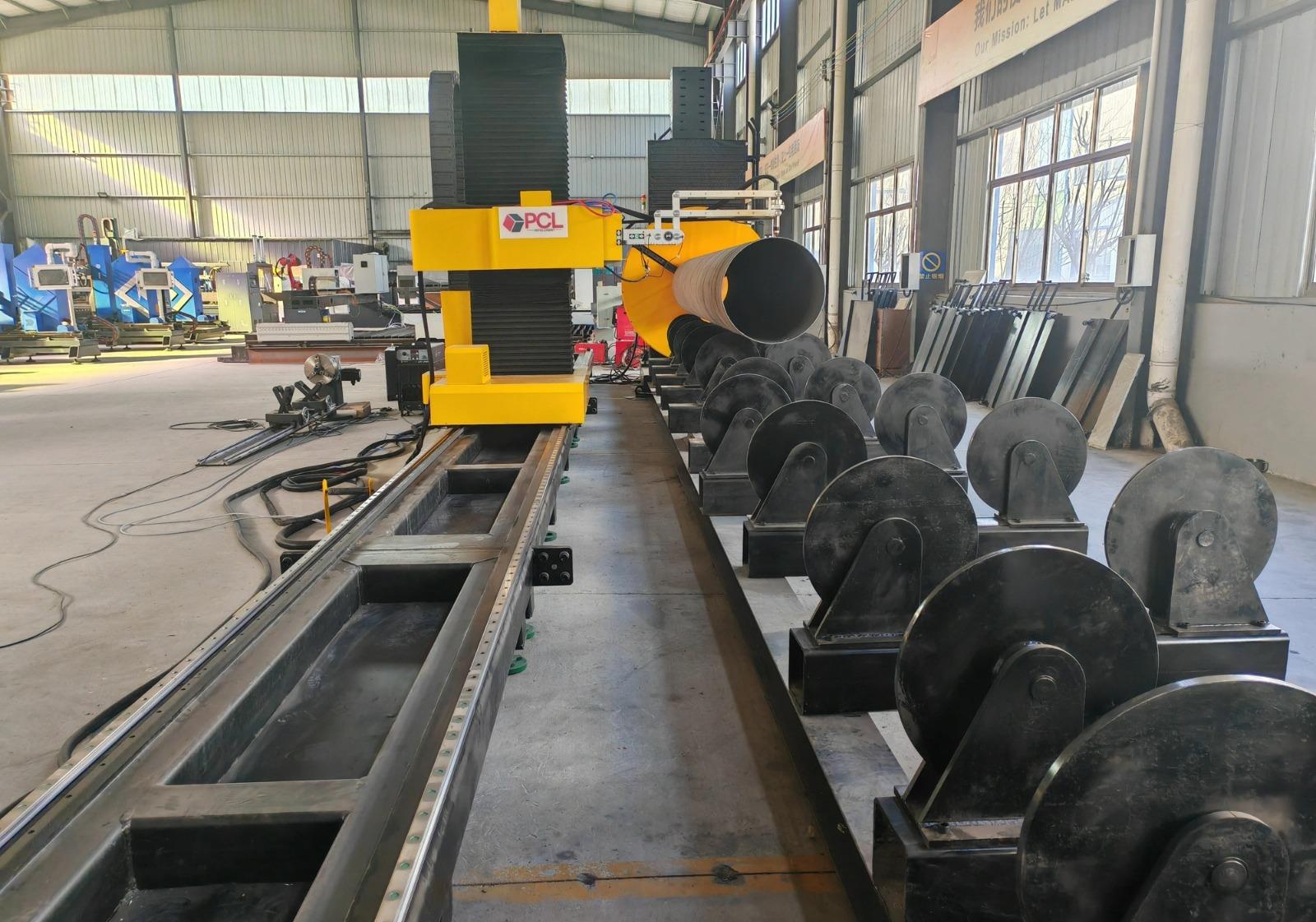
Intersection accuracy is maintained through a combination of mechanical rigidity in the beam handling system and sophisticated sensing technologies. Before the plasma torch is ignited, the system typically utilizes tactile or non-contact laser sensors to detect the actual dimensions of the H-beam. Since structural steel often deviates from theoretical mill specifications (web off-center or flange tilt), the offline programming software adjusts the cutting path in real-time based on the sensed data. This ensures that the web cutouts and flange penetrations align perfectly with the mating components, regardless of minor deformations in the raw material.
Advanced Plasma Beveling for Weld Preparation
For shipyards, the preparation of edges for welding is a labor-intensive process. Automated H-beam lines solve this by incorporating 5-axis or 6-axis plasma heads capable of complex beveling. These systems can perform A, V, Y, and K-style bevels directly on the beam flanges and webs. The ability to create a variable bevel along a contoured cut is a specific requirement in naval architecture where stress concentrations must be minimized.
The plasma beveling process utilizes high-current density torches that can pierce and cut through heavy-walled sections efficiently. Unlike traditional mechanical milling or grinding, plasma beveling provides a rapid thermal cutting solution that reaches the required metallurgical quality for marine-grade steel. By executing the beveling simultaneously with the part cut-off, the production line removes an entire secondary operation from the shipyard floor. The industrial engineer’s focus here is on the kerf compensation algorithms within the control system, which must account for the changing angle of the plasma arc to maintain dimensional precision across the beveled edge.
Low Maintenance Profiles for Industrial Environments
From an OEE (Overall Equipment Effectiveness) perspective, the choice of plasma technology is often driven by its robustness in harsh shipyard environments. Shipyards are characterized by dust, vibration, and temperature fluctuations—conditions that are particularly taxing on sensitive equipment. Plasma cutting systems are inherently low maintenance compared to alternative thermal cutting technologies. The consumables, such as nozzles and electrodes, are the primary wear items and are designed for rapid replacement, often featuring “quick-change” designs that minimize downtime.
The mechanical simplicity of a plasma H-beam line contributes to its long-term reliability. The power sources are ruggedized for high duty cycles, and the motion control systems are shielded from the conductive dust generated during the cutting process. Furthermore, modern plasma systems incorporate self-diagnostic tools that monitor gas flow, coolant temperature, and arc voltage. By tracking these variables, maintenance teams can shift from reactive to preventative maintenance, scheduling component replacements during natural breaks in the production schedule rather than during peak operation hours.
Optimizing the Material Handling Workflow
An H-Beam Production Line is only as fast as its slowest conveyor. Industrial engineers must design the flow of material to complement the speed of the plasma station. This involves high-speed input conveyors, automatic beam cross-transfers, and outfeed systems that sort processed parts. The synchronization of these mechanical elements with the cutting station is managed by the PLC (Programmable Logic Controller), which communicates with the OLP software to track each beam by its unique part ID.
Safety and ergonomics also play a vital role in the production line design. Automated beam rotators and positioners eliminate the need for overhead crane intervention during the cutting process, reducing the risk of accidents and speeding up the cycle time per beam. By housing the plasma station in a dedicated enclosure with integrated fume extraction, the shipyard ensures a cleaner working environment while adhering to environmental regulations regarding the capture of particulate matter generated during the thermal cutting process.
Data Integration and Production Tracking
The final layer of a sophisticated H-beam production line is the integration of cutting data into the shipyard’s ERP system. As the plasma torch completes each cut, the system logs the time taken, the consumables used, and any deviations encountered. This data provides industrial engineers with a transparent view of the production costs and throughput. This feedback loop is essential for refining the offline programming parameters and improving future project estimates.
By focusing on the precision of plasma intersections and the efficiency of robotic beveling, shipyards can achieve a level of structural accuracy that was previously impossible. The combination of robust hardware and intelligent software allows for the mass customization of H-beams, supporting the modular construction techniques that define modern shipbuilding. The result is a streamlined, low maintenance operation that delivers high-quality structural components with minimal human intervention, directly contributing to the vessel’s structural integrity and the shipyard’s bottom line.
-


LT240S tube laser cutting machine
-
LT120S tube laser cutting machine
-
Sale

Tank Fillet Welding Machine
Original price was: $1,000.00.$900.00Current price is: $900.00. -
Sale

MAK100 tube laser cutting machine
Original price was: $5,500.00.$5,000.00Current price is: $5,000.00. -

portable plasma air cutting machine
$1,200.00 -

2in1 fiber laser cutting machine
-

Air cooling Laser welding machine
-

HF h beam laser cutting machine
-

LT240 laser cutting machine
-

Laser welding machine
-


Cobot Welding Station
-

Gantry welding robot solution
-

Tracked Wheeled AGV Welding robot
-

LFH6020 Fiber laser cutting machine
-
LFP6020
-

robotic welidng machine
Advanced Fiber Laser Tube Processing Technology
Our CNC Fiber Laser Tube Cutting systems revolutionize metal fabrication by integrating high-precision cutting, punching, and profiling into a single automated workflow. Designed for versatility, this technology handles a wide array of profiles including Round, Square, Rectangular, and Oval tubes, as well as complex L-shaped and U-shaped channels.
- Precision Punching: High-speed hole punching with micron-level accuracy, eliminating the need for mechanical drilling or die-stamping.
- Complex Profiling: Advanced 3D pathing allows for intricate interlocking joints and specialized notch cuts, ideal for structural frames.
- High Material Efficiency: Intelligent nesting software minimizes scrap, reducing raw material costs across large production runs.
- Clean Finish: Delivers oxide-free, burr-free edges that require zero secondary grinding before welding.

Seamlessly processing multiple profiles with consistent precision.
Global Delivery & Logistics



From our high-tech manufacturing facility directly to your global site. PCL WeldCut ensures secure packaging, professional handling, and reliable international logistics to safeguard your equipment throughout the entire journey.