Fiber Laser Cutting Machine with Offline Programming for Bridge Trusses
In this article
Optimizing Bridge Truss Fabrication through Fiber Laser Integration
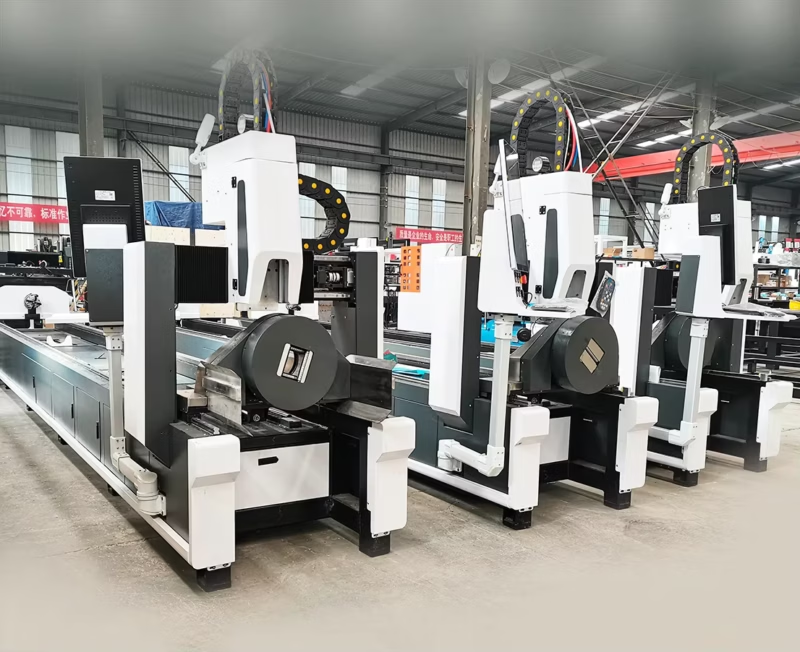
In bridge engineering, the structural integrity of truss assemblies depends heavily on the precision of individual components. Traditionally, the fabrication of gusset plates, chords, and vertical members involved a fragmented workflow consisting of mechanical punching, thermal cutting, and extensive secondary grinding. The introduction of Fiber Laser Technology has overhauled this sequence by providing a single-source solution for high-precision cutting. Unlike legacy systems, fiber lasers utilize a solid-state gain medium, resulting in a beam wavelength of approximately 1.07 microns. This allows for superior absorption rates in structural steels, enabling faster cutting speeds and a significantly reduced kerf width.
Industrial engineers are now prioritizing fiber laser systems because they address the primary bottleneck in heavy fabrication: post-cut processing. By achieving an edge quality that meets or exceeds ISO 9013 Grade 2 standards, the need for manual grinding to remove dross or square up edges is eliminated. This direct-to-assembly capability accelerates the production cycle and ensures that the geometric tolerances required for Bridge Trusses—often within fractions of a millimeter—are consistently maintained across large production runs.
The Technical Advantage: Precision Punching and Marking
A critical requirement in bridge truss assembly is the accurate placement of bolt holes and alignment marks. Fiber Laser Technology allows for the integration of “punching” (small diameter hole piercing) and “marking” (surface etching) within the same CNC program. This replaces the manual layout process where technicians would use chalk lines or physical templates to mark hole centers and assembly locations.
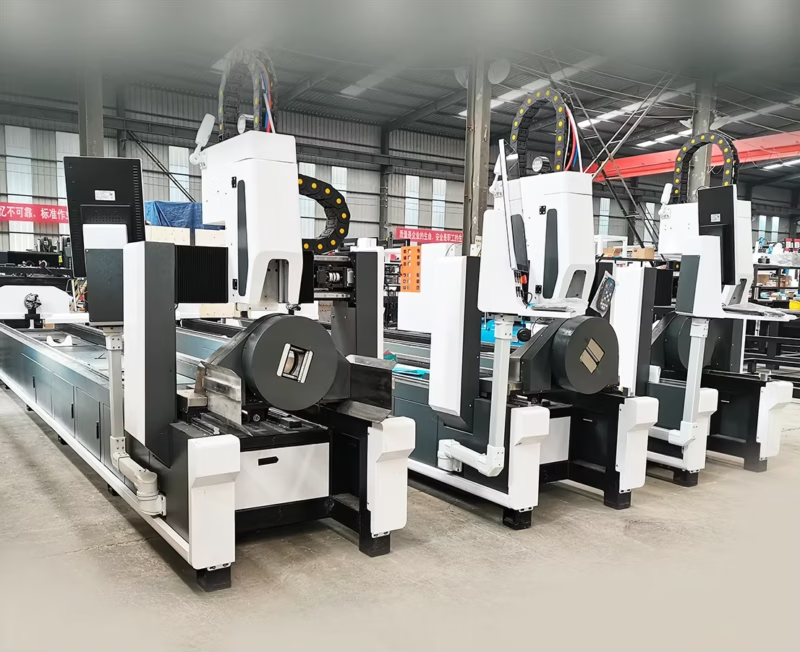
The laser’s ability to switch from high-energy cutting to low-energy etching in milliseconds enables the machine to etch part numbers, heat numbers, and weldment boundaries directly onto the steel plate. For bridge trusses, where every component must be traceable to its mill certificate, this automated marking is an essential quality control feature. Furthermore, the precision of laser-pierced holes ensures that when multiple plates are stacked for a bolted connection, the alignment is perfect, preventing the need for reaming in the field.
Eliminating the Heat Affected Zone (HAZ) Grinding Requirement
Structural steel used in bridge construction is sensitive to thermal cycles. Excessive heat input can alter the grain structure of the material, leading to localized hardening and potential brittleness. Traditional thermal cutting methods often leave a wide Heat Affected Zone (HAZ) that engineers require to be ground away to expose the base metal.
Fiber lasers mitigate this issue through high power density and narrow focus. The energy is concentrated into such a small area that the material is vaporized and ejected by high-pressure assist gases (typically Nitrogen or Oxygen) before the surrounding metal can absorb significant heat. The resulting HAZ is so negligible that structural codes often waive the requirement for edge grinding. This is a massive operational gain, as it removes hundreds of man-hours from the fabrication schedule and reduces the consumption of abrasive materials.
Workflow Synchronization via Offline Programming (OLP)
The efficiency of a fiber laser machine is only as good as the instructions it receives. Offline Programming (OLP) serves as the digital bridge between the engineering office and the shop floor. In traditional setups, machine operators would program parts at the controller, leading to machine downtime. OLP allows engineers to create, simulate, and optimize cutting paths on a remote workstation while the laser is actively processing another job.
For bridge trusses, which often utilize complex nesting patterns to save on expensive high-tensile steel, OLP software uses advanced algorithms to maximize sheet utilization. It accounts for grain direction requirements specified by the bridge design and calculates the most efficient sequence to minimize heat accumulation in the plate. This proactive approach identifies potential collisions between the cutting head and tipped parts before the first pierces are made, protecting the equipment and reducing scrap.
Digital Twin and Simulation in Bridge Engineering
Offline Programming (OLP) facilitates the creation of a digital twin for the fabrication process. By importing 3D CAD models of the truss components, the software can automatically determine the optimal lead-ins and lead-outs for the laser. This is particularly vital for the thick gusset plates used in heavy-duty span bridges. The simulation environment allows the industrial engineer to verify that the piercing sequence will not cause plate warping, ensuring that the final parts are perfectly flat for assembly.
Furthermore, OLP systems can be integrated with Enterprise Resource Planning (ERP) software to provide real-time data on gas consumption, electricity usage, and time-per-part metrics. This level of data transparency is crucial for accurate bidding and project management in large-scale infrastructure tenders.
The Economic Impact on Throughput and Labor
From an industrial engineering perspective, the transition to fiber Laser Cutting with OLP is a capital investment that redefines the cost-per-part. By consolidating three distinct operations—layout marking, hole punching, and profile cutting—into one automated station, the labor burden is significantly reduced. The high cutting speeds of modern 10kW to 20kW fiber lasers mean that even thick-section bridge components can be processed at rates previously unattainable.
The reliability of the Heat Affected Zone (HAZ) management and the precision of the cut edges also mean that the “fit-up” time during the assembly of the bridge truss is shortened. When parts are cut precisely to the digital model, they interlock or align without the need for mechanical forcing or field adjustments. This “first-time-right” manufacturing philosophy is the cornerstone of modern industrial engineering and is perfectly embodied by the synergy of fiber lasers and offline programming.
Conclusion: A New Standard for Infrastructure Fabrication
The application of Fiber Laser Cutting Machines in the bridge truss sector represents a move toward high-velocity, high-precision manufacturing. By eliminating the archaic requirements of post-cut grinding and manual marking, fabricators can deliver safer, more accurate structures in less time. The integration of Offline Programming (OLP) ensures that the hardware is utilized to its maximum potential, turning complex engineering drawings into physical components with unmatched fidelity. As bridge designs become more complex and material costs rise, the efficiency and precision of fiber laser technology will remain the primary driver of competitive advantage in the heavy fabrication industry.






