Precision 3D Tube Laser Cutting: Advancing HVAC Duct Fabrication
The transition from traditional mechanical cutting and plasma processing to 3D fiber laser technology represents a fundamental shift in HVAC duct manufacturing. In an industry where airtight seals and structural integrity are non-negotiable, the ability to execute a 45-degree bevel cut directly on the production line eliminates significant manual labor. This technical analysis explores the integration of 3D tube laser machines in the production of duct pipes, focusing on the mechanical stability, material range, and digital workflow required for industrial-scale efficiency.
Risk Mitigation: Stability in Industrial Environments
HVAC fabrication facilities are inherently dusty environments due to the presence of insulation materials, metal shavings, and heavy machinery. For a fiber laser source, particulate ingress is a primary failure vector. Industrial-grade 3D tube lasers mitigate this through a completely sealed cabinet design with independent climate control. By maintaining a positive pressure environment within the laser source housing, the system prevents the accumulation of microscopic dust on sensitive optical components, ensuring a consistent beam quality over thousands of operational hours.
Beyond environmental protection, the mechanical precision of the chuck system is the most critical factor in achieving a tight Geometric Tolerance. HVAC pipes, particularly those with thin walls, are susceptible to deformation when clamped. Advanced 3D laser systems utilize self-centering pneumatic or electric chucks that apply proportional pressure based on the material thickness and diameter. This ensures that the center of the tube remains aligned with the focal point of the laser head. Without this precision centering, a 45-degree bevel cut would result in an uneven edge, leading to gaps during the assembly of elbow joints or T-sections.
Material Versatility and Profile Flexibility
While galvanized steel remains the standard for most ductwork, specialized HVAC applications often require aluminum for weight reduction or copper for heat exchange efficiency. These materials are highly reflective, posing a risk of Back-reflection that can travel back through the delivery fiber and damage the laser diode. Modern 3D tube lasers incorporate optical isolators and sensors that monitor the return of reflected light. If the system detects a hazardous level of back-reflection, it automatically adjusts the power parameters or halts the process, protecting the equipment while allowing for the processing of non-ferrous alloys.
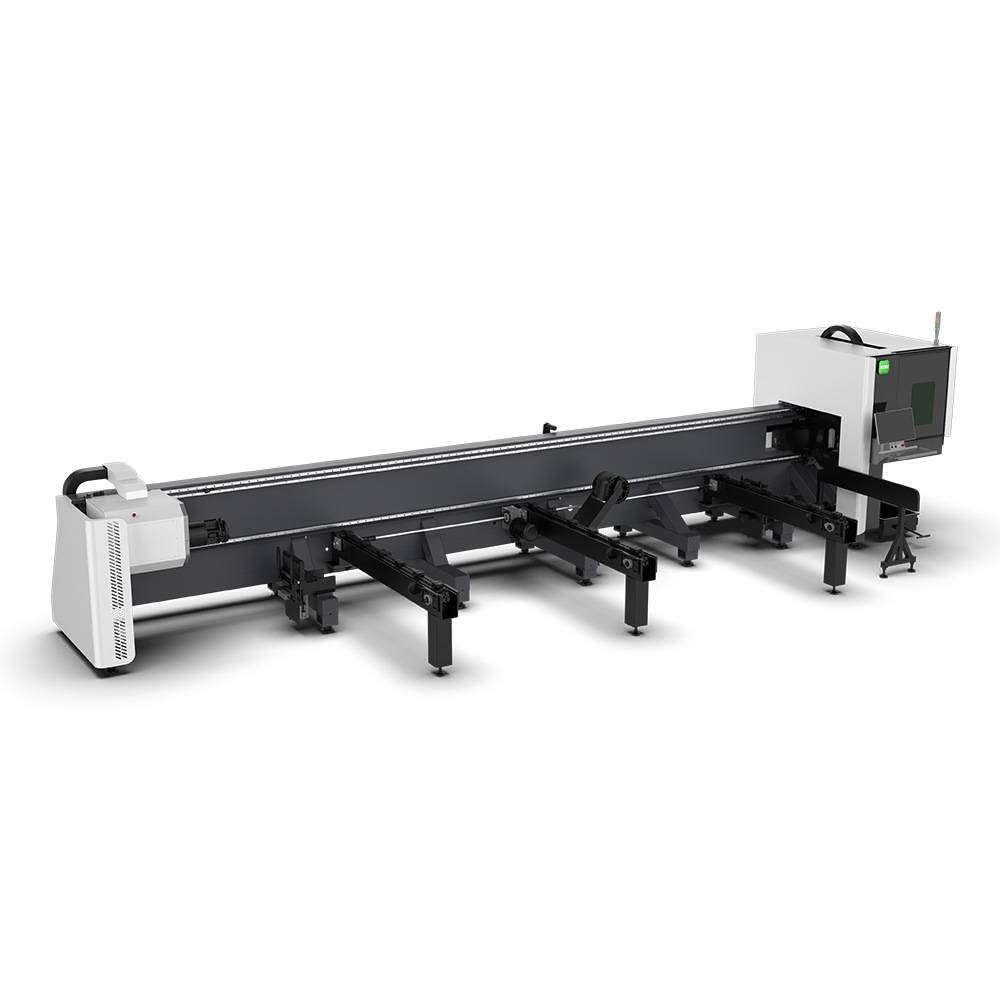
The utility of the 3D laser extends beyond standard cylindrical pipes. HVAC support structures frequently utilize H-beams, C-channels, and rectangular profiles. A 5-axis 3D cutting head allows the machine to traverse the complex geometry of these profiles. The 45-degree beveling capability is particularly useful here, as it enables the creation of interlocking structural frames that require minimal welding. The software calculates the compensation for the beam diameter, ensuring that the Kerf width is accounted for when cutting thick-walled structural supports.
Workflow Efficiency: Eliminating Secondary Processing
The primary cost driver in traditional HVAC fabrication is the labor associated with secondary processing. Manual plasma cutting leaves behind dross and a significant Heat-Affected Zone, both of which must be removed via grinding before the parts can be joined. A 3D tube laser delivers a burr-free finish that allows for immediate assembly. The precision of the 45-degree bevel ensures that the fit-up is seamless, which is essential for maintaining the airtight standards required by modern building codes.
Efficiency is further maximized through digital integration. By connecting the laser system to an ERP (Enterprise Resource Planning) platform, production managers can automate the nesting process. The software analyzes the current inventory of raw pipes and optimizes the cutting paths to minimize scrap. This digital thread ensures that every component is tracked from the raw material stage to the final installation on the job site. The ability to import 3D CAD files directly into the nesting software reduces the risk of human error in translating blueprints to the factory floor.
Technical Comparison: Traditional vs. 3D Laser Processing
The following table illustrates the performance metrics of traditional mechanical/plasma methods compared to automated 3D tube laser cutting for HVAC applications.
| Feature | Traditional (Plasma/Saw) | 3D Tube Laser |
|---|---|---|
| Cutting Precision | ±1.0mm to 2.0mm | ±0.05mm to 0.1mm |
| Bevel Capability | Manual setup required | Automated 5-axis (0-45°) |
| Secondary Processing | Grinding and deburring | None (Burr-free) |
| Material Waste | 15-20% (Manual nesting) | 3-5% (Digital nesting) |
| Setup Time | High (Manual jigs) | Low (Software-driven) |
Implementation Strategy for HVAC Manufacturers
Adopting 3D tube laser technology requires more than just equipment procurement; it demands a shift toward a Digital Twin methodology. In this workflow, the exact physical properties of the duct pipe are modeled in a virtual environment before the first cut is made. This allows for collision detection, ensuring the 5-axis head does not interfere with the chucks or the pipe during complex beveling maneuvers.
The return on investment (ROI) for this technology is found in the intersection of speed and quality. While the initial capital expenditure for a 3D fiber laser is higher than a plasma table, the reduction in labor hours and the elimination of manual rework typically lead to a payback period of less than 24 months for mid-to-large scale HVAC contractors. By streamlining the fabrication of complex duct geometries, manufacturers can increase their output capacity without a corresponding increase in the workforce, effectively scaling their operations to meet the demands of modern construction timelines.
Conclusion
The integration of 3D tube laser cutting with 45-degree beveling represents the most significant advancement in duct fabrication in recent decades. By addressing the critical challenges of dust-related downtime, material reflectivity, and workflow bottlenecks, industrial operators can achieve a level of precision that was previously unattainable. As the HVAC industry continues to move toward more stringent efficiency and leakage standards, the adoption of automated laser technology becomes not just an advantage, but a necessity for competitive manufacturing.
-


LT240S tube laser cutting machine
-
LT120S tube laser cutting machine
-
Sale

Tank Fillet Welding Machine
Original price was: $1,000.00.$900.00Current price is: $900.00. -
Sale

MAK100 tube laser cutting machine
Original price was: $5,500.00.$5,000.00Current price is: $5,000.00. -

portable plasma air cutting machine
$1,200.00 -

2in1 fiber laser cutting machine
-

Air cooling Laser welding machine
-

HF h beam laser cutting machine
-

LT240 laser cutting machine
-

Laser welding machine
-


Cobot Welding Station
-

Gantry welding robot solution
-

Tracked Wheeled AGV Welding robot
-

LFH6020 Fiber laser cutting machine
-
LFP6020
-

robotic welidng machine
Advanced Fiber Laser Tube Processing Technology
Our CNC Fiber Laser Tube Cutting systems revolutionize metal fabrication by integrating high-precision cutting, punching, and profiling into a single automated workflow. Designed for versatility, this technology handles a wide array of profiles including Round, Square, Rectangular, and Oval tubes, as well as complex L-shaped and U-shaped channels.
- Precision Punching: High-speed hole punching with micron-level accuracy, eliminating the need for mechanical drilling or die-stamping.
- Complex Profiling: Advanced 3D pathing allows for intricate interlocking joints and specialized notch cuts, ideal for structural frames.
- High Material Efficiency: Intelligent nesting software minimizes scrap, reducing raw material costs across large production runs.
- Clean Finish: Delivers oxide-free, burr-free edges that require zero secondary grinding before welding.

Seamlessly processing multiple profiles with consistent precision.
Global Delivery & Logistics



From our high-tech manufacturing facility directly to your global site. PCL WeldCut ensures secure packaging, professional handling, and reliable international logistics to safeguard your equipment throughout the entire journey.