Field Report: Deployment of Single Pulse Collaborative Arc Welding Systems
Location: Industrial Zone, 10th of Ramadan City, Cairo, Egypt
Project Oversight: Senior Welding Engineer
This report details the technical deployment and operational integration of a Single Pulse Collaborative Arc Welding System within a high-output fabrication facility in Cairo. The primary objective was the transition from manual Metal Active Gas (MAG) welding to a semi-autonomous framework to address the increasing demand for galvanized piping used in regional cooling infrastructure and fire suppression systems. The following analysis focuses on the synergy between automated logic and collaborative hardware, specifically addressing the metallurgical hurdles of galvanized pipe welding.
The Synergy: Collaborative Arc Welding System meets Automated Welding
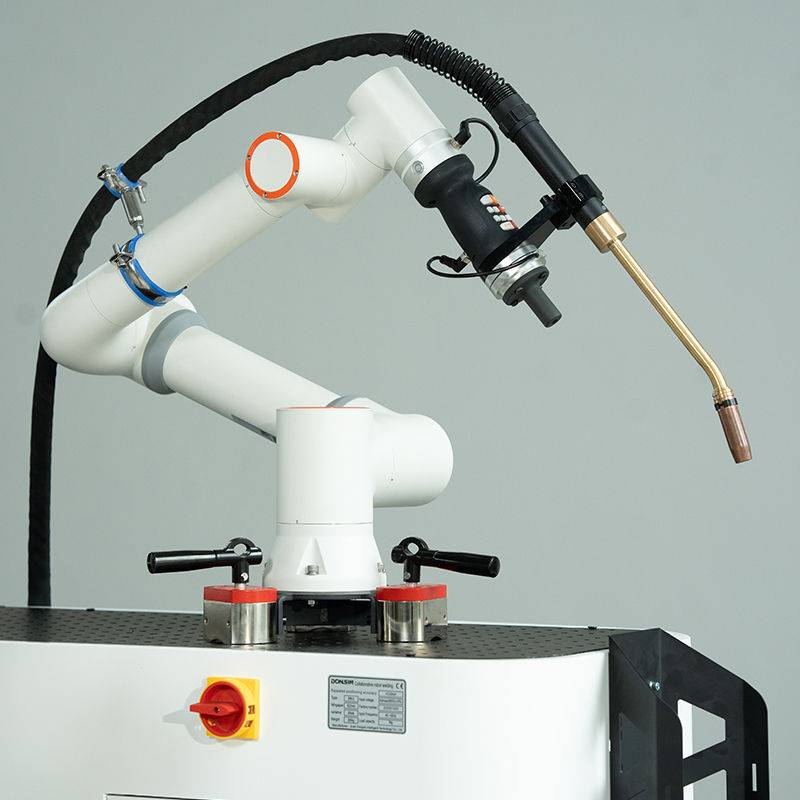
In the context of a Cairo-based workshop—where floor space is at a premium and the workforce is transitioning from traditional crafts to technical oversight—the distinction between a standard industrial robot and a Collaborative Arc Welding System is critical. Traditional Automated Welding often requires extensive safety cell infrastructure, which limits the flexibility of a shop handling varying pipe geometries. By implementing a collaborative system (cobot), we integrated the precision of automation directly into the manual workflow without the need for light curtains or physical barriers that interrupt material flow.
The synergy here lies in the “Human-in-the-loop” philosophy. While the Automated Welding component handles the consistency of the arc length, travel speed, and oscillation, the operator focuses on the fit-up and the specific challenges of the Cairo climate. Ambient temperatures in the workshop often exceed 40°C, which affects the viscosity of lubricants and the thermal expansion of the pipe segments before the arc is even struck. The Collaborative Arc Welding System allows for rapid “lead-through” programming, where the engineer can manually guide the torch to teach the path, while the automated system handles the complex pulse-on-pulse wave logic required to bridge gaps in less-than-perfect fit-ups.
Operational Efficiency in Local Infrastructure Projects
In our Cairo deployment, we observed that the primary bottleneck was not the weld time, but the setup time. By using a Collaborative Arc Welding System, we reduced the changeover time between different pipe diameters by 45%. The automated software allows for saved “jobs” or “schedules,” meaning a welder can switch from a 4-inch schedule 40 pipe to an 8-inch thin-wall galvanized segment with a simple touchscreen command, rather than manual recalibration of a power source.
Addressing the Metallurgy: Galvanized Pipe Welding Challenges
The most significant technical hurdle in this project was Galvanized Pipe welding. As is common in regional infrastructure, the pipes are hot-dip galvanized to prevent corrosion in the high-salinity and humid environments near the coast and the Nile Delta. However, zinc has a boiling point of approximately 907°C, while steel melts at around 1,500°C. When the arc is struck, the zinc vaporizes instantly, leading to significant spatter, copper-colored fumes, and—most dangerously—intergranular stress corrosion cracking or “zinc entrapment” porosity.
To combat this, we leveraged the Automated Welding system’s “Single Pulse” capability. Traditional short-circuit transfer is too violent for galvanized surfaces, causing the zinc vapor to become trapped in the weld pool as it rapidly solidifies. By using a Single Pulse regime, we achieved a one-drop-per-pulse metal transfer. This creates a more stable, “calm” weld pool. The controlled heat input allows the zinc gas to escape ahead of the solidification front, drastically reducing internal porosity.
Technical Parameter Adjustments for Zinc Escape
Through iterative testing on-site, we identified that a specific “pulse-on-pulse” frequency was required. We set the Collaborative Arc Welding System to a travel speed slightly slower than what would be used for black steel. This “slow-and-steady” automated approach, coupled with a 10-degree push angle (instead of a pull angle), allowed the arc force to push the molten zinc away from the leading edge of the puddle. This is a nuance that manual welders often struggle to maintain over a 10-hour shift, but which an automated system executes with 100% repeatability.
Lessons Learned: Technical Field Observations
1. Gas Shielding and Atmospheric Interference
One of the primary lessons learned in Cairo was the impact of workshop ventilation on the Collaborative Arc Welding System. Because cobots are often used in open environments (without the sealed cabinets of traditional automated welding), they are susceptible to drafts. We found that a standard 80/20 Argon/CO2 mix was insufficient in the afternoon when the facility’s large-scale fans were at full power to cool the staff. We had to increase gas flow rates to 25 L/min and switch to a larger gas lens to ensure the Galvanized Pipe welding remained free of atmospheric nitrogen contamination. If the shielding gas is compromised, the zinc oxide reacts even more violently, resulting in catastrophic weld failure.
2. The “Zinc Cleaning” Fallacy
While many textbooks suggest grinding away the galvanization prior to welding, in a high-volume Cairo production environment, this is often skipped or done poorly. The Automated Welding system had to be programmed to “burn through” the residual zinc. We learned that a slightly longer arc-off time at the end of the pulse cycle allowed the crater to fill properly, preventing the common “pipe-end” cracks associated with galvanized materials. We implemented a “pre-flow” of gas and a “hot start” parameter within the automated logic to vaporize the surface zinc before the wire feeder reached the base metal.
3. Spatter Management on Cobot Hardware
Despite the “clean” nature of pulse welding, Galvanized Pipe welding inherently produces more spatter than raw steel. We noted that the sensors on the Collaborative Arc Welding System—specifically the force-torque sensors used for hand-guiding—are sensitive to heavy spatter buildup. We had to implement a strict maintenance schedule: every 50 cycles, the automated torch cleaner (reamer) would cycle, and the cobot joints were protected with specialized Kevlar heat-sleeves. This is a practical field requirement that is often overlooked in the initial CAPEX phase but is vital for the longevity of automated systems in harsh environments.
Synergy and the Local Workforce
The integration of a Collaborative Arc Welding System in Egypt is as much a human triumph as a technical one. The transition to Automated Welding did not replace the local welders; instead, it elevated them to “Cobot Technicians.” The “senior” manual welders provided the tribal knowledge regarding how the weld pool “should look” when the zinc is properly boiling off, and we translated that visual feedback into the digital pulse parameters of the system.
We found that the collaborative nature of the system allowed for real-time adjustments. If a technician noticed a slight variation in the pipe’s galvanization thickness (which can vary significantly between batches), they could use the “Override” toggle on the cobot pendant to adjust the voltage by ±5% without stopping the automated program. This level of granular control is where the Collaborative Arc Welding System proves its worth over rigid, non-collaborative automation.
Conclusion
The deployment in Cairo confirms that the future of regional infrastructure fabrication lies in the tight integration of Automated Welding logic and collaborative hardware. By specifically tuning our Single Pulse parameters to handle the volatile nature of Galvanized Pipe welding, we achieved a 30% increase in first-pass yield and a significant reduction in post-weld cleanup. The “Cairo Setup”—characterized by high heat, variable material quality, and the need for flexible automation—serves as a blueprint for future Collaborative Arc Welding System deployments in emerging industrial hubs. The key takeaway remains: the hardware provides the consistency, but the engineering must be tuned to the metallurgical reality of the material and the environmental reality of the shop floor.
-


Cantilever Welding Robot solution
-


GF laser cutting machine
-

P3015 plasma cutting machine
-

LFP3015 Fiber Laser Cutter
-

pipe plasma cutting machine
-
LFH 4020 Fiber Laser Cutting Machine
-
LFP4020
-

gantry plasma air cutting machine
-

3D robot cutting machine
-

8 axis plasma cutting machine
-

5 axis plasma cutting machine
-

LT360 tube laser cutting machine
-

robot welding workstation
-

SF6060 fiber laser cutting machine
