Technical Integration of Zero-Tailing Robotic MAG Systems
In the fabrication of pressure vessels, the integrity of every circumferential and longitudinal seam is subject to rigorous Non-Destructive Testing (NDT). Traditional Metal Active Gas (MAG) welding processes often suffer from inconsistencies at the arc-start and arc-end points, leading to material waste and potential defects. The introduction of Intelligent Robotic Welder systems featuring zero-tailing technology addresses these inefficiencies by synchronizing the wire feeder motor with the power source output at a microsecond level.
Zero-tailing technology specifically targets the elimination of the “wire stub” that typically remains at the end of a weld cycle. In manual or standard automated setups, the burn-back settings often leave 10-15mm of wasted wire per cycle. In high-volume pressure vessel production, where a single vessel may require hundreds of arc initiations for multi-pass welds, this waste accumulates into significant raw material loss. The intelligent system utilizes a reverse-retract motion at the moment of arc extinction, ensuring the wire is positioned perfectly for the next strike without manual clipping.
Optimizing the MAG Process for Thick-Walled Vessels
Pressure vessels often utilize carbon steel or low-alloy steel plates ranging from 12mm to over 50mm in thickness. Achieving full penetration requires a stable spray transfer or globular transfer mode. Intelligent robotic systems enhance the MAG welding process by utilizing waveform control. This digital modulation of the current and voltage prevents spatter, which is a primary cause of post-weld cleanup costs.
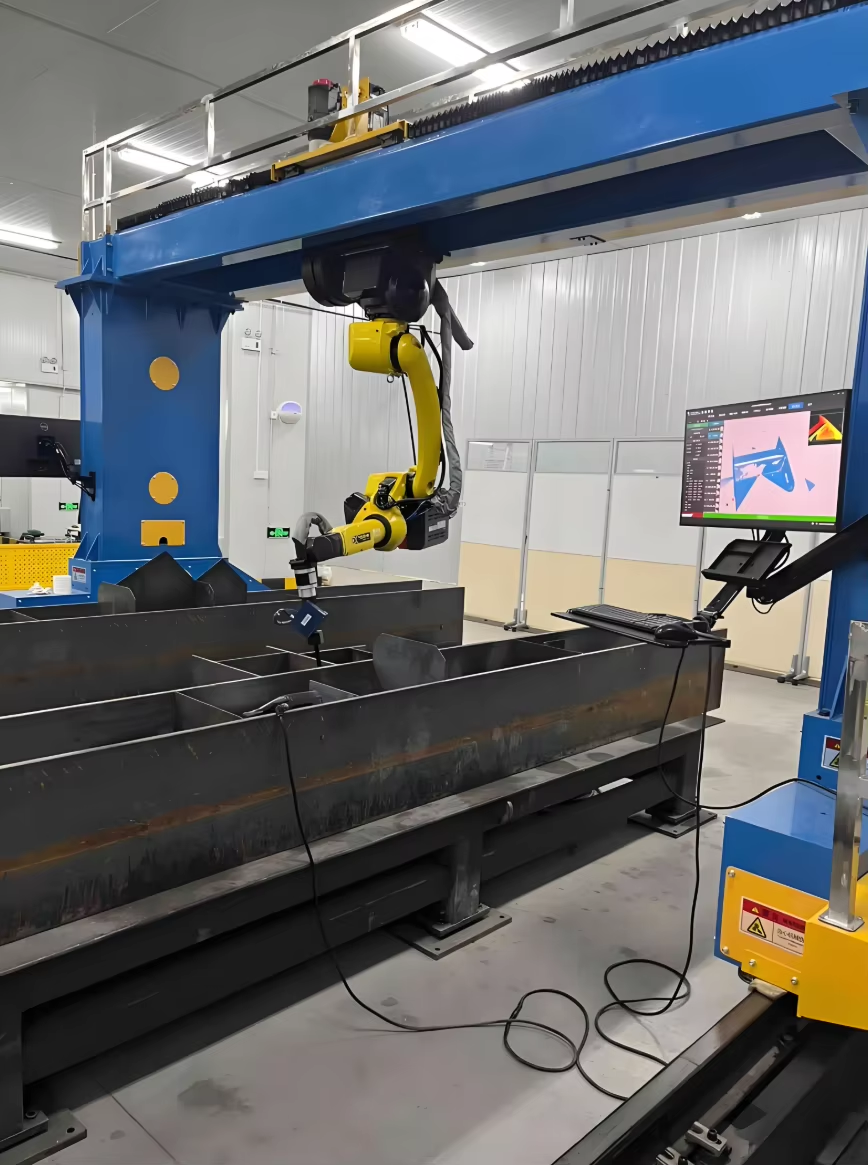
The robotic controller manages the torch angle and travel speed with a level of precision that exceeds manual capabilities. For multi-pass heavy-wall sections, the robot employs adaptive “through-the-arc” seam tracking. This allows the system to compensate for minor variations in groove geometry or thermal distortion in real-time. By maintaining a constant stick-out distance, the system ensures uniform heat input, which is critical for preserving the mechanical properties of the Heat-Affected Zone (HAZ).
Economic Analysis and Labor ROI
The primary driver for shifting to robotic automation in the pressure vessel sector is the measurable Return on Investment (ROI) regarding labor productivity. The global shortage of certified high-pressure welders has driven labor costs upward while reducing the consistency of output. An industrial engineer must view the robotic cell not as a replacement for a welder, but as a force multiplier.
Deposition Rates and Duty Cycles
A manual welder typically operates at a duty cycle of 30% to 40% when considering fatigue, helmet-down time, and repositioning. In contrast, an intelligent robotic welder operates at a duty cycle exceeding 80%. When combined with higher deposition rates—moving from 2-3 kg/h in manual MAG to 6-8 kg/h in tandem-arc or optimized robotic MAG—the throughput per square foot of factory floor space doubles.
ROI calculations should include the reduction in “Repair Rate.” In pressure vessel manufacturing, a 2% failure rate in radiographic testing (RT) is common for manual welding. Each repair requires gouging, re-prepping, and re-welding, which costs approximately five times the initial weld cost. Robotic systems frequently bring the RT failure rate below 0.5%, providing a direct boost to the bottom line that often pays for the robotic arm within 18 to 24 months of operation.
Shifting Labor Competency
The labor ROI is also found in the upskilling of the workforce. Instead of three manual welders, a facility utilizes one “Robotic Operator” and one “Technician.” The operator focuses on jigging and part flow, while the technician manages the zero-tailing technology parameters and program optimization. This reduces the physical strain on workers, leading to lower turnover and reduced workers’ compensation claims related to heat and fume exposure.
Maintenance Protocols for High-Uptime Environments
To sustain the ROI of an automated welding cell, a preventative maintenance (PM) schedule must be strictly enforced. Unlike manual machines, a robot does not “feel” when a liner is wearing out or when the contact tip is eroding. Sensor-based feedback is the engineer’s primary tool for maintenance management.
Consumable Management
The contact tip is the most frequent point of failure. Intelligent systems monitor the “arc hours” and the stability of the current. A sudden increase in voltage fluctuation often indicates tip wear. Automated tip changers can be integrated, but most industrial engineers prefer a scheduled swap every 4-8 hours of arc time, depending on the wire type and current levels. High-quality zirconium-chrome-copper tips are recommended for the high-amperage cycles required for Pressure Vessels.
Wire Feed System and Liners
The zero-tailing mechanism relies on a high-torque, low-inertia motor. Maintenance must focus on the drive rolls and the wire conduit. Dust and metal shavings inside the liner can cause “bird-nesting” or erratic wire feed, which destroys the weld profile. Industrial engineers should mandate the use of compressed air “blow-outs” of the liner every time a new wire drum is loaded. Using 250kg or 500kg bulk drums instead of small spools reduces downtime for changeovers and ensures a more consistent wire cast for the MAG welding head.
Data-Driven Process Control and SEO Integration
Modern Robotic Welding cells function as IoT nodes. Every weld bead produces a data log containing average current, voltage, gas flow, and travel speed. For pressure vessel manufacturers, this provides a digital “birth certificate” for every vessel, simplifying compliance with ASME (American Society of Mechanical Engineers) or similar international standards.
By analyzing this data, industrial engineers can perform bottleneck analysis. For instance, if the robot is waiting for the vessel to be rotated on the positioner, the ROI of the welding power source is being wasted. Optimizing the “arc-on” time through better material handling and multi-station setups ensures that the zero-tailing technology is utilized to its maximum potential. The integration of pressure vessel welding software allows for offline programming, which means the robot remains productive while the next vessel’s weld paths are being calculated on a workstation.
Final Throughput Considerations
The transition to intelligent robotic welding is not merely a hardware upgrade; it is a systemic shift in manufacturing philosophy. By focusing on the MAG process’s stability, the reduction of wire waste through zero-tailing, and the rigorous management of maintenance cycles, manufacturers can achieve a level of consistency that manual processes cannot match. The resulting increase in deposition rates, coupled with the near-elimination of NDT-related rework, positions the facility as a high-margin leader in the global pressure vessel market.
-

Cantilever Welding Robot solution
-

GF laser cutting machine
-

P3015 plasma cutting machine
-

LFP3015 Fiber Laser Cutter
-

pipe plasma cutting machine
-
LFH 4020 Fiber Laser Cutting Machine
-
LFP4020
-

gantry plasma air cutting machine
-

3D robot cutting machine
-

8 axis plasma cutting machine
-

5 axis plasma cutting machine
-

LT360 tube laser cutting machine
-

robot welding workstation
-

SF6060 fiber laser cutting machine
Advanced Fiber Laser Tube Processing Technology
Our CNC Fiber Laser Tube Cutting systems revolutionize metal fabrication by integrating high-precision cutting, punching, and profiling into a single automated workflow. Designed for versatility, this technology handles a wide array of profiles including Round, Square, Rectangular, and Oval tubes, as well as complex L-shaped and U-shaped channels.
- Precision Punching: High-speed hole punching with micron-level accuracy, eliminating the need for mechanical drilling or die-stamping.
- Complex Profiling: Advanced 3D pathing allows for intricate interlocking joints and specialized notch cuts, ideal for structural frames.
- High Material Efficiency: Intelligent nesting software minimizes scrap, reducing raw material costs across large production runs.
- Clean Finish: Delivers oxide-free, burr-free edges that require zero secondary grinding before welding.

Seamlessly processing multiple profiles with consistent precision.
Global Delivery & Logistics



From our high-tech manufacturing facility directly to your global site. PCL WeldCut ensures secure packaging, professional handling, and reliable international logistics to safeguard your equipment throughout the entire journey.
