Intelligent Robotic Welder with Zero-tailing technology for Oil & Gas Tanks

In this article
- Advancing Oil & Gas Tank Fabrication via Intelligent MAG Robotics
- The Mechanics of Zero-Tailing Technology
- MAG Welding Optimization for Heavy Plate Applications
- Improving Arc-On Time and Duty Cycle
- Predictive Maintenance and System Longevity
- Quantitative ROI: Labor Displacement and Throughput Analysis
- Scalability in Tank Farm Construction
- Safety and Environmental Engineering Factors
- Final Engineering Summary
Advancing Oil & Gas Tank Fabrication via Intelligent MAG Robotics
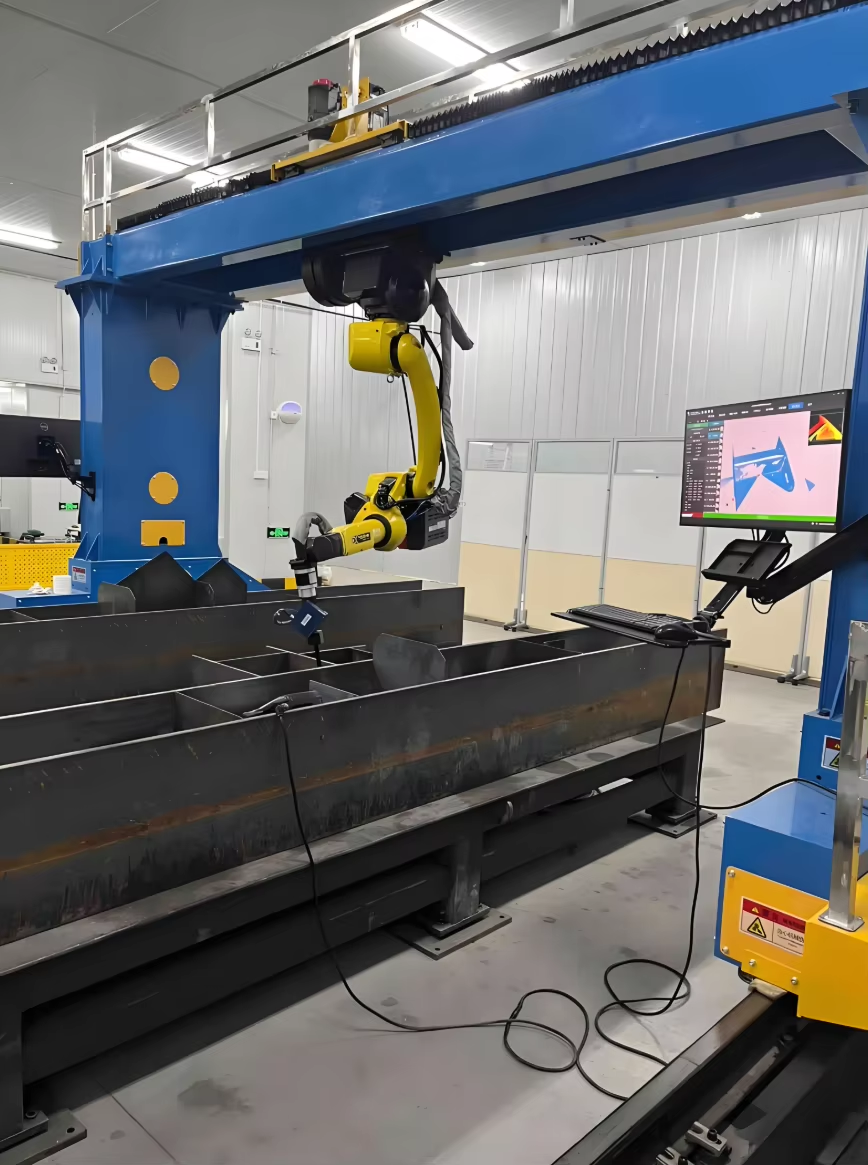
In the heavy fabrication sector, specifically within the constraints of API 650 and 653 standards for Oil & Gas Tanks, the transition from manual Metal Active Gas (MAG) welding to intelligent robotic systems represents a fundamental shift in industrial engineering strategy. The objective is no longer simply “joining metal” but optimizing the deposition rate while minimizing the heat-affected zone (HAZ). Intelligent Robotic Welders utilize advanced sensors and real-time feedback loops to maintain arc stability across long-seam and circumferential welds, which are critical for the structural integrity of high-capacity storage vessels.
The Mechanics of Zero-Tailing Technology
One of the most significant advancements in Robotic Welding is the implementation of zero-tailing technology. In traditional MAG welding, the start and end of a weld bead—the “lead” and “tail”—often suffer from inconsistent penetration, cratering, or excessive wire protrusion. Zero-tailing systems utilize synchronized wire-feed control and crater-fill algorithms that precisely manage the wire retraction and gas post-flow. This ensures that every millimeter of the weld is structurally sound, eliminating the need for secondary grinding or “tie-in” repairs. For an industrial engineer, this translates to a direct reduction in consumable waste and a drastic decrease in the duty cycle interruption caused by manual cleanup of weld terminations.
MAG Welding Optimization for Heavy Plate Applications
The choice of MAG welding for Oil & Gas tanks is driven by the need for high deposition rates and deep penetration in thick carbon steel plates. Intelligent robotic systems enhance this process by modulating the waveform and pulse frequency in real-time. This prevents common defects such as undercut or porosity, which are frequently encountered in manual overhead or vertical-up positions. By digitizing the welding parameters, the robotic system ensures that the intelligent robotic welder maintains a consistent contact-tip-to-work distance (CTWD), even when minor plate irregularities or fit-up gaps are present.
Improving Arc-On Time and Duty Cycle
Manual welding operations in tank farms or fabrication shops typically operate at a 30% to 40% duty cycle due to operator fatigue, repositioning, and electrode/wire changes. In contrast, an automated robotic system can sustain an arc-on time exceeding 85%. By deploying a continuous wire-feed system and high-capacity gas manifolds, the robot minimizes downtime. The industrial engineering focus here is on the reduction of “non-value-added” time. Every minute the arc is not struck represents a loss in throughput; robotics mitigate this by maintaining a steady travel speed that no human operator can replicate over a 12-hour shift.
Predictive Maintenance and System Longevity
Maintenance of a robotic welding cell is a critical component of the total cost of ownership (TCO). Unlike manual torches that are subject to physical abuse, robotic MAG torches are mounted on high-precision arms with collision detection. Maintenance protocols for these systems focus on the wire delivery path and cooling efficiency. Automated torch cleaners (reamers) are integrated into the cell to remove spatter buildup without human intervention, ensuring gas flow remains laminar and the arc remains focused.
Consumable Management and Monitoring
Modern systems incorporate “smart” contact tips and liners that track wire throughput. Data logs provide engineers with predictive indicators; for instance, if the motor torque on the wire feeder increases, it signals a potential blockage in the liner before a bird-nesting event occurs. This shift from reactive to proactive maintenance ensures that the system stays operational during peak production windows, which is essential when deadlines for tank commissioning are tight.
Quantitative ROI: Labor Displacement and Throughput Analysis
The labor ROI for an intelligent robotic welder is calculated by comparing the “burdened labor rate” of skilled welders against the amortized cost of the robotic asset and its energy consumption. In the current market, certified high-pressure welders are in short supply and command high wages. A single robotic unit, operating across two or three shifts, can typically replace the output of three to four manual welders while maintaining a lower defect rate.
Defect Reduction and Rework Costs
In Oil & Gas applications, a single failed radiographic or ultrasonic test (UT) can cost thousands of dollars in rework, involving carbon-arc gouging, re-welding, and re-testing. Robotic systems achieve a first-pass yield often exceeding 99%. By reducing the “Repair Rate” from a typical manual average of 3-5% down to less than 0.5%, the system pays for itself solely through the avoidance of rework costs. This reliability is a cornerstone of the zero-tailing technology value proposition, as it ensures that the most vulnerable parts of the weld (the starts and stops) are as robust as the body of the bead.
Scalability in Tank Farm Construction
For large-scale projects involving multiple 100,000-barrel tanks, scalability is achieved through the standardization of weld procedures (WPS). Once a robotic program is optimized for a specific plate thickness and joint geometry, it can be cloned across multiple units. This ensures “process uniformity,” where the quality of the weld on Tank 1 is identical to the weld on Tank 50. This level of consistency is impossible to achieve with a human workforce of varying skill levels and fatigue points.
Safety and Environmental Engineering Factors
Removing the welder from the immediate vicinity of the arc significantly improves the safety profile of the fabrication site. Reducing exposure to hexavalent chromium (in stainless applications) or general welding fumes and intense UV radiation lowers insurance premiums and improves compliance with health and safety regulations. Furthermore, the efficiency of the MAG process under robotic control reduces the total shielding gas consumption and electrical draw per linear meter of weld, contributing to a more sustainable manufacturing footprint.
Final Engineering Summary
The integration of an intelligent robotic welder with zero-tailing capabilities is not merely an equipment upgrade; it is a strategic overhaul of the welding workflow. By focusing on maintenance predictability, maximizing labor ROI through increased duty cycles, and utilizing zero-tailing technology to eliminate bead-end defects, Oil & Gas firms can ensure their infrastructure is built to the highest standards of safety and efficiency. The shift to automated MAG welding provides the precision required for modern energy demands while securing a significant competitive advantage in fabrication throughput.






