The Engineering Necessity of Automation in LNG Infrastructure
Liquefied Natural Gas (LNG) storage tanks and processing facilities require rigorous structural integrity due to the cryogenic temperatures and volatile nature of the stored media. The primary materials—typically 9% nickel steel or specialized stainless alloys—demand high-precision joining techniques. Traditional manual welding in these sectors faces challenges including welder fatigue, inconsistent bead geometry, and the logistical difficulty of reaching vertical and overhead girth seams. The introduction of the Magnetic Crawler robotic system addresses these variables by providing a stabilized, mobile platform that maintains constant contact with the ferrous substrate, regardless of orientation.
Mechanical Architecture of the Magnetic Crawler
Industrial engineers categorize these robots as specialized mobile platforms designed for high-adhesion maneuverability. The crawler utilizes high-strength permanent magnets or switchable electromagnets integrated into its drive tracks. This design ensures that the gravitational pull acting on the welding payload does not compromise the “stick” force against the tank wall. For LNG applications, the crawler must support a payload including the welding torch, wire feeder, and often a seam-tracking sensor array. The drive system typically employs high-torque stepper motors with closed-loop feedback, allowing for travel speeds that are precisely synchronized with the wire feed speed to maintain a constant heat input.
Optimizing the MAG Welding Process for Cryogenic Service
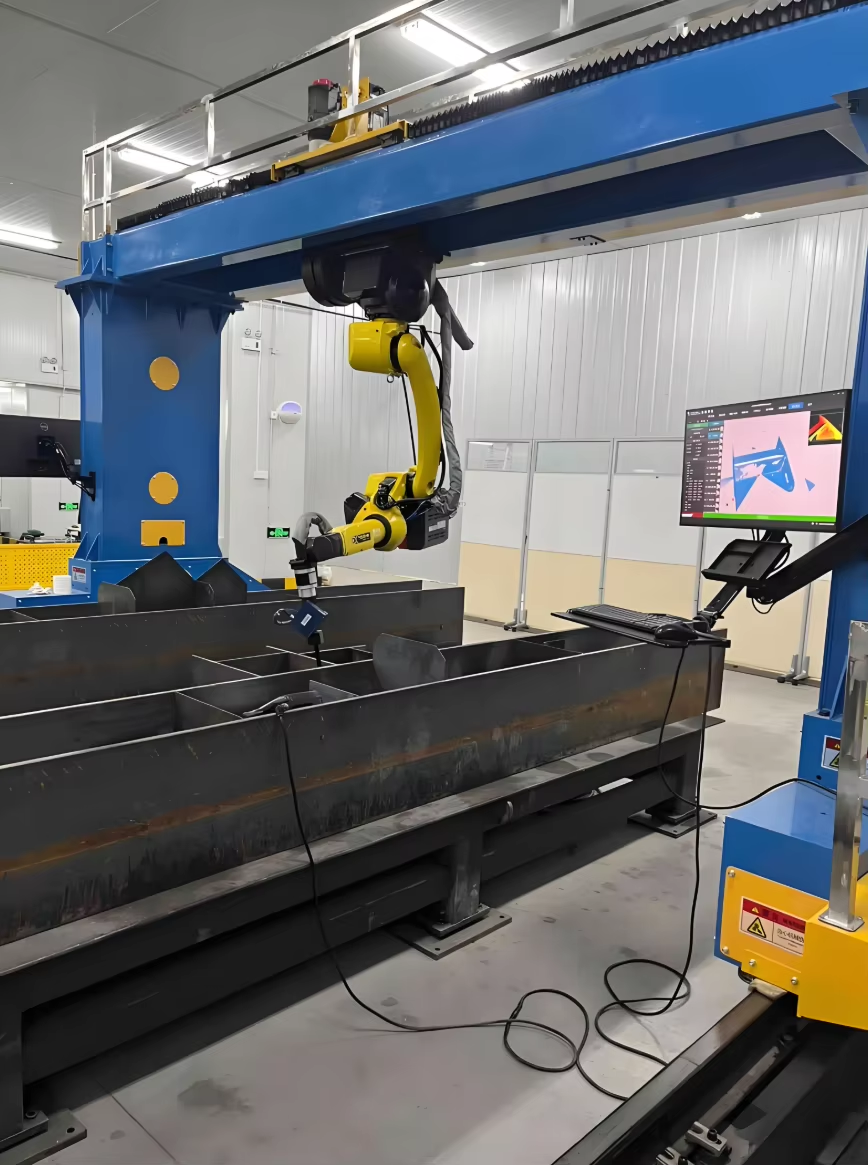
The MAG Welding (Metal Active Gas) process is the preferred modality for robotic crawler integration in LNG projects. Unlike manual shielded metal arc welding (SMAW), MAG provides a continuous electrode feed, which significantly increases the operating duty cycle. In an automated setup, the robot controls the torch angle, stick-out distance, and travel speed with a degree of repeatability that human operators cannot achieve over 12-hour shifts.
Deposition Rates and Heat Input Control
In LNG tank construction, controlling heat input is critical to prevent grain growth in the heat-affected zone (HAZ), which could compromise the fracture toughness of the 9% nickel steel. Intelligent Robotic Welders utilize pulsed-MAG waveforms to optimize the droplet transfer. By modulating the current, the system achieves a stable spray transfer at lower average heat inputs. This precision results in a superior metallurgical profile and reduces the likelihood of lack-of-fusion defects, which are common in manual vertical-up welding. From an engineering standpoint, the deposition rate increases from approximately 1.5 kg/hr in manual processes to over 4 kg/hr in automated crawler configurations.
Intelligent Sensing and Real-Time Adaptive Control
The “intelligence” of the robotic welder is derived from its integrated sensor suite. LNG tanks are rarely perfectly uniform; slight variations in gap width or plate alignment (fit-up) can lead to weld failure. Modern crawlers utilize through-the-arc sensing (TASC) or laser-based vision systems to monitor the joint geometry in real-time. If the sensor detects a wider gap, the robot’s controller automatically adjusts the weave width and travel speed. This Weld Integrity management reduces the reliance on post-weld rework, which is exponentially more expensive than getting the pass right the first time.
Maintenance Protocols for High-Utilization Robotics
To maintain peak operational efficiency, industrial maintenance schedules for robotic crawlers must be strictly enforced. Because these machines operate in proximity to the high-heat arc and in potentially dusty construction environments, component wear is accelerated. Maintenance is divided into three tiers: daily operational checks, weekly mechanical calibration, and monthly system overhauls.
Component-Specific Maintenance Requirements
The wire drive assembly requires the most frequent attention. Feed rollers must be inspected for groove wear to prevent wire slipping, which causes arc instability. The magnetic tracks require cleaning to remove metallic dust and slag buildup that could interfere with the magnetic flux and reduce adhesion. Furthermore, the umbilical cables—carrying power, shielding gas, and data—must be checked for sheath integrity to prevent signal interference or gas leaks. Implementing a predictive maintenance strategy using the robot’s onboard diagnostics can reduce unscheduled downtime by identifying motor torque anomalies before a total failure occurs.
Quantifying Labor ROI and Economic Impact
The primary driver for adopting robotic crawlers in LNG projects is the Labor ROI. The global shortage of certified high-pressure vessel welders has driven labor costs to record highs. An industrial engineering analysis of manual vs. Robotic Welding reveals a significant shift in cost structure. While the initial capital expenditure (CAPEX) for a robotic crawler is high, the reduction in operational expenditure (OPEX) is substantial.
Comparative Analysis of Productivity
A single robotic operator can often supervise two or three crawler units simultaneously. In a manual environment, three welders would be required, plus three assistants for grinding and cable management. The robot achieves a duty cycle (arc-on time) of 70-85%, compared to 25-35% for manual welders who require breaks, repositioning, and setup time. When calculating the cost per meter of weld, the robotic system typically pays for itself within the first 18 months of a major LNG tank project. This calculation includes the drastic reduction in Non-Destructive Testing (NDT) failures; whereas manual welding may see a 5-8% repair rate, intelligent crawlers frequently operate at less than 1%.
Safety and Ergonomic Risk Mitigation
Beyond the direct financial metrics, the crawler system removes the human welder from hazardous positions. Welding the upper courses of an LNG tank requires working at significant heights or in confined spaces. By using a magnetic crawler, the technician remains on a stable platform or on the ground, controlling the unit via a pendant or remote interface. This reduces the risk of falls and respiratory issues associated with long-term exposure to welding fumes. From an insurance and liability perspective, this risk transition further improves the project’s bottom line.
Conclusion: The Future of LNG Construction
The integration of intelligent robotic welders with Magnetic Crawler technology represents a fundamental shift in how large-scale energy infrastructure is built. By focusing on MAG process optimization, rigorous maintenance, and the clear Labor ROI offered by high-duty-cycle automation, firms can deliver LNG projects faster and with higher structural reliability. The transition from manual labor to “operator-as-manager” of robotic systems is no longer an optional upgrade but a requirement for competitiveness in the global industrial landscape.
-


Cantilever Welding Robot solution
-


GF laser cutting machine
-

P3015 plasma cutting machine
-

LFP3015 Fiber Laser Cutter
-

pipe plasma cutting machine
-
LFH 4020 Fiber Laser Cutting Machine
-
LFP4020
-

gantry plasma air cutting machine
-

3D robot cutting machine
-

8 axis plasma cutting machine
-

5 axis plasma cutting machine
-

LT360 tube laser cutting machine
-

robot welding workstation
-

SF6060 fiber laser cutting machine
