Intelligent Robotic Welder with Laser Seam Tracking for Shipbuilding

In this article
Optimizing Shipbuilding Throughput via Robotic MAG Integration
In the heavy industrial environment of a shipyard, the welding of hull blocks and stiffeners represents the highest concentration of labor hours and the most significant bottleneck in the production timeline. Traditional manual welding, while flexible, suffers from inconsistent duty cycles and human fatigue, particularly when executing long-stretching fillet welds in the Metal Active Gas (MAG) format. The shift toward intelligent Robotic Welding systems is not merely a technological upgrade but a fundamental change in production engineering. By utilizing robotic arms capable of 100% duty cycles, shipbuilders can achieve a level of consistency that manual operators cannot maintain over an eight-hour shift.
The primary challenge in shipbuilding automation is the lack of uniformity in large-scale steel assemblies. Unlike the automotive industry, where parts are stamped with sub-millimeter precision, shipyard plates often exhibit thermal distortion and fit-up gaps. This is where laser seam tracking becomes critical. The system uses a structured light sensor to scan the joint geometry milliseconds ahead of the welding arc. This data allows the robot controller to make real-time adjustments to the torch position and the weld parameters, ensuring that the arc remains centered in the groove despite variations in the seam path.
Technical Mechanism of Laser Seam Tracking
Laser seam tracking functions as the “eyes” of the robotic system, providing a closed-loop feedback mechanism. In a standard MAG setup, the robot follows a pre-programmed path. However, if the workpiece is misaligned by even three millimeters, the weld bead may miss the root entirely, leading to catastrophic structural failure. The intelligent welder utilizes a triangulation-based laser sensor to calculate the profile of the joint. This system identifies the root point, the groove angle, and the gap width.
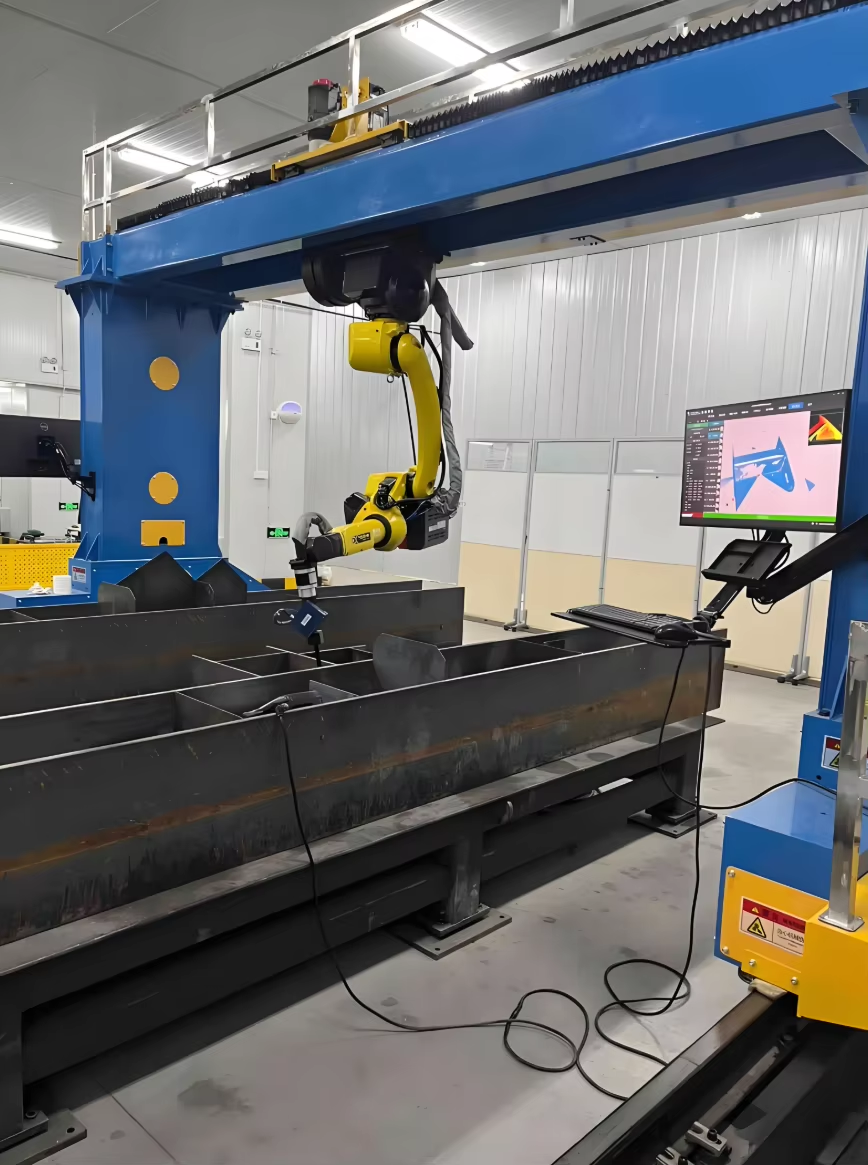
For industrial engineers, the value lies in the adaptive welding capabilities. When the sensor detects a wider gap, the system can automatically adjust the wire feed speed, travel speed, and oscillation width to ensure proper fusion and reinforcement. This level of autonomy reduces the need for constant operator intervention and allows a single technician to oversee multiple robotic cells, significantly increasing the square footage of completed weld metal per man-hour.
Maintenance Protocols for High-Uptime Robotic Cells
The reliability of a robotic welding system is predicated on a rigorous preventive maintenance schedule. Because shipbuilding involves high-amperage MAG welding, the environment is characterized by heavy spatter and high thermal radiation. The robotic torch and the laser tracking sensor are the most vulnerable components. To maintain operational availability, maintenance programs must focus on three primary areas: the wire delivery system, the sensor optics, and the mechanical linkages of the robot.
Consumable Management and Torch Maintenance
The contact tip and gas nozzle require frequent inspection. Spatter buildup can obstruct gas flow, leading to porosity in the weld bead. Automated reaming stations, also known as “torch cleaners,” should be integrated into the robotic cell. These stations mechanically clean the nozzle and apply anti-spatter spray at programmed intervals. Liners must be replaced based on the volume of wire consumed to prevent friction-related feeding issues that cause arc instability.
Sensor Protection and Calibration
The laser seam tracker is an optical instrument operating in a harsh environment. It must be protected by a pressurized air curtain or a sacrificial clear shield to prevent spatter from etching the lens. Monthly calibration checks are required to ensure the coordinate system of the sensor remains aligned with the TCP (Tool Center Point) of the welding torch. Any deviation here results in a systematic offset that compromises weld integrity.
Mechanical and Controller Maintenance
The robotic arm itself requires lubrication of the axes and inspection of the wire harness. In shipbuilding, the robot often moves along long rails or gantry systems. These external axes must be checked for alignment to prevent vibration, which the laser sensor might interpret as joint geometry changes, leading to erratic torch movement.
Labor ROI and Economic Impact Analysis
The transition to robotic MAG welding is often scrutinized through the lens of Capital Expenditure (CAPEX) versus Operating Expenditure (OPEX). However, a true industrial engineering assessment focuses on the labor ROI derived from increased deposition rates and decreased defect rates. Manual MAG welding in a shipyard typically sees an “arc-on” time of 25% to 30% due to the need for repositioning, breaks, and joint preparation. A robotic system can easily achieve an arc-on time of 70% to 85%.
When calculating ROI, the following factors must be quantified:
1. Deposition Efficiency: Robotic systems can operate at higher currents and travel speeds than manual welders without sacrificing quality. This results in more kilograms of weld metal deposited per hour.
2. Rework Reduction: In shipbuilding, the cost of gouging out a defective weld and re-welding is approximately four times the cost of the initial weld. The precision of laser-guided systems reduces the defect rate to near zero, eliminating the secondary costs of NDT (Non-Destructive Testing) failures.
3. Skill Shift: The labor requirement moves from a “welder” to a “robotic operator.” While the hourly rate for a technician may be higher, the productivity multiplier—where one operator manages three robots—drastically lowers the cost per unit of production.
Furthermore, the long-term ROI is realized through the stabilization of the production schedule. Human factors, such as labor shortages in the skilled trades, create volatility in shipyard delivery dates. Robots provide a predictable throughput rate, allowing project managers to schedule block assembly with high degrees of accuracy.
Integrating Intelligence: The Future of MAG Operations
The “intelligence” in these systems refers to the software’s ability to log data for every centimeter of the weld. This data logging creates a digital twin of the ship’s structural integrity. By recording the voltage, current, and travel speed alongside the laser-scanned geometry, shipbuilders can provide 100% traceability for class societies and regulatory bodies. This reduces the administrative burden of quality assurance and provides a feedback loop for continuous process improvement.
Industrial engineers must also consider the ergonomics of the workspace. By delegating the most strenuous and hazardous welding tasks—such as those in confined spaces or involving long overhead fillets—to robotic systems, the shipyard improves the safety profile of the facility. This leads to lower insurance premiums and higher worker retention, which are indirect but significant contributors to the overall ROI of the automation investment.
Conclusion
The implementation of intelligent robotic MAG welding with Laser Seam Tracking is a strategic necessity for modern shipbuilding. The ability to compensate for real-world material variations through automated tracking ensures that the high-speed benefits of robotics are not negated by fit-up errors. While the initial investment is substantial, the combination of increased deposition rates, rigorous maintenance-driven uptime, and the optimization of human capital ensures a rapid return on investment. For the industrial engineer, the goal is clear: transform the welding process from a manual craft into a controlled, high-output manufacturing system.






