Advanced Integration of 5-Axis Robotic MAG Welding in Tank Construction
In the demanding sector of Oil & Gas tank fabrication, the transition from semi-automatic to fully automated MAG welding is no longer a luxury but a fundamental requirement for maintaining competitive throughput. The structural integrity of high-pressure storage vessels depends entirely on the consistency of the weld bead and the depth of penetration. Intelligent Robotic Welders utilizing 5-axis movement provide the necessary dexterity to handle large-scale circumferential and longitudinal seams with a level of precision that manual operators cannot maintain over a 10-hour shift.
Unlike standard 3-axis systems, a 5-axis robotic configuration allows the welding torch to maintain an optimal lead angle and work angle relative to the joint geometry. In tank fabrication, where plates are often thick and require multi-pass welds, the ability of the robot to adjust its orientation in real-time ensures that the arc energy is directed precisely into the root of the bevel. This minimizes defects such as lack of side-wall fusion and porosity, which are common in manual operations due to operator fatigue and inconsistent torch positioning.
The Technical Advantage of 5-Axis Torch Manipulation
The “intelligent” component of these systems refers to the integration of seam tracking and adaptive control algorithms. for Oil & Gas Tanks, which may have slight dimensional variances due to plate rolling tolerances, the robot uses through-arc sensing or tactile probing to find the start point and track the joint during the welding process. The 5-axis capability is critical here; it allows the system to compensate for “high-low” fit-up issues by dynamically tilting the torch to redistribute the weld pool.
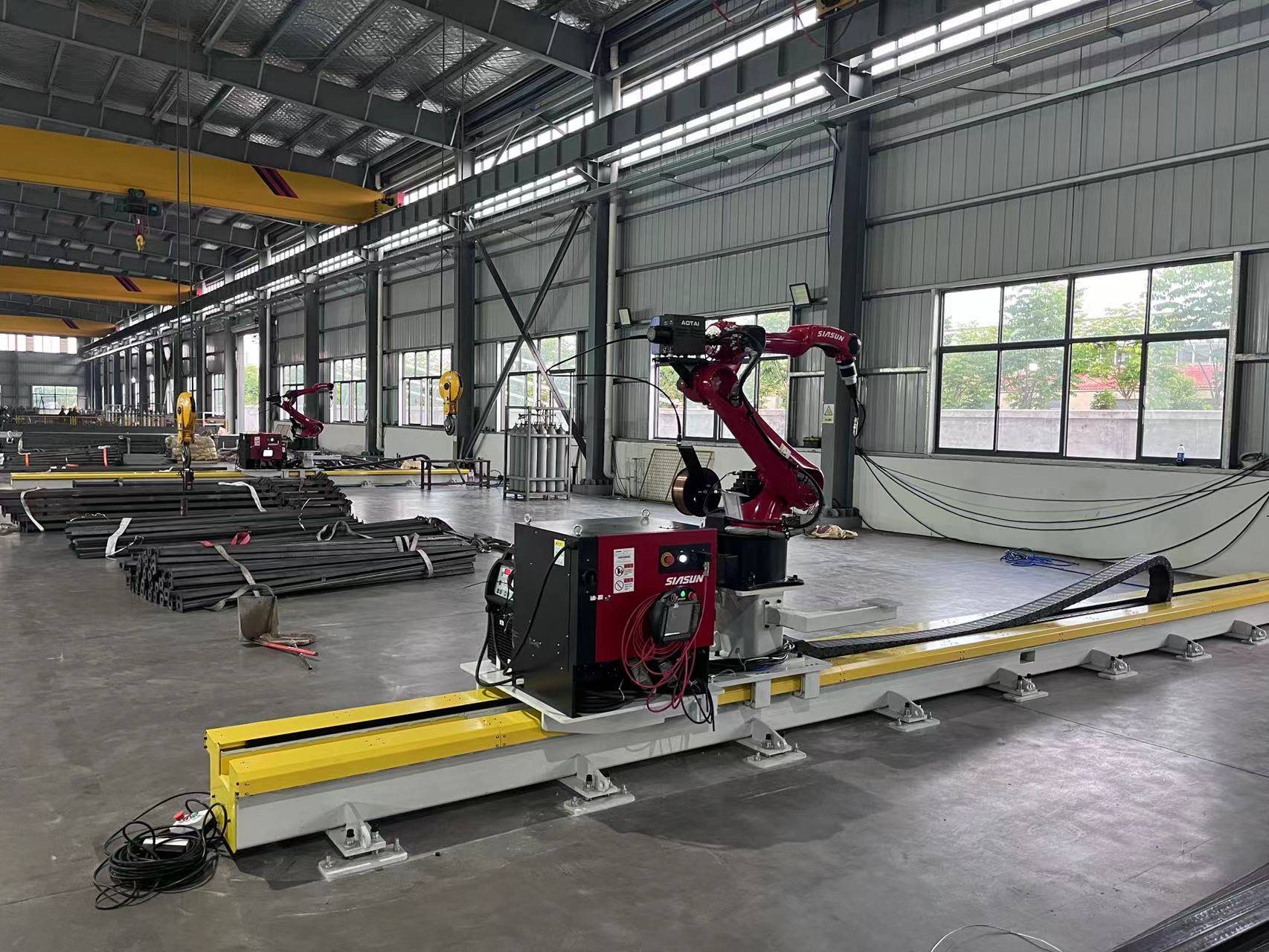
By utilizing 5-axis robotic beveling maneuvers—specifically for welding into pre-prepared V, U, or J-grooves—the system optimizes the deposition rate. The Metal Active Gas (MAG) process, typically using a mixture of Argon and CO2, benefits from this stability. A stable arc length maintained by the robot results in reduced spatter and a more uniform heat-affected zone (HAZ), which is vital for the metallurgical properties of the tank steel, particularly in low-temperature or sour-service environments.
MAG Process Parameters and Deposition Efficiency
Industrial engineers must focus on the “arc-on time” as the primary metric for efficiency. In manual MAG welding, the duty cycle rarely exceeds 30-40% due to the need for repositioning, cleaning, and operator breaks. A robotic system, however, can achieve duty cycles of 75-85%. By optimizing wire feed speeds and voltage settings within the robot’s synergic power source, we can maximize the pounds-per-hour of filler metal deposited.
For thick-walled Oil & Gas tanks, the robot can be programmed for multi-pass sequences where the 5-axis head adjusts the weave pattern for the root, hot, fill, and cap passes. This consistency ensures that the volumetric fill of the groove is precise, reducing the over-welding that often occurs in manual processes. Over-welding not only wastes expensive filler wire and shielding gas but also introduces unnecessary heat into the base metal, potentially compromising the structural grain profile.
Labor ROI and Economic Impact Analysis
The financial justification for an intelligent robotic welder is built on three pillars: labor displacement, consumable savings, and rework elimination. In current market conditions, skilled welders certified for API 650 or 653 standards are scarce and command high wages. A robotic cell allows a single operator—who does not necessarily need the manual dexterity of a master welder—to oversee two or more robotic stations.
Welding labor ROI is calculated by comparing the cost-per-foot of weld. When factoring in the speed of a 5-axis robot (which can weld up to 2-3 times faster than a human when considering non-stop operation), the payback period typically falls between 18 to 24 months. Furthermore, the reduction in weld rejection rates is a significant cost saver. In manual tank welding, repair rates of 3-5% are common. Robots frequently bring this down to less than 0.5%. Given that the cost of repairing a rejected weld in a pressure vessel can be ten times the cost of the initial weld, the impact on the bottom line is immediate.
Rigorous Maintenance Protocols for High Uptime
To protect the investment, a preventative maintenance (PM) schedule is mandatory. Robotic MAG systems operate in harsh environments filled with metallic dust and heat. The maintenance focus must be on the wire delivery system and the torch components.
Key maintenance tasks include:
- Contact Tip Replacement: Automated systems wear tips faster due to higher duty cycles; use of high-quality chrome-zirconium copper tips is recommended.
- Liner Cleaning: The wire conduit should be blown out with compressed air every 24 hours of operation to prevent bird-nesting and feed motor strain.
- Cable Management: The 5-axis movement puts torsional stress on the torch lead. Daily inspections for jacket wear prevent unexpected grounding issues.
- Reamer Station Maintenance: The automated nozzle cleaning station (reamer) must be checked for anti-spatter fluid levels and blade sharpness to ensure the gas shroud remains clear.
Implementing tank fabrication efficiency strategies requires that the robot’s calibration (TCP – Tool Center Point) is verified weekly. If the TCP shifts by even a millimeter due to a minor collision or heat expansion, the 5-axis trajectory will be off, leading to off-center beads and potential fusion defects.
Standardization and Scalability
As production scales, the data collected by the intelligent welder’s controller provides a feedback loop for industrial engineers. By monitoring parameters like average current and gas flow per tank, management can predict material requirements with 98% accuracy. This level of data-driven manufacturing transforms the welding shop from a traditional craft-based operation into a precision engineering facility.
Conclusion
The deployment of a 5-axis robotic MAG welding system for Oil & Gas tanks represents a strategic shift toward high-margin manufacturing. By prioritizing precision torch manipulation and robust process control, manufacturers can achieve superior weld quality while drastically reducing the cost-per-joint. The success of this technology hinges on the disciplined application of maintenance protocols and a clear understanding of the ROI metrics associated with automated arc-on time.
-

Cantilever Welding Robot solution
-

GF laser cutting machine
-

P3015 plasma cutting machine
-

LFP3015 Fiber Laser Cutter
-

pipe plasma cutting machine
-
LFH 4020 Fiber Laser Cutting Machine
-
LFP4020
-

gantry plasma air cutting machine
-

3D robot cutting machine
-

8 axis plasma cutting machine
-

5 axis plasma cutting machine
-

LT360 tube laser cutting machine
-

robot welding workstation
-

SF6060 fiber laser cutting machine
Advanced Fiber Laser Tube Processing Technology
Our CNC Fiber Laser Tube Cutting systems revolutionize metal fabrication by integrating high-precision cutting, punching, and profiling into a single automated workflow. Designed for versatility, this technology handles a wide array of profiles including Round, Square, Rectangular, and Oval tubes, as well as complex L-shaped and U-shaped channels.
- Precision Punching: High-speed hole punching with micron-level accuracy, eliminating the need for mechanical drilling or die-stamping.
- Complex Profiling: Advanced 3D pathing allows for intricate interlocking joints and specialized notch cuts, ideal for structural frames.
- High Material Efficiency: Intelligent nesting software minimizes scrap, reducing raw material costs across large production runs.
- Clean Finish: Delivers oxide-free, burr-free edges that require zero secondary grinding before welding.

Seamlessly processing multiple profiles with consistent precision.
Global Delivery & Logistics



From our high-tech manufacturing facility directly to your global site. PCL WeldCut ensures secure packaging, professional handling, and reliable international logistics to safeguard your equipment throughout the entire journey.
