Optimizing Wind Tower Production via Robotic MAG Welding
In the heavy fabrication industry, wind tower production represents a unique challenge due to the massive scale of components and the stringent structural integrity requirements. The fabrication of tower sections involves the welding of thick-walled cylindrical cans, typically using Metal Active Gas (MAG) welding. Traditional manual or semi-automatic methods often suffer from inconsistencies in penetration and bead geometry, leading to costly rework. The introduction of Intelligent Robotic Welders equipped with 3D Vision positioning transforms this process from a labor-intensive bottleneck into a high-throughput automated workflow.
The Role of 3D Vision in Adaptive Welding
3D vision positioning systems serve as the sensory input for the robotic controller, allowing for real-time adjustments to the welding path. In wind tower fabrication, the fit-up of large-diameter sections is rarely perfect. Variations in root gaps, groove angles, and tack weld placements are common. A 3D sensor scans the joint ahead of the arc, creating a high-resolution point cloud of the seam.
The robotic system uses this data to perform adaptive welding. If the vision system detects a wider-than-expected gap, the controller automatically adjusts the wire feed speed, travel speed, and torch oscillation amplitude to ensure full penetration without burn-through. This eliminates the need for manual pre-welding measurements and allows the robot to maintain a consistent heat input, which is critical for preserving the metallurgical properties of the high-strength steel used in wind segments.
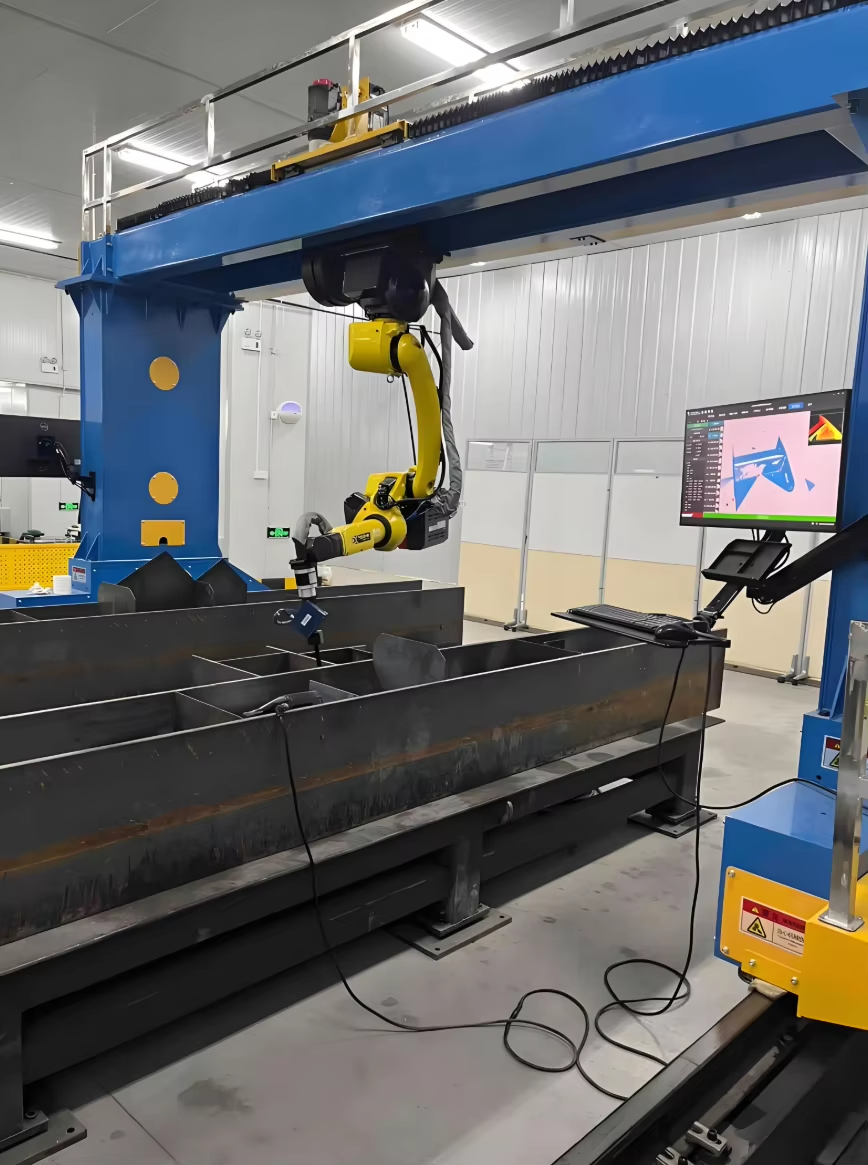
MAG Process Parameters for Thick-Plate Steel
The MAG process, utilizing a shielding gas mixture of Argon and CO2, is the preferred method for the girth and longitudinal seams of wind towers. To achieve the required deposition rates, these robotic cells often utilize high-current spray transfer modes or pulsed-arc technologies.
Robotic integration allows for the use of larger diameter wires (1.2mm to 1.6mm) at higher duty cycles than a human operator can sustain. While a manual welder might achieve a duty cycle of 30-40%, a robotic cell consistently operates at 85-90%. This increase in “arc-on” time directly translates to more kilograms of weld metal deposited per hour. Furthermore, the robot’s ability to maintain a constant contact-tip-to-work distance (CTWD) ensures a stable arc, which reduces spatter and minimizes post-weld cleaning requirements.
Managing Heat Input and Interpass Temperatures
Large-scale welding requires careful management of heat input to prevent distortion and maintain the Charpy V-notch toughness of the heat-affected zone (HAZ). Intelligent robots can be programmed with interpass temperature constraints. If a section exceeds the maximum allowable temperature, the system can autonomously shift to a different segment of the tower or pause until the sensor indicates the material has cooled to the required threshold. This level of process control is difficult to manage manually across three shifts but is standard for vision-integrated robotics.
Maintenance Protocols for Robotic Welding Cells
To maintain peak operational efficiency, a rigorous preventive maintenance schedule is mandatory. Unlike manual equipment, robotic welding torches are subject to high-speed movements and continuous thermal loads.
Torch and Consumable Management
The contact tip is the most frequent point of failure. In a robotic setup, an automated tip-changing station or a reaming station is used to clear spatter and apply anti-spatter liquid every few cycles. The wire conduit or liner must also be inspected weekly for debris buildup, which can cause erratic wire feeding and arc instability. Maintenance engineers must prioritize the calibration of the 3D vision sensor, ensuring that the optical windows are clean and that the sensor-to-tool-center-point (TCP) offset remains accurate within sub-millimeter tolerances.
Systemic Preventive Maintenance
Beyond the torch, the robot’s axes and the cable bundle (the dress pack) require inspection for wear. In wind tower fabrication, the robot often moves along long linear tracks. These tracks must be lubricated and checked for alignment to prevent vibrations that could interfere with the 3D vision’s scanning accuracy. By implementing a scheduled 2000-hour grease change and daily calibration checks, facilities can achieve a Mean Time Between Failures (MTBF) that supports 24/7 production cycles.
Labor ROI and Economic Impact
The primary driver for adopting robotic welding in wind tower plants is the Return on Investment (ROI) derived from labor optimization. The global shortage of certified high-pressure welders has driven labor costs upward. A single robotic welding cell can typically perform the work of three to four manual welders per shift when accounting for the increased deposition rate and the elimination of human fatigue.
Total Cost of Ownership (TCO) Analysis
While the initial capital expenditure (CAPEX) for a 3D-vision-equipped robot is significant, the TCO over a five-year period is lower than maintaining a manual workforce for the same output. ROI is calculated not just through labor replacement, but through the drastic reduction in “scrap and rework.” In wind towers, a single subsurface defect in a 40mm thick weld requires hours of carbon-arc gouging, grinding, and re-welding. Robotic systems with vision tracking reduce defect rates from an industry average of 3-5% down to less than 0.5%.
Workforce Upskilling
Implementing robotics does not necessarily eliminate the need for personnel; rather, it shifts the labor requirement from manual welders to robotic technicians. These operators focus on supervising the 3D vision parameters, managing consumables, and analyzing weld data for continuous improvement. This transition increases the plant’s overall competency and reduces the physical strain on workers, leading to better employee retention in high-demand manufacturing environments.
Conclusion: The Future of Heavy Fabrication
The integration of 3D vision positioning with robotic MAG welding represents the current benchmark for throughput and quality in wind tower fabrication. By automating the most demanding aspects of the welding process, manufacturers can guarantee structural reliability while significantly shortening production timelines. As the wind energy sector continues to scale toward larger turbines and taller towers, the precision and repeatability provided by intelligent robotic systems will be the deciding factor in maintaining global competitiveness.
-

Cantilever Welding Robot solution
-

GF laser cutting machine
-

P3015 plasma cutting machine
-

LFP3015 Fiber Laser Cutter
-

pipe plasma cutting machine
-
LFH 4020 Fiber Laser Cutting Machine
-
LFP4020
-

gantry plasma air cutting machine
-

3D robot cutting machine
-

8 axis plasma cutting machine
-

5 axis plasma cutting machine
-

LT360 tube laser cutting machine
-

robot welding workstation
-

SF6060 fiber laser cutting machine
Advanced Fiber Laser Tube Processing Technology
Our CNC Fiber Laser Tube Cutting systems revolutionize metal fabrication by integrating high-precision cutting, punching, and profiling into a single automated workflow. Designed for versatility, this technology handles a wide array of profiles including Round, Square, Rectangular, and Oval tubes, as well as complex L-shaped and U-shaped channels.
- Precision Punching: High-speed hole punching with micron-level accuracy, eliminating the need for mechanical drilling or die-stamping.
- Complex Profiling: Advanced 3D pathing allows for intricate interlocking joints and specialized notch cuts, ideal for structural frames.
- High Material Efficiency: Intelligent nesting software minimizes scrap, reducing raw material costs across large production runs.
- Clean Finish: Delivers oxide-free, burr-free edges that require zero secondary grinding before welding.

Seamlessly processing multiple profiles with consistent precision.
Global Delivery & Logistics



From our high-tech manufacturing facility directly to your global site. PCL WeldCut ensures secure packaging, professional handling, and reliable international logistics to safeguard your equipment throughout the entire journey.
