Technical Integration of 3D Vision in Heavy-Duty MAG Welding
In the Oil & Gas sector, the structural integrity of storage tanks is non-negotiable. Traditional manual welding of large-scale tanks presents significant ergonomic challenges and variability in weld quality. The introduction of Intelligent Robotic Welder systems utilizes 3D vision positioning to bridge the gap between automated repeatability and the environmental unpredictability of field-erected or shop-fabricated tanks.
The core of this technology lies in the 3D vision sensor, typically a structured light or laser profile scanner mounted on the robot’s faceplate. Unlike standard 2D cameras, 3D sensors generate a high-resolution point cloud that identifies the exact geometry of the weld groove. In Oil & Gas applications, where plate fit-up for large-diameter tanks often involves gaps and offsets beyond standard tolerances, the 3D vision system performs real-time adaptive sensing. It calculates the cross-sectional area of the joint and adjusts the robot’s trajectory and welding parameters—such as travel speed and wire feed rate—on the fly.
The MAG Process: Optimization for Thick-Plate Carbon Steel
Metal Active Gas (MAG) welding remains the industry standard for tank construction due to its high deposition rates and deep penetration capabilities. When coupled with an intelligent robotic arm, the MAG process evolves from a manual task into a precision-engineered operation. The robotic controller manages the Seam Tracking algorithm, ensuring that the arc remains perfectly centered in the root of the joint, regardless of thermal distortion.
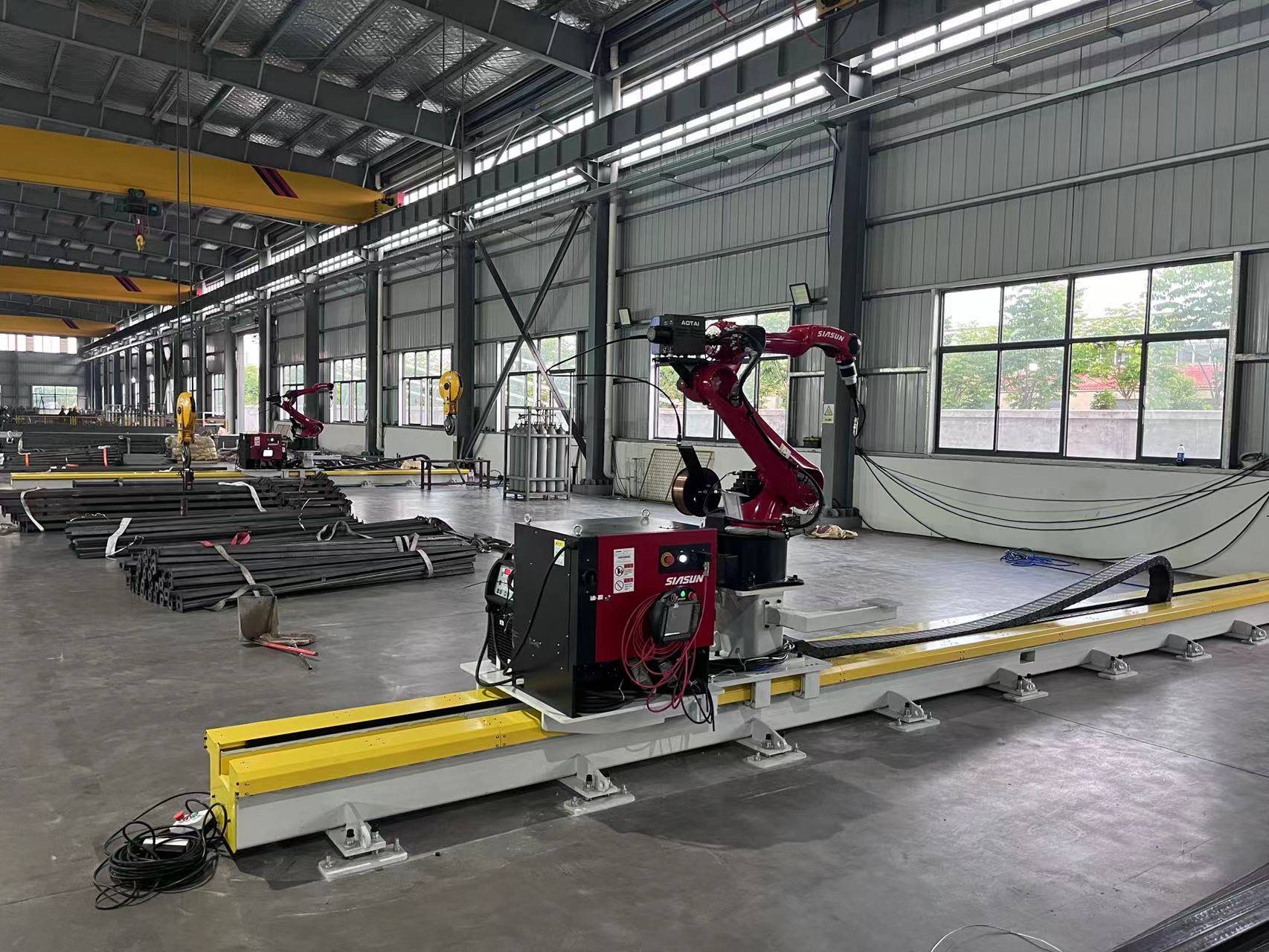
For vertical-up and horizontal girth welds on storage tanks, the robotic system employs advanced waveform control. Pulsed-MAG profiles are utilized to manage the heat input, minimizing the Heat Affected Zone (HAZ) and reducing the risk of burn-through on thinner tank shells. By precisely controlling the droplet transfer, the robotic system achieves a spatter-free finish, which significantly reduces post-weld cleaning time—a critical factor in overall project throughput.
Overcoming Geometric Variability in Tank Construction
Large-scale energy infrastructure components rarely exhibit perfect fit-up. Thermal expansion, gravity-induced sagging of large plates, and tack-welding inaccuracies create a dynamic environment. A static robotic program would fail under these conditions. However, 3D vision positioning allows for “Look-Ahead” sensing. As the robot progresses along the seam, the sensor scans the path millimeters ahead of the arc.
This data is fed into the motion controller to compensate for “workpiece wander.” If the vision system detects a narrowing in the V-groove, it can automatically increase the travel speed or adjust the oscillation width to prevent over-filling. This level of autonomy ensures that every inch of the weld meets API 650 or 653 standards, which are rigorous benchmarks for Oil & Gas tank construction and repair.
Labor ROI: Quantifying the Shift from Manual to Automated
The primary driver for robotic adoption is the Labor ROI. The global shortage of certified high-pressure welders has driven labor costs to an all-time high. A manual welder typically maintains an “arc-on” time of 20% to 30% due to fatigue, repositioning, and environmental breaks. In contrast, an intelligent robotic cell can achieve arc-on times exceeding 75%.
Comparative Analysis of Throughput
In a standard 10-hour shift, a manual welder may complete 15 linear meters of high-quality MAG welding on a storage tank. A 3D vision-guided robot, operating with optimized parameters and continuous wire feeding, can often double or triple this output. The ROI is calculated not just by the speed of the weld, but by the elimination of “repair cycles.” In manual operations, the rework rate for X-ray quality welds can range from 3% to 5%. Robotic systems, once calibrated, reduce this rate to less than 0.5%, saving thousands of dollars in grinding, re-welding, and re-testing costs.
Maintenance Cycles and System Longevity
Industrial engineers must account for the Maintenance requirements of Robotic Welding systems to ensure long-term reliability. Unlike manual torches, robotic MAG torches are subject to constant high-duty cycles. Preventive maintenance schedules focus on three primary areas: the wire delivery system, the 3D sensor protection, and the robotic joints.
Consumable Management
The contact tip and gas nozzle are the most frequently replaced items. Automated nozzle cleaning stations are integrated into the robotic cell to perform mechanical reaming and anti-spatter injection every 30 to 60 minutes of arc time. This ensures consistent gas coverage and prevents arc instability.
Vision System Protection
The 3D vision sensor is the most sensitive component. It is typically protected by a high-speed air curtain and replaceable protective windows to prevent weld spatter and smoke from clouding the optics. In Oil & Gas environments, where dust and humidity are prevalent, the sensor housing must be rated at least IP67. Scheduled inspection of these protective layers is vital to prevent “vision drift,” which could lead to seam tracking errors.
Strategic Deployment in Tank Repair and Maintenance
Beyond new construction, intelligent robotic welders are increasingly deployed for the maintenance of existing Oil & Gas assets. Tank floor replacement and shell patch welding are hazardous tasks involving confined spaces. Deploying a robotic crawler equipped with 3D vision and a MAG torch removes the human operator from the immediate danger zone.
The robot can be programmed to perform “scan-then-weld” routines. First, it maps the corroded area that has been prepared for repair. Then, it generates a custom toolpath to fill the excavated area with a precise amount of filler metal, maintaining the structural integrity of the vessel. This digital record of the weld path and parameters also serves as an automated “as-built” report for regulatory compliance, providing a level of traceability that manual welding cannot match.
Technical Conclusion for Industrial Planning
Implementing a 3D vision-positioned robotic MAG welder is a capital-intensive decision that requires a focus on process integration rather than just hardware acquisition. The success of the system depends on the synergy between the vision algorithms and the power source’s ability to respond to command changes. For the Oil & Gas industry, the transition to automated welding is a strategic imperative. It addresses the volatility of the labor market and elevates the quality of critical infrastructure.
By focusing on Duty Cycle optimization and minimizing the variance inherent in manual processes, firms can realize a full return on investment within 18 to 24 months, depending on the volume of fabrication. As the industry moves toward more complex storage solutions, the precision afforded by 3D vision will become the baseline for all high-pressure welding operations.
-


Cantilever Welding Robot solution
-


GF laser cutting machine
-

P3015 plasma cutting machine
-

LFP3015 Fiber Laser Cutter
-

pipe plasma cutting machine
-
LFH 4020 Fiber Laser Cutting Machine
-
LFP4020
-

gantry plasma air cutting machine
-

3D robot cutting machine
-

8 axis plasma cutting machine
-

5 axis plasma cutting machine
-

LT360 tube laser cutting machine
-

robot welding workstation
-

SF6060 fiber laser cutting machine
