Precision Integration of 3D Vision in Oil and Gas Tank Fabrication
The construction of large-scale storage tanks for the oil and gas industry requires adherence to stringent structural standards, such as API 650. Historically, these projects relied heavily on manual labor, where welders operated in challenging environments, often dealing with heat, height, and confined spaces. The introduction of 3D Vision Positioning has fundamentally altered the throughput capacity of these fabrication cycles. Unlike traditional fixed-automation tracks, 3D vision allows a robotic system to perceive deviations in plate fit-up, gap width, and root face alignment in real-time.
Industrial engineers are now deploying six-axis robotic arms mounted on mobile crawlers or gantry systems to handle long-seam horizontal and vertical welds. The 3D sensor—typically utilizing structured light or stereo-vision cameras—scans the joint geometry milliseconds before the arc is struck. This data is fed into the controller to adjust the torch path and welding parameters dynamically. This level of adaptability is critical in tank construction where massive steel plates may exhibit slight warping or thermal expansion during the welding process.
Metal Active Gas (MAG) Welding Optimization
The primary process utilized in these automated cells is Metal Active Gas (MAG) Welding. By using a mixture of Argon and Carbon Dioxide (CO2), the system achieves deep penetration and high-quality bead profiles required for pressure-vessel grade steel. In a robotic configuration, the stability of the MAG process is maximized through digitized wire feeders and precise gas flow control.
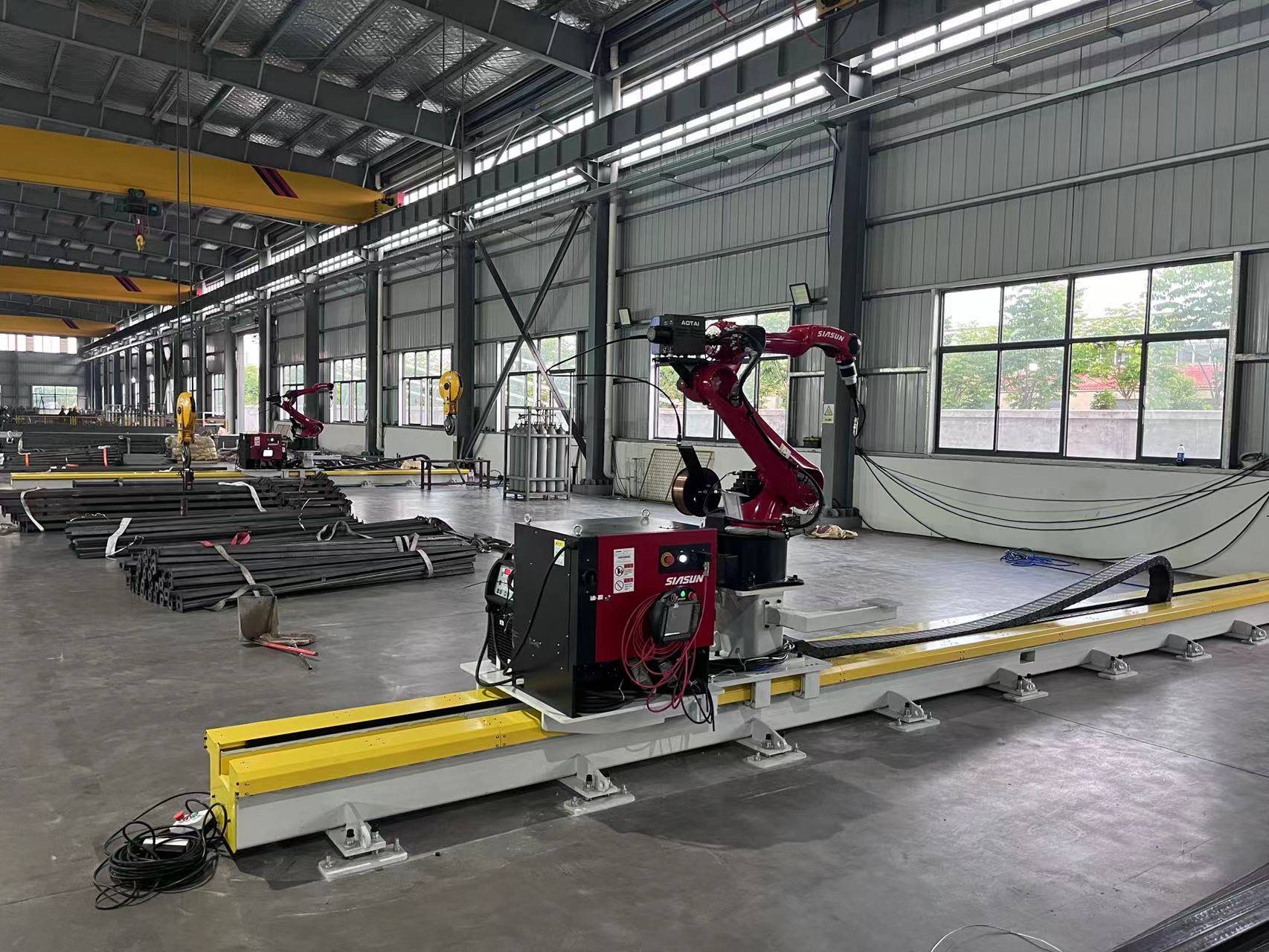
For industrial applications, the transition from manual to robotic MAG welding eliminates the “stop-start” inconsistencies inherent in human operation. A robot can maintain a consistent stick-out distance and travel speed over a 10-meter seam without fatigue. This consistency directly impacts the heat-affected zone (HAZ) of the steel plates. By optimizing the travel speed and voltage via the robotic controller, engineers can ensure that the cooling rate of the weld metal meets the required grain structure specifications, thereby reducing the risk of hydrogen-induced cracking—a common failure point in high-stress oil storage environments.
Maintenance Protocols for High-Availability Robotic Cells
From an operational standpoint, the reliability of an intelligent welder is predicated on a robust maintenance schedule. Unlike manual equipment, which is often run to failure, Robotic Welding cells require proactive intervention to maintain the accuracy of the 3D vision system and the quality of the MAG output.
Vision System Calibration
The 3D vision sensor is the most sensitive component of the system. In the harsh environment of a tank farm or fabrication shop, dust, metallic particles, and welding spatter can occlude the optical lenses. Maintenance protocols must include daily cleaning of the protective glass and weekly recalibration of the coordinate system to ensure the tool center point (TCP) remains within a 0.5mm tolerance.
Consumable Management
To prevent downtime, industrial engineers implement automated nozzle cleaning stations. These stations periodically ream the gas nozzle to remove spatter, apply anti-spatter fluid, and check the wire tip for wear. The contact tip, which transfers current to the welding wire, must be replaced based on “arc-on hours” metrics rather than visual inspection to prevent arc instability. This data-driven approach ensures that the Weld Deposition Efficiency remains above 90% throughout the shift.
Quantifying Labor ROI and Throughput Gains
The primary driver for adopting robotic welding in the oil and gas sector is the Labor ROI Analysis. Manual welding in this industry faces a shrinking pool of certified high-pressure welders and rising hourly wages. However, the ROI of a robotic system is not just found in the reduction of headcount, but in the exponential increase in the duty cycle.
A typical manual welder has an arc-on time (the actual time the arc is burning) of approximately 20% to 30% due to the need for repositioning, breaks, and joint preparation. In contrast, an Intelligent Robotic Welder with 3D vision can achieve arc-on times exceeding 75%. In the context of a 50,000-barrel storage tank, this equates to a reduction in welding man-hours by nearly 60%.
Reduction in Rework Costs
Rework is the most significant “hidden cost” in tank construction. A single failed ultrasonic or radiographic test on a vertical seam can cost thousands of dollars in grinding, re-welding, and re-testing. Robotic systems guided by 3D vision significantly lower the defect rate. Because the vision system monitors the gap and adjusts the weave pattern in real-time, the probability of lack-of-fusion or slag inclusion is nearly eliminated. When calculating ROI, engineers must factor in the savings from reduced non-destructive testing (NDT) failures.
Safety and Insurance Premiums
Automating the welding process moves the human operator away from the immediate vicinity of the arc, fumes, and intense heat. This reduction in workplace hazard exposure can lead to lower workers’ compensation claims and reduced insurance premiums for the fabrication firm. While these are “soft” costs, they contribute significantly to the total cost of ownership (TCO) over the 10-year lifespan of the robotic asset.
Conclusion: The Engineering Imperative
For the oil and gas infrastructure sector, the shift toward intelligent robotic MAG welding is no longer a luxury but a requirement for remaining competitive. The combination of 3D vision for adaptive positioning and the high-deposition capabilities of the MAG process provides a technical solution to the labor shortages and quality demands of the industry. By focusing on meticulous maintenance and a clear understanding of the ROI metrics—specifically arc-on time and rework reduction—industrial engineers can successfully integrate these systems to produce safer, more durable storage assets.
-


Cantilever Welding Robot solution
-


GF laser cutting machine
-

P3015 plasma cutting machine
-

LFP3015 Fiber Laser Cutter
-

pipe plasma cutting machine
-
LFH 4020 Fiber Laser Cutting Machine
-
LFP4020
-

gantry plasma air cutting machine
-

3D robot cutting machine
-

8 axis plasma cutting machine
-

5 axis plasma cutting machine
-

LT360 tube laser cutting machine
-

robot welding workstation
-

SF6060 fiber laser cutting machine
