Optimization of Heavy-Duty Bridge Truss Fabrication through Intelligent MAG Robotic Systems
The structural integrity of bridge trusses depends on the precision and consistency of heavy-gauge welds. Historically, this sector has relied on manual labor due to the sheer scale of the components and the inherent variability in fit-up tolerances. However, the introduction of 3D vision-guided Robotic Welding has shifted the paradigm from manual craft to industrial engineering precision. By utilizing Metal Active Gas (MAG) processes combined with real-time spatial analysis, manufacturers can now automate the welding of complex truss nodes and long-seam chords with higher deposition rates than manual equivalents.
Technical Integration of 3D Vision in Structural Welding
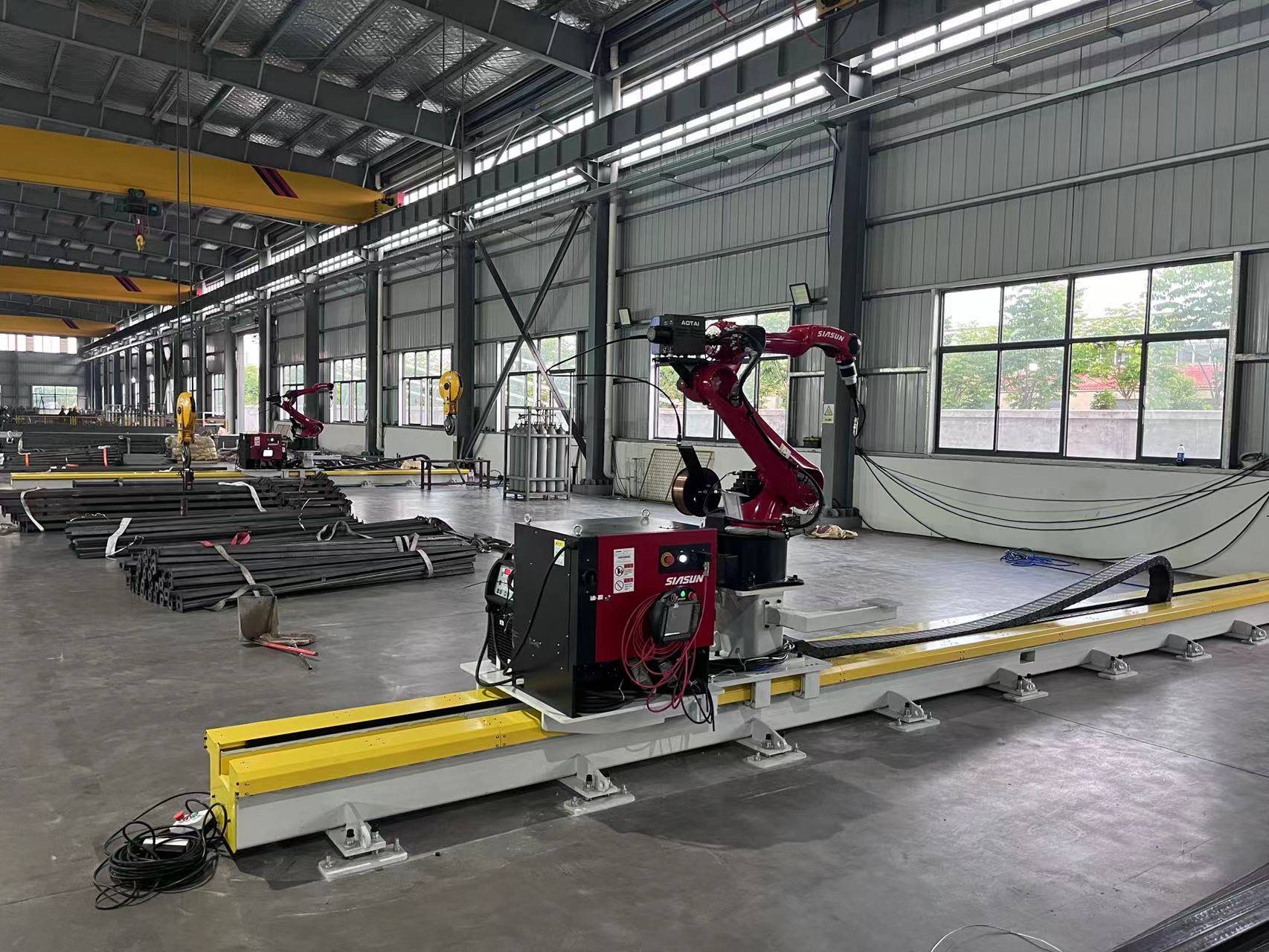
Traditional fixed-path robotics fail in bridge truss applications because large-scale steel components often exhibit thermal distortion or dimensional variances from prior assembly stages. A 3D vision system, typically mounted on the robot’s sixth axis or a localized gantry, scans the joint geometry before the arc is struck. This “look-ahead” capability allows the controller to adjust the welding parameters and torch orientation in real-time.
Adaptive Path Planning and Seam Tracking
The core of an intelligent welder is its ability to interpret point cloud data. For a bridge truss, the system identifies the root gap and groove angle of the joint. If the gap exceeds the programmed nominal value, the robot automatically adjusts its weave pattern and travel speed to ensure full penetration without burn-through. This automated truss welding capability eliminates the need for expensive, high-precision jigging, as the robot adapts to the workpiece rather than requiring the workpiece to be perfect.
MAG Process Optimization for High Deposition
The Metal Active Gas (MAG) process is preferred for bridge work due to its high deposition rates and deep penetration characteristics. In a robotic cell, the power source is integrated via high-speed Fieldbus communication. This allows for pulse-on-pulse control, which stabilizes the arc during high-amperage cycles. For thick-plate bridge chords, the robot can execute multi-pass welds where each subsequent layer is adjusted based on the thermal profile and bead geometry of the previous pass, ensuring consistent mechanical properties across the entire heat-affected zone (HAZ).
Maintenance Protocols for Industrial Robotic Welding Cells
To maintain a high OEE (Overall Equipment Effectiveness), the maintenance strategy for a robotic welder must be proactive rather than reactive. Because bridge truss welding involves long arc-on times, the hardware is subjected to significant thermal stress and spatter accumulation.
Consumable Management and Torch Calibration
The contact tip and gas nozzle are the primary failure points in high-volume MAG welding. Intelligent systems utilize automated reamer stations (torch cleaners) that mechanically remove spatter and apply anti-spatter liquid at programmed intervals. Furthermore, Tool Center Point (TCP) calibration is critical. After any nozzle contact or tip change, the robot performs an automated TCP check using an infrared sensor to ensure the wire exit point remains within a +/- 0.5mm tolerance, preventing weld deviation.
Wire Delivery and Power Source Maintenance
In 24/7 fabrication environments, wire delivery systems must be optimized. Using bulk drums (250kg to 500kg) reduces downtime associated with spool changes. Maintenance teams must inspect the wire liners and drive rolls weekly to prevent friction buildup, which causes “bird-nesting” or inconsistent wire feed speeds—factors that lead to porosity and weld defects in structural steel.
Quantitative Analysis of Labor ROI
The primary driver for adopting robotic welding labor ROI strategies is the global shortage of certified structural welders. While the initial capital expenditure for a vision-guided robotic cell is significant, the payback period is compressed through three primary channels: productivity ratios, rework reduction, and consumable efficiency.
Productivity and Arc-On Time
A manual welder typically maintains an arc-on time of 20% to 30% due to fatigue, setup, and the need for protective gear adjustments. An intelligent robotic system can maintain an arc-on time of 75% to 85%. In the context of bridge trusses, one robotic cell can often replace the output of three to four manual welding stations, depending on the complexity of the multi-pass requirements. This allows the existing workforce to be upskilled into robot operators and weld technicians, focusing on high-level quality control rather than repetitive manual labor.
Reduction in Non-Destructive Testing (NDT) Failures
Bridge components are subject to rigorous Ultrasonic Testing (UT) and Radiographic Testing (RT). Manual welding is prone to inclusions and lack of fusion due to human inconsistency, especially during long shifts. Robotic systems deliver a high degree of repeatability. By using 3D vision weld tracking, the system ensures the arc remains centered in the joint, significantly reducing the rate of weld rejection. Avoiding even a single major repair on a bridge truss can save thousands of dollars in labor, grinding, and re-welding costs.
Calculating the Payback Period
When calculating ROI, industrial engineers must look beyond the hourly wage. The total cost of a manual welder includes benefits, safety equipment, insurance, and the overhead of rework. For a bridge truss facility, a robotic system typically sees a full ROI within 18 to 24 months. This calculation accounts for the increased throughput of tonnage per month and the reduction in floor space required for the same volume of output.
Safety and Workplace Ergonomics
Transitioning to robotic MAG welding improves the shop floor environment by removing operators from the immediate vicinity of welding fumes, UV radiation, and intense heat. In a bridge truss shop, handling large beams is inherently dangerous. Automation reduces the frequency of manual material handling, as the robot can reach difficult angles that would require a human welder to work in ergonomically hazardous positions.
Conclusion
The integration of Intelligent Robotic Welders equipped with 3D vision represents the future of heavy structural steel fabrication. For the bridge industry, this technology addresses the critical challenges of labor shortages and the demand for higher structural reliability. By focusing on the Metal Active Gas (MAG) robotic integration and maintaining strict maintenance protocols, firms can achieve a sustainable competitive advantage through superior weld quality and a robust return on investment. The transition from manual processes to vision-guided automation is no longer a luxury but a technical necessity for modern industrial infrastructure projects.
-


Cantilever Welding Robot solution
-


GF laser cutting machine
-

P3015 plasma cutting machine
-

LFP3015 Fiber Laser Cutter
-

pipe plasma cutting machine
-
LFH 4020 Fiber Laser Cutting Machine
-
LFP4020
-

gantry plasma air cutting machine
-

3D robot cutting machine
-

8 axis plasma cutting machine
-

5 axis plasma cutting machine
-

LT360 tube laser cutting machine
-

robot welding workstation
-

SF6060 fiber laser cutting machine
Advanced Fiber Laser Tube Processing Technology
Our CNC Fiber Laser Tube Cutting systems revolutionize metal fabrication by integrating high-precision cutting, punching, and profiling into a single automated workflow. Designed for versatility, this technology handles a wide array of profiles including Round, Square, Rectangular, and Oval tubes, as well as complex L-shaped and U-shaped channels.
- Precision Punching: High-speed hole punching with micron-level accuracy, eliminating the need for mechanical drilling or die-stamping.
- Complex Profiling: Advanced 3D pathing allows for intricate interlocking joints and specialized notch cuts, ideal for structural frames.
- High Material Efficiency: Intelligent nesting software minimizes scrap, reducing raw material costs across large production runs.
- Clean Finish: Delivers oxide-free, burr-free edges that require zero secondary grinding before welding.

Seamlessly processing multiple profiles with consistent precision.
Global Delivery & Logistics



From our high-tech manufacturing facility directly to your global site. PCL WeldCut ensures secure packaging, professional handling, and reliable international logistics to safeguard your equipment throughout the entire journey.
