Field Report: Deployment of Intelligent Arc Control in High-Volume Galvanized Production
1.0 Introduction and Site Context
This report summarizes the field implementation of an Intelligent Arc Control All-in-one Cobot Station at a Tier-2 automotive and HVAC component manufacturing facility in Chonburi, Thailand. The site conditions are typical of the Eastern Economic Corridor: high ambient humidity (averaging 75-85%) and a shop floor temperature exceeding 35°C during peak hours. These environmental factors, combined with the volatility of galvanized pipe welding, presented a significant challenge to manual welding consistency and operator health.
The primary objective was the transition from manual MIG/MAG stations to an integrated collaborative framework. The project targeted the welding of 42mm OD galvanized steel piping used in structural HVAC supports. In the Chonburi industrial landscape, where skilled labor competition is fierce, the deployment of Collaborative Robotics is no longer a luxury but a requirement for maintaining throughput and weld quality standards (ISO 5817).
2.0 The All-in-one Cobot Station: Architecture and Integration
The “All-in-one Cobot Station” utilized in this deployment differs from traditional robotic cells. It integrates the power source, the controller, the wire feeder, and the collaborative arm onto a unified, mobile chassis. For our operations in Chonburi, this portability was critical. We frequently had to reconfigure the floor layout to accommodate fluctuating batch sizes for different export markets.
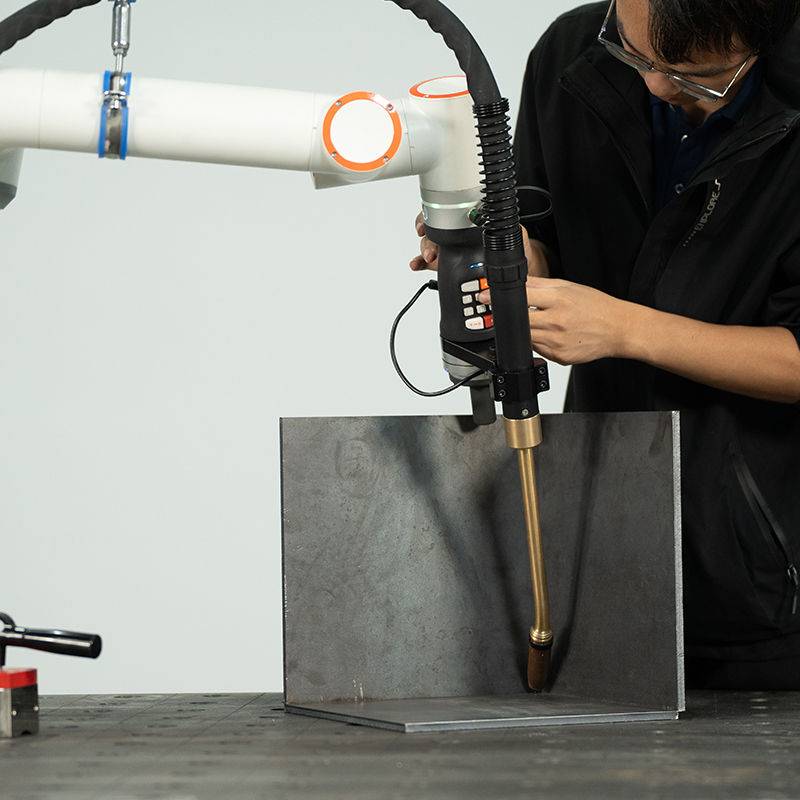
2.1 Synergy Between Station and Collaborative Robotics
The synergy between the All-in-one Cobot Station and collaborative robotics lies in the removal of physical and metaphorical barriers. Traditional industrial robots require heavy fencing and light curtains, which consume valuable floor space. In the Chonburi workshop, where real estate is optimized for lean flow, the collaborative robotics aspect allowed our senior welders to work alongside the machine. The welder handles the jigging and tacking, while the cobot executes the continuous circumferential welds on the galvanized pipe.
The “Intelligent Arc Control” software acts as the connective tissue. By utilizing high-speed digital feedback loops, the power source adjusts waveform parameters in real-time to compensate for the erratic behavior of the zinc coating during the welding process.
3.0 Technical Challenges: Galvanized Pipe Welding Physics
Galvanized pipe welding is notoriously difficult due to the disparity between the melting point of steel (~1500°C) and the boiling point of zinc (~906°C). In a standard arc environment, the zinc vaporizes violently, leading to three primary defects: internal porosity, heavy spatter, and arc instability. In the Chonburi facility, these defects previously led to a 12% rework rate in manual stations.
3.1 Managing Zinc Vaporization with Intelligent Arc Control
The Intelligent Arc Control system was programmed with a specific “Low-Heat Pulse” mode. This mode alternates between a high-energy peak to penetrate the base metal and a low-energy background to allow the zinc vapor to escape before the weld pool freezes. By fine-tuning the pulse frequency, we achieved a “scalloped” bead appearance that effectively outgassed the zinc, reducing porosity to less than 1.5% in X-ray testing.
3.2 Spatter Mitigation and Post-Weld Cleanup
Traditional MAG welding on galvanized surfaces results in “pop-outs” where trapped gas explodes through the puddle. The All-in-one Cobot Station utilizes a highly regulated wire-retraction sensing technology. When the system detects a short circuit that doesn’t clear normally—a precursor to spatter—the Intelligent Arc Control modifies the current ramp-down. This resulted in a 60% reduction in post-weld grinding time, a major bottleneck in our Chonburi production line.
4.0 Collaborative Robotics in the Chonburi Environment
Operating collaborative robotics in a tropical, industrial environment like Chonburi requires specific considerations for the hardware and the human element. The humidity can affect the friction coefficients in the cobot joints, and the high salt content in the air can lead to premature oxidation of the wire feed rollers.
4.1 Environmental Hardening
We implemented a pressurized cabinet system for the All-in-one Cobot Station’s core electronics. However, the collaborative robotics arm itself remained exposed. Lesson learned: regular IP67-rated cleaning of the sensors is mandatory. Dust buildup on the torque sensors occasionally triggered false-positive collision detections, halting production. A weekly maintenance schedule was established to calibrate the sensitivity of the collaborative joints against the ambient heat-induced expansion of the metal jigs.
4.2 Human-Robot Interaction (HRI)
The “Collaborative” nature allowed us to upskill our existing workforce. A welder with 15 years of manual experience in Chonburi doesn’t need to learn C++ to run this station. The “Lead-Through” programming allowed the welder to manually move the cobot arm along the pipe’s circumference to set the Tool Center Point (TCP). This localized tribal knowledge—knowing exactly where the heat needs to be focused on a specific pipe thickness—was successfully digitized into the cobot’s memory.
5.0 Data-Driven Results: Performance Metrics
After three months of operation in the Chonburi plant, the data for the All-in-one Cobot Station against manual galvanized pipe welding is as follows:
- Cycle Time: Reduced from 4 minutes 20 seconds (manual) to 1 minute 55 seconds (cobot), including loading/unloading.
- Consumable Efficiency: 15% reduction in shielding gas (92% Ar / 8% CO2 mix) due to optimized pre-flow and post-flow settings managed by the Intelligent Arc Control.
- Weld Consistency: Standard deviation of bead width narrowed from 2.1mm to 0.4mm.
- Health & Safety: Significant reduction in welder exposure to hexavalent chromium and zinc oxide fumes, as the operator can stand 2 meters away from the arc without losing control of the process.
6.0 Lessons Learned and Senior Engineering Observations
Deploying an All-in-one Cobot Station is not a “plug-and-play” endeavor, despite what the marketing brochures suggest. It requires a deep understanding of the metallurgy of galvanized pipe welding and the kinematics of collaborative robotics.
6.1 The Importance of Grounding
In the Chonburi facility, we initially encountered “ghosting” in the touch-sensing logic. We traced this back to poor electrical grounding in the factory’s older wing. The high-frequency components of the Intelligent Arc Control are sensitive to electromagnetic interference (EMI). We had to install a dedicated copper grounding rod for the All-in-one station to ensure the arc remained stable during the pulse transitions.
6.2 Wire Feed Consistency
Galvanized pipe welding requires a very consistent wire feed speed to maintain the keyhole. We found that the heat in Thailand softened the standard polymer liners, causing “bird-nesting” at the feed rollers. We switched to a high-temp Teflon-graphite liner, which solved the friction issues and allowed the collaborative robotics arm to move through its full range of motion without varying the wire tension.
6.3 Torch Angle and Zinc Soot
A major lesson learned involved the torch angle. In manual welding, the welder often compensates for zinc soot buildup by eye. The cobot cannot “see” the soot. We had to program a “torch cleaning cycle” every 10 pipes, where the cobot moves to a specialized station to ream the nozzle and apply anti-spatter spray. This significantly improved arc start reliability.
7.0 Conclusion
The integration of the Intelligent Arc Control All-in-one Cobot Station has transformed our galvanized pipe welding operations in Chonburi. By leveraging collaborative robotics, we have bridged the gap between manual flexibility and robotic precision. The synergy between the unified station design and the advanced arc physics control allowed us to overcome the inherent difficulties of welding zinc-coated materials in a challenging climate. Future deployments will focus on expanding this “all-in-one” philosophy to our heavier structural steel lines, utilizing the same collaborative framework to maintain safety and agility on the shop floor.
-


Cantilever Welding Robot solution
-


GF laser cutting machine
-

P3015 plasma cutting machine
-

LFP3015 Fiber Laser Cutter
-

pipe plasma cutting machine
-
LFH 4020 Fiber Laser Cutting Machine
-
LFP4020
-

gantry plasma air cutting machine
-

3D robot cutting machine
-

8 axis plasma cutting machine
-

5 axis plasma cutting machine
-

LT360 tube laser cutting machine
-

robot welding workstation
-

SF6060 fiber laser cutting machine
