Fiber Laser Cutting Machine with 3D Vision positioning for Bridge Trusses
In this article
- Advanced Integration of Fiber Laser Technology in Bridge Truss Fabrication
- The Mechanics of 3D Vision Positioning
- Consolidated Workflow: Punch, Mark, and Cut
- Eliminating Secondary Operations: The No-Grinding Advantage
- Kinematics and Multi-Axis Processing
- Data Integration and Industry 4.0
- Conclusion: The ROI of Precision
Advanced Integration of Fiber Laser Technology in Bridge Truss Fabrication
In the domain of heavy structural engineering, the production of bridge trusses requires a level of precision that traditional mechanical methods often struggle to achieve consistently. The introduction of fiber Laser Cutting technology has fundamentally shifted the baseline for accuracy and production efficiency. Unlike older thermal processes, fiber lasers utilize a solid-state laser source to generate a beam that is delivered via flexible fiber-optic cable to the cutting head. This setup provides a high-density energy focused into a microscopically small spot size, enabling kerf widths that are significantly narrower than any other thermal cutting method.
For bridge truss components—often consisting of large-scale H-beams, I-beams, and box sections—the primary challenge is not just the cut itself, but the alignment of that cut relative to the physical reality of the steel. Structural steel sections frequently possess inherent deviations such as camber, sweep, or twist from the rolling mill. Integrating a 3D vision positioning system allows the CNC controller to “see” these deviations in real-time, adjusting the cutting path to ensure that every bolt hole and connection interface is positioned with sub-millimeter accuracy relative to the actual workpiece geometry.
The Mechanics of 3D Vision Positioning
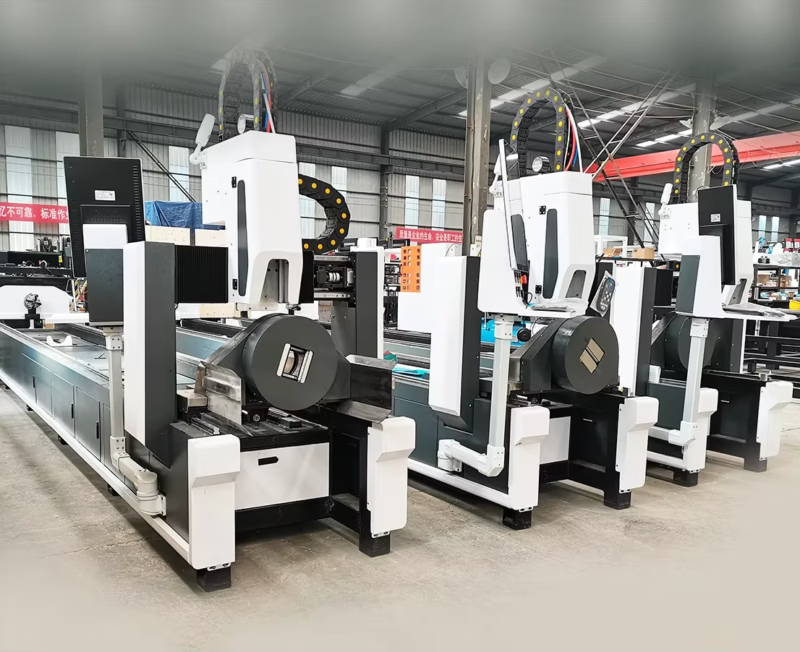
The 3D vision system operates by utilizing high-resolution CCD cameras and laser line profilers to capture a point cloud of the structural member as it enters the cutting zone. This data is compared instantaneously against the original CAD/CAM model. The software calculates the transformation matrix required to map the theoretical coordinates onto the physical part. This process compensates for manufacturing tolerances in the raw material, ensuring that when the bridge truss fabrication components arrive at the construction site, they fit together with zero-clearance precision.
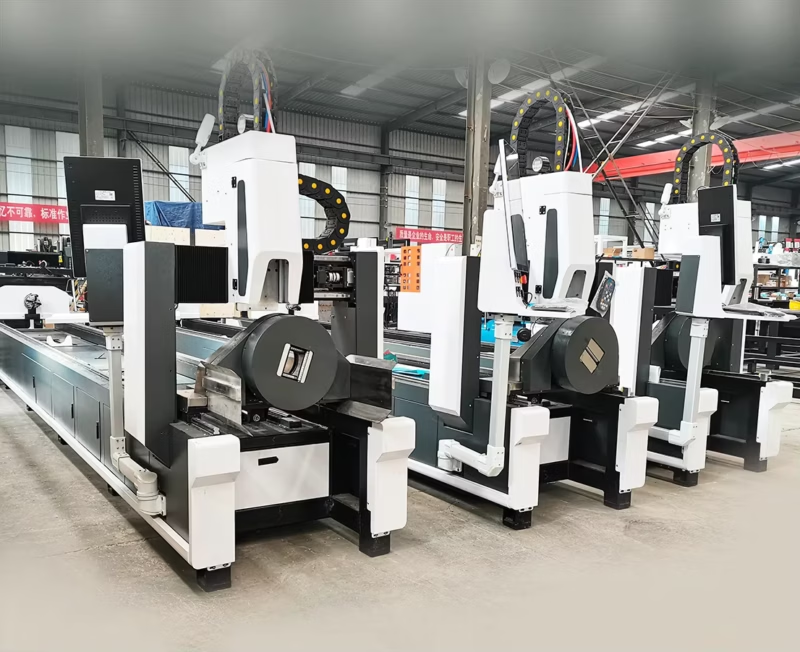
This vision-driven approach eliminates the need for manual layout and center-punching. In conventional workflows, engineers spend significant man-hours marking hole centers and cut lines. The automated vision system identifies the edges and centerlines of the beams, automatically nesting the required features within the boundaries of the material while maintaining structural edge distances required by engineering codes.
Consolidated Workflow: Punch, Mark, and Cut
The efficiency of a fiber laser system is most evident in its ability to perform multiple operations in a single setup. A high-wattage fiber laser (typically ranging from 12kW to 30kW for bridge applications) handles three distinct tasks: marking, punching (hole cutting), and profiling.
Surface Marking and Traceability
The laser can be modulated to a lower power setting to “etch” or mark the surface of the steel. This is used for part identification numbers, fold lines, or assembly guides for secondary components. Because this marking is done in the same coordinate system as the cutting, it is perfectly indexed to the geometry of the part, facilitating faster assembly and better traceability throughout the lifespan of the bridge.
High-Precision Hole Cutting (Punching)
Historically, holes in bridge trusses were drilled or punched using hydraulic presses. Fiber lasers now offer a “laser punching” capability that produces bolt holes with exceptional cylindricality and surface finish. The heat-affected zone (HAZ) is minimized due to the high cutting speed and the specific wavelength of the fiber laser, which is readily absorbed by carbon steel. This ensures that the material properties around the hole remain within design specifications, preventing brittleness that could lead to fatigue cracking under cyclic loading.
Eliminating Secondary Operations: The No-Grinding Advantage
One of the most significant cost drivers in truss production is the manual labor required for secondary finishing. Traditional thermal cutting often leaves dross (slag) and a hardened edge that must be ground down before painting or assembly. Fiber laser cutting, when optimized with the correct assist gas (typically Oxygen or Nitrogen), produces a clean, dross-free edge that requires no further mechanical treatment.
The high-frequency stability of the fiber laser beam results in a surface roughness (Rz) that meets or exceeds international standards for structural steel. By moving directly from the laser bed to the assembly or coating stage, manufacturers can reduce their total cycle time by up to 40%. This elimination of grinding also reduces shop noise, dust, and the ergonomic risks associated with manual power tool use.
Kinematics and Multi-Axis Processing
Bridge trusses often require complex bevels and miter cuts to facilitate intricate node connections. A 5-axis or 6-axis fiber laser head allows for the cutting of these geometries on three-dimensional profiles. The automated nesting software calculates the complex tool paths required to maintain a constant focal distance and nozzle standoff height, even as the head tilts to accommodate the web and flange transitions of an I-beam.
Thermal Management and Material Integrity
Unlike other processes that dump massive amounts of heat into the workpiece, the fiber laser’s high energy density allows for rapid cooling. This “cold” cutting process prevents the large-scale thermal distortion that can warp long bridge chords. Maintaining the straightness of a 12-meter truss member during the cutting process is critical; the fiber laser’s localized heat input ensures that the pre-calculated camber of the beam remains within tolerance.
Data Integration and Industry 4.0
The modern Fiber Laser Cutting Machine is a data-rich environment. Every cut is logged, and the vision system can provide a “digital twin” report of the finished part, verifying that all dimensions meet the project requirements before the part even leaves the machine. This level of quality assurance is vital for infrastructure projects where the cost of field rectification is astronomical. The integration of 3D vision positioning system data into the factory’s ERP system allows for real-time tracking of production bottlenecks and material utilization rates.
Furthermore, the maintenance of these systems is streamlined through internal sensors that monitor beam quality, protective window health, and gas pressure. For the industrial engineer, this means higher uptime and more predictable maintenance schedules compared to mechanical punching or traditional cutting tools.
Conclusion: The ROI of Precision
Investing in fiber laser technology with 3D vision is a strategic move toward high-specification bridge fabrication. The capital expenditure is offset by the dramatic reduction in manual labor, the elimination of secondary finishing processes, and the near-total reduction in scrapped material due to positioning errors. As bridge designs become more complex and material specifications more stringent, the ability to punch, mark, and cut with absolute precision in a single automated flow becomes the primary differentiator for competitive structural steel fabricators.