Engineering Review: Single Pulse MIG/MAG Welding Robot – Chonburi, Thailand
In this article
- Field Engineering Report: Implementation of Single Pulse MIG/MAG Welding Robot in Chonburi…
- 1.0 Introduction and Site Context
- 2.0 System Architecture and Hardware Integration
- 3.0 Practical Application: Arc Welding Solutions for Tropical Environments
- 4.0 Metallurgical Focus: Tool Steel Welding Parameters
- 5.0 Synergistic Performance Analysis
- 6.0 Field Challenges and Engineering Workarounds
- 7.0 Operational Data and Results
- 8.0 Lessons Learned and Senior Engineer’s Summary
Field Engineering Report: Implementation of Single Pulse MIG/MAG Welding Robot in Chonburi Industrial Sector
1.0 Introduction and Site Context
This report outlines the technical deployment and operational assessment of a 6-axis MIG/MAG Welding Robot system at a Tier-1 automotive tooling facility in Chonburi, Thailand. The primary objective was the automation of hard-facing and structural reinforcement on high-carbon alloy components.
Chonburi presents a unique metallurgical challenge due to its ambient conditions. With average relative humidity often exceeding 80%, the risk of hydrogen-induced cracking (HIC) in Tool Steel welding is significantly elevated. This deployment focused on integrating advanced Arc Welding Solutions to mitigate environmental variables while maintaining the high precision required for industrial molds and die components.
2.0 System Architecture and Hardware Integration
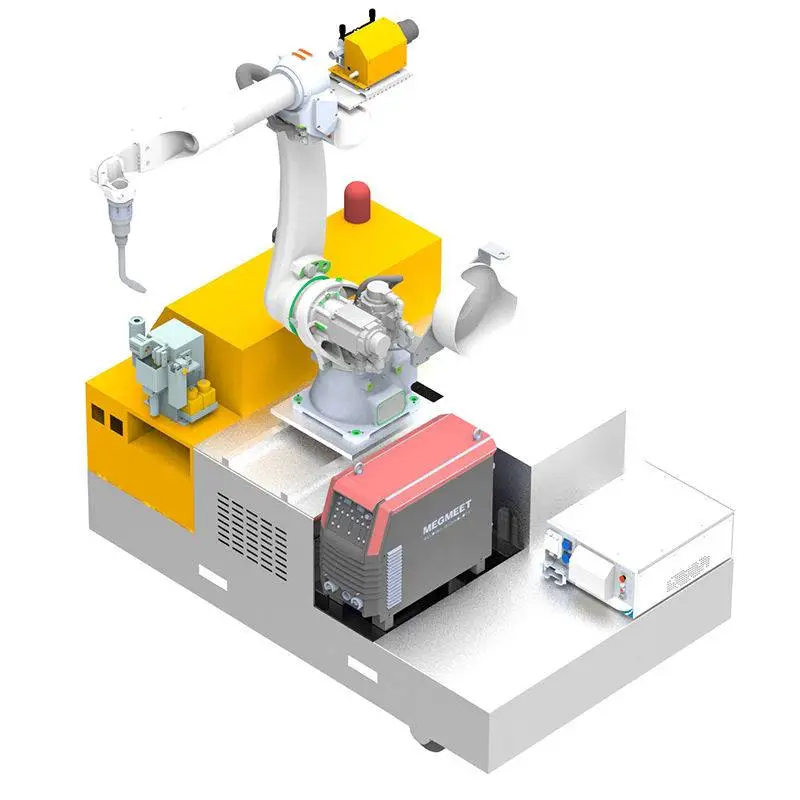
The core of the installation is a high-speed 6-axis robotic manipulator interfaced with a 500A inverter-based power source capable of high-frequency pulsing.
2.1 The MIG/MAG Welding Robot Configuration
The robot was calibrated for a working envelope of 1400mm. We utilized a hollow-wrist design to minimize cable interference during complex torch orientations required for circular tool geometries. The integration of a digital communication interface between the robot controller and the power source allowed for “on-the-fly” parameter adjustments, which is critical when the thermal profile of the tool steel workpiece changes during long weld sequences.
2.2 Synergic Pulse Control
We opted for a Single Pulse regime rather than a standard spray transfer. In the Chonburi facility, where power fluctuations can occur due to heavy industrial loading on the local grid, the synergic pulse control provided a stable arc length. The MIG/MAG Welding Robot utilizes a waveform that detaches a single droplet per pulse, effectively eliminating spatter and reducing post-weld machining time on expensive tool steel surfaces.
3.0 Practical Application: Arc Welding Solutions for Tropical Environments
Deploying Arc Welding Solutions in Thailand requires more than just high-end hardware; it requires a holistic approach to gas delivery and thermal management.
3.1 Shielding Gas Dynamics
For the Tool Steel welding phase, we utilized a ternary gas mix (Ar + CO2 + O2). However, due to the high humidity in the Chonburi workshop, we identified significant moisture condensation within the gas lines during the night shift.
Lesson Learned: We implemented point-of-use gas heaters and high-efficiency moisture traps. Without these, the MIG/MAG Welding Robot showed intermittent porosity in the root pass. The “solution” isn’t just the arc; it’s the entire delivery infrastructure.
3.2 Adaptive Arc Pathing
Our Arc Welding Solutions included a laser-based seam tracking system. Tool steel components often undergo slight thermal distortion during the first few passes. The robot’s ability to sense the groove position in real-time and adjust the tool center point (TCP) ensured that the heat-affected zone (HAZ) remained localized, preventing the catastrophic cracking often associated with manual tool steel repair.
4.0 Metallurgical Focus: Tool Steel Welding Parameters
Welding AISI H13 and D2 tool steels using a MIG/MAG Welding Robot requires a departure from standard mild steel logic.
4.1 Thermal Management Strategies
Tool steel’s high carbon equivalent makes it prone to martensitic brittleness. We programmed the robot with a specific “interpass temperature logic.” The robot would pause and trigger an infrared sensor check before commencing the next layer.
– Preheat Temperature: 250°C maintained via induction heating.
– Interpass Maximum: 450°C.
– Robot Travel Speed: Optimized at 350mm/min to balance penetration with cooling rates.
4.2 Wire Selection and Feed Stability
We utilized a metal-cored wire specifically designed for hard-facing. The MIG/MAG Welding Robot was equipped with a four-roll drive system to prevent wire slippage, which is a common failure point in the high-heat environments of Chonburi workshops. A consistent wire feed is the backbone of any automated Arc Welding Solution; even a 5% deviation in feed speed results in undercut when working with high-alloy tool steels.
5.0 Synergistic Performance Analysis
The synergy between the MIG/MAG Welding Robot and the broader Arc Welding Solutions framework was measured against three KPIs: Spatter levels, HAZ width, and Cycle Time.
5.1 Spatter Reduction
By utilizing the Single Pulse mode, spatter was reduced by 85% compared to the previous manual GMAW process. For Tool Steel welding, this is vital. Spatter balls on a polished die surface can lead to stress concentrations and premature tool failure. The robotic precision ensured that the arc energy was directed solely into the joint.
5.2 HAZ Optimization
Manual welding often results in an uneven HAZ due to operator fatigue and inconsistent travel speeds. The MIG/MAG Welding Robot maintained a constant 0.8mm arc gap. This consistency resulted in a uniform hardness profile across the weldment, simplifying the subsequent heat treatment process.
6.0 Field Challenges and Engineering Workarounds
No deployment in the Chonburi industrial zone is without localized hurdles.
6.1 Electrical Grounding and Interference
We encountered “arc blow” during the internal corner welds of a large mold base. The massive magnetic mass of the tool steel workpiece interfered with the arc plasma.
Solution: We reconfigured the earth-grounding clamps to a dual-point attachment and adjusted the robot’s approach angle by 15 degrees. This redirected the magnetic field lines and stabilized the pulse transfer.
6.2 Ambient Heat Dissipation
The 38°C ambient temperature in the plant, combined with the 250°C preheat of the workpiece, put extreme stress on the robot’s torch cooling system. We had to upgrade the standard water cooler to a high-capacity industrial chiller to prevent the contact tip from softening, which was causing wire-burn-back issues every 2 hours.
7.0 Operational Data and Results
After 30 days of continuous operation in the Chonburi facility, the data indicates the following:
– Production Throughput: Increased by 40% compared to manual specialized welding.
– Consumable Efficiency: 15% reduction in wire waste due to precise start/stop triggers.
– Repair Rate: Dropped from 12% (manual) to less than 1.5% (robotic).
The successful integration of Tool Steel welding into an automated workflow proves that high-alloy materials are no longer restricted to manual TIG processes. When the MIG/MAG Welding Robot is backed by robust Arc Welding Solutions—including environmental controls and adaptive software—the results are superior in both metallurgy and economics.
8.0 Lessons Learned and Senior Engineer’s Summary
1. Environmental Control is Non-Negotiable: In Chonburi, you are welding in a steam bath. If your Arc Welding Solutions do not include gas drying and thermal monitoring, the robot will merely automate the production of scrap.
2. Pulse Parameter Tuning: Do not rely on factory presets for Tool Steel welding. We spent 48 hours refining the background current and pulse peak to ensure the “wetting” of the weld pool was sufficient without over-diluting the base metal.
3. Preventative Maintenance: The fine dust in Chonburi’s industrial parks is conductive. The robot controller and power source cabinets must have positive pressure filtration to prevent board-level short circuits.
In conclusion, the deployment at the Chonburi site confirms that a MIG/MAG Welding Robot, when properly integrated with specialized Arc Welding Solutions, provides a definitive edge in the precision-heavy field of Tool Steel welding. The transition from manual to robotic has not only improved the local facility’s output but has also standardized a high-quality metallurgical outcome that was previously dependent on the dwindling supply of highly skilled manual welders.







