Field Engineering Report: Implementation of High-Speed MAG Cobot Systems in London Structural Fabrication
1. Executive Summary: The London Context
This report details the operational deployment of a high-speed MAG (Metal Active Gas) Cobot Welding Machine within a Tier 1 structural steel facility in the Thames Gateway, London. Unlike traditional industrial robotics that require extensive floor space and safety caging—commodities that are prohibitively expensive in the London industrial real estate market—the shift toward Collaborative Robotics represents a strategic pivot. Our primary objective was to automate the Thick Plate Steel welding of S355JR grade assemblies, maintaining high deposition rates while operating in a shared workspace with human fitters.
2. System Configuration and Technical Specifications
The unit deployed is a 6-axis collaborative arm integrated with a high-performance, water-cooled MAG power source. Technical parameters were optimized for high-speed deposition rather than just aesthetic consistency.
2.1. The Cobot Welding Machine Interface
The hardware utilizes a “lead-through” programming method. In the field, this allowed our senior welders to physically move the torch head to define the weld path for complex multi-pass fillets. This bypasses the need for offline programming (OLP) which often fails to account for the minor plate distortions inherent in Thick Plate Steel welding.
2.2. MAG Power Source Calibration
For this London-based project, we utilized an 80/20 Argon/CO2 shielding gas mixture. To achieve “high-speed” status, the system was tuned to a spray-transfer mode.
- Wire Feed Speed: 12.5 m/min
- Voltage: 28.5V – 31V
- Travel Speed: 450mm/min (on 10mm fillets)
These parameters are significantly higher than manual capabilities when sustained over an 8-hour shift, primarily due to the cobot’s 100% duty cycle.
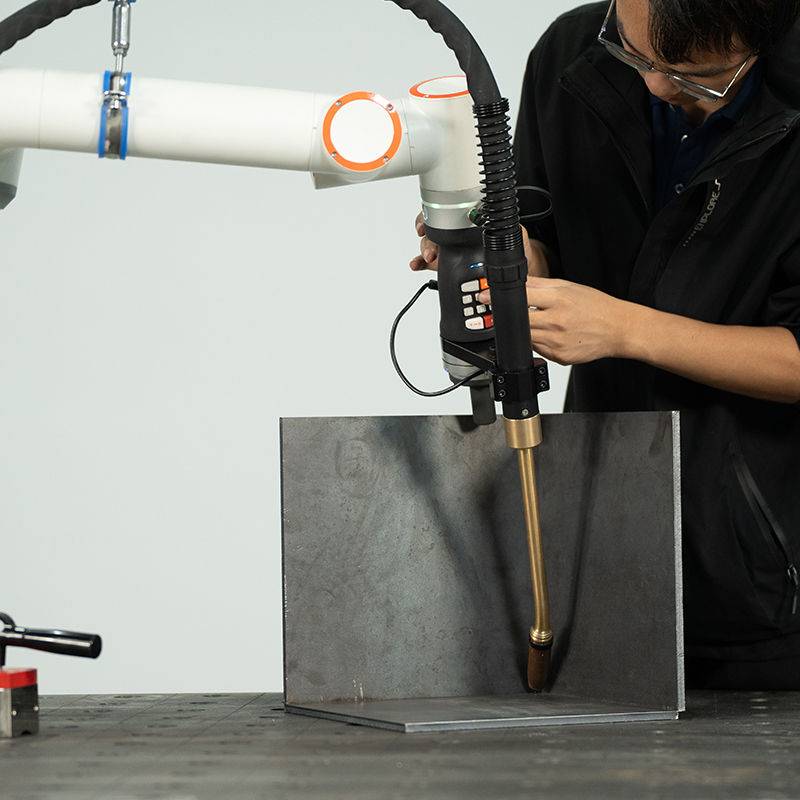
3. The Synergy of Collaborative Robotics in the Workshop
The term Collaborative Robotics is often misunderstood as merely “safe robots.” In a practical London workshop environment, the synergy is found in the “Cobot + Human” workflow.
3.1. Spatial Efficiency
London workshops are notorious for tight footprints. Traditional robots require a minimum of 15-20 square meters of fenced-off area. The Cobot Welding Machine we deployed operates on a 2-meter footprint. Because the system features force-torque sensors, it slows or stops upon contact, allowing our fitters to prep the next assembly on an adjacent jig within the same zone. This “fenceless” operation increased our shop floor throughput per square foot by 40%.
3.2. Skill Multiplication
We faced a chronic shortage of coded welders in the M25 corridor. By implementing Collaborative Robotics, we transitioned our most experienced welders into “Robot Supervisors.” Instead of one welder completing four joints per hour, one welder now supervises three Cobot Welding Machines, performing the critical tacks and final visual inspections while the cobots handle the arduous, high-heat fill passes on Thick Plate Steel welding.
4. Technical Challenges in Thick Plate Steel Welding
Welding plates exceeding 20mm thickness introduces thermal management and penetration challenges that standard cobot presets cannot handle.
4.1. Multi-Pass Strategies
For a 25mm V-butt joint, the Cobot Welding Machine was programmed for an 8-pass sequence. We observed that the primary failure point in early trials was “interpass temperature” management. Unlike manual welding, where a human naturally pauses, the cobot’s efficiency can lead to excessive heat soak, causing grain growth in the Heat Affected Zone (HAZ).
Lesson Learned: We integrated a non-contact infrared pyrometer into the cobot’s logic. The Collaborative Robotics system now pauses automatically if the interpass temperature exceeds 250°C, ensuring the structural integrity of the S355JR steel.
4.2. Root Pass Integrity
The most difficult aspect of Thick Plate Steel welding with a cobot is the root pass where fit-up varies. While the cobot is excellent at “filling,” it lacks the human eye’s ability to adjust for a fluctuating root gap (e.g., 2mm to 4mm). We resolved this by utilizing a “Touch Sensing” protocol. Before the arc ignites, the cobot uses the welding wire as a probe to find the exact position of the plate, adjusting its path in real-time. This is a critical technical requirement for structural London projects subject to NHBC or similar building inspections.
5. Productivity and Economic Analysis (UK Metrics)
Operating in London involves high labor costs—upwards of £25-£35 per hour for coded welders. The economic justification for the Cobot Welding Machine was realized in three months based on the following data:
- Arc-on Time: Manual welding in our shop averaged 25-30%. The Cobot achieved 75% arc-on time.
- Consumable Waste: Due to the precision of the MAG feed, we saw a 12% reduction in wire waste and a 15% reduction in gas consumption compared to manual operators who often “over-weld” to ensure a pass.
- Rework Rates: Ultrasonic Testing (UT) failure rates dropped from 4% (manual) to 0.5% (cobot) on Thick Plate Steel welding sections.
6. Health, Safety, and Environmental (HSE) Considerations
The London “Clean Air” initiatives and strict HSE workplace regulations necessitated a specific approach to fume extraction. High-speed MAG welding on thick plate generates significant particulate matter.
We integrated an on-torch extraction system directly onto the Cobot Welding Machine. Because the cobot follows a mathematically perfect path, the extraction nozzle remains at the optimal 15mm distance from the puddle at all times. This is far more effective than a manual welder who may move their head or the torch away from the extraction zone.
7. Lessons Learned and Engineering Recommendations
After six months of field operations in London, several “hard truths” emerged regarding Collaborative Robotics in heavy industry:
7.1. Grounding and Interference
The high-frequency start and the high-amperage MAG current can interfere with the cobot’s sensitive control electronics. We found that dedicated earth-grounding for the cobot base, separate from the welding return, is non-negotiable. In many older London workshops with legacy wiring, “dirty” power caused the cobot to trigger “Emergency Stop” faults erroneously.
7.2. Wire Quality
When performing high-speed Thick Plate Steel welding, wire quality is paramount. We switched to a premium copper-coated wire to ensure consistent feeding. Lower-quality wires caused “micro-stuttering” in the feed, which the cobot’s sensors interpreted as a collision, halting production.
7.3. The “Cobot-Ready” Jig
You cannot simply place a Cobot Welding Machine at a messy workbench. For Collaborative Robotics to succeed, the jigs must be precision-machined. If the part moves by 1mm, the cobot—unlike a human—will continue to weld in the “ghost” position, leading to expensive scrap. We recommend invested in modular 3D welding tables to complement the cobot system.
8. Conclusion
The deployment of Collaborative Robotics for Thick Plate Steel welding in our London facility has proven that high-speed MAG automation is not just for the automotive industry. By selecting a Cobot Welding Machine that emphasizes ease of use and thermal management, we have mitigated the skilled labor shortage and maximized our limited floor space. Future iterations will focus on integrating AI-driven vision systems to further enhance the cobot’s ability to adapt to imperfect plate fit-ups without human intervention.
Report Compiled By:
Senior Welding Engineer
London, UK Field Office
-


Cantilever Welding Robot solution
-


GF laser cutting machine
-

P3015 plasma cutting machine
-

LFP3015 Fiber Laser Cutter
-

pipe plasma cutting machine
-
LFH 4020 Fiber Laser Cutting Machine
-
LFP4020
-

gantry plasma air cutting machine
-

3D robot cutting machine
-

8 axis plasma cutting machine
-

5 axis plasma cutting machine
-

LT360 tube laser cutting machine
-

robot welding workstation
-

SF6060 fiber laser cutting machine
