Engineering Review: Heavy-duty Industrial Cobot Welding Machine – Frankfurt, Germany
In this article
- Field Engineering Report: Implementation of Collaborative Robotics in Tool Steel Fabrication
- Location: Frankfurt am Main, Germany
- Date: October 2023 – February 2024
- 2. The Technical Synergy: Cobot Welding Machine vs. Collaborative Robotics
- 3. Metallurgy and Tool Steel Welding Challenges
- 4. Operational Observations from the Frankfurt Workshop
- 5. Lessons Learned and Technical Refinements
- 6. Economic and Quality Results
- 7. Conclusion
Field Engineering Report: Implementation of Collaborative Robotics in Tool Steel Fabrication
Location: Frankfurt am Main, Germany
Date: October 2023 – February 2024
1. Introduction and Project Objective
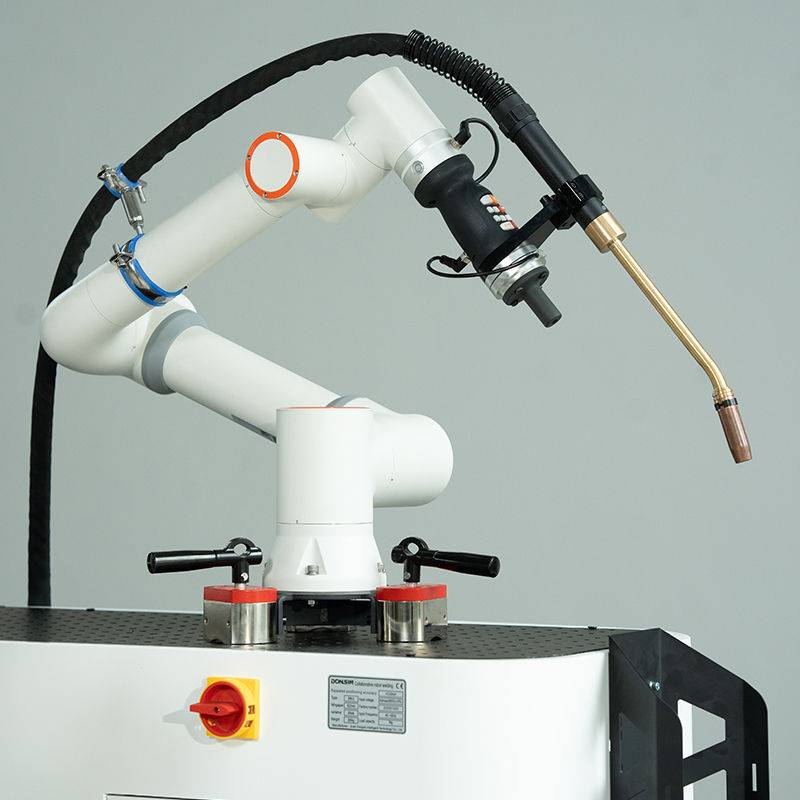
The primary objective of this field deployment in Frankfurt was to evaluate the integration of a high-payload **Cobot Welding Machine** within a facility specializing in the repair and surfacing of industrial stamping dies. In the German manufacturing sector, specifically within the automotive supply chains of Hessen, the demand for high-precision Tool Steel welding has traditionally been met by senior manual welders. However, the scarcity of specialized labor and the need for repeatable thermal cycles have necessitated a shift toward Collaborative Robotics.
This report details the technical synergy between human intervention and automated precision, focusing on the metallurgical challenges of tool steel and the operational efficiency of collaborative systems in a high-stakes industrial environment.
2. The Technical Synergy: Cobot Welding Machine vs. Collaborative Robotics
In the context of this Frankfurt workshop, it is vital to distinguish between the **Cobot Welding Machine (the hardware/power-source assembly) and Collaborative Robotics** (the operational philosophy and safety framework).
The Cobot Welding Machine utilized in this deployment featured a 20kg payload capacity and an integrated CMT (Cold Metal Transfer) power source. Unlike traditional industrial robots that require extensive light curtains and physical fencing, the “collaborative” aspect allowed our engineers to stand within the working envelope during the “Dry Run” and “Touch Sensing” phases.
The synergy manifests in the “Hand Guiding” feature. In tool steel repair, the geometry of the worn die is rarely uniform. By using Collaborative Robotics, the lead welder in Frankfurt could manually move the robot arm to define the complex start-and-stop points on a damaged H13 tool steel block. The machine then takes over the execution of the weld path with a level of travel-speed consistency that no manual operator can maintain over a four-hour shift. This eliminates the “Monday morning” variance in bead profile.
3. Metallurgy and Tool Steel Welding Challenges
Tool Steel welding is notoriously unforgiving due to the high carbon and alloy content (Chromium, Molybdenum, Vanadium) which increases hardenability and the risk of cold cracking (Hydrogen Induced Cracking). In the Frankfurt facility, we were primarily dealing with DIN 1.2344 (equivalent to AISI H13).
3.1 Thermal Management Protocols
The critical challenge was maintaining a consistent interpass temperature. Manual welders often struggle with the heat radiation from a preheated 300°C die. By utilizing a Cobot Welding Machine, we were able to maintain a steady torch angle and arc length while the operator monitored the thermal sensors from a safe distance.
We implemented a pulsed-arc profile to minimize the Heat Affected Zone (HAZ). One lesson learned in the field was that while the cobot provides mechanical consistency, the metallurgy still dictates the pace. We had to program “dwell times” into the robot logic to ensure the interpass temperature did not exceed 400°C, which would result in over-tempering the base metal and reducing the final Rockwell hardness (HRC) of the tool.
3.2 Filler Metal Integration
We utilized a matching chemistry cored wire for the cladding process. The cobot’s wire feed controller was synced via EtherCAT to the robot’s motion controller. This allowed for real-time adjustments of the “Stick-Out” (Contact-to-Work Distance), which is crucial when navigating the deep cavities of a stamping die.
4. Operational Observations from the Frankfurt Workshop
Frankfurt’s industrial regulations regarding worker safety (DGUV) are among the strictest in the world. The transition to Collaborative Robotics was initially met with skepticism by the local works council (Betriebsrat).
4.1 Safety and Force-Torque Sensing
The Cobot Welding Machine is equipped with high-sensitivity Force-Torque sensors in every joint. During the Frankfurt trials, we conducted “Collision Impact Tests.” Because the robot operates without a cage, it must stop instantaneously upon contact with a human. We found that at welding speeds of 8mm/s, the kinetic energy was well within the ISO/TS 15066 limits. This allowed the senior welder to remain close to the arc to manage the gas shielding in a way that would be impossible with a caged high-speed robot.
4.2 Programming via “Teach Pendant” and Hand-Guiding
The shift from G-code or complex KRL programming to the cobot’s intuitive tablet interface reduced the “Program-to-Weld” time by 60%. In a job-shop environment like the one in Frankfurt, where every tool steel die is unique, the ability to “show” the robot the path rather than “code” the path is the difference between profitability and a loss.
5. Lessons Learned and Technical Refinements
No field deployment is without its friction points. The Frankfurt project highlighted several areas where the theory of Collaborative Robotics met the reality of the welding shop floor.
Lesson 1: The “Ghost in the Machine” (EMC Interference)
High-frequency (HF) starts in TIG-based cobot systems caused intermittent communication drops between the robot controller and the power source. We learned that for Tool Steel welding, the grounding (earthing) must be redundant. We moved to a Lift-Arc start protocol which resolved the interference, ensuring the cobot didn’t “stutter” mid-bead.
Lesson 2: Surface Preparation is Non-Negotiable
The cobot is “blind” to surface contaminants. In manual welding, a technician sees a pocket of porosity forming and can “dig it out” with the arc. The Cobot Welding Machine will simply weld over it, sealing in the defect. We had to implement a mandatory white-metal grind and solvent degrease protocol before the robot was allowed to strike an arc.
Lesson 3: Shielding Gas Dynamics
Frankfurt’s workshop has a high-velocity HVAC system. Because the cobot operates in an open environment (no cage/enclosure), cross-drafts frequently disturbed the argon shield. We had to retrofit the torch with a large-diameter gas lens and increase the flow rate by 15% compared to standard manual settings to compensate for the lack of a physical cell enclosure.
6. Economic and Quality Results
After four months of field testing, the data from the Frankfurt site showed:
- Quality: A 92% reduction in post-weld machining time. Because the cobot deposited the tool steel filler with +/- 0.1mm accuracy, the “over-building” of the die was minimized.
- Hardness Consistency: Post-weld hardness testing showed a uniform 52-54 HRC across the entire repaired surface, indicating a stable thermal cycle.
- Throughput: While the arc-on time remained similar to manual welding, the total “Cycle Time” dropped because the operator could prep the next die while the cobot was welding the first.
7. Conclusion
The deployment of the Cobot Welding Machine in Frankfurt demonstrates that the future of specialized fabrication lies in the hybrid model. Collaborative Robotics does not replace the welder; it replaces the welder’s exposure to heat and the physical strain of maintaining a steady hand for hours.
For Tool Steel welding, the cobot acts as a high-precision tool that executes the metallurgical plan developed by the engineer. As we move forward, the integration of AI-driven vision systems will likely be the next step, allowing the cobot to “see” the wear on a die and automatically generate a weld path. For now, the Frankfurt model of “Human-Led, Robot-Executed” remains the gold standard for high-alloy applications.
End of Report.
Signed,
Senior Welding Engineer, Frankfurt Field Office







