Precision Engineering in Heavy Construction: The Integrated Tube Laser Evolution
Heavy construction frameworks, including bridge trusses, crane booms, and industrial scaffolding, demand extreme structural integrity and geometric precision. Traditional fabrication methods—relying on manual layout, band saws, and mechanical drills—create significant bottlenecks in the supply chain. The transition to an Automatic tube laser machine integrated with a robotic arm and CNC rail lubrication represents a shift from labor-intensive craftsmanship to high-throughput industrial manufacturing. This system addresses the primary challenges of material waste, secondary processing time, and the shrinking pool of skilled manual operators.
Intelligence-Driven Material Optimization
The primary cost driver in heavy construction is raw material procurement. Conventional cutting methods often result in 15-20% scrap rates due to manual nesting errors and the inability to use short remnants. Modern tube laser systems utilize advanced software capable of achieving 95% material utilization. This is achieved through a Nesting Algorithm that calculates the most efficient placement of parts across a standard stock length, including the use of common-cut lines and micro-jointing to minimize waste.
Furthermore, structural tubes used in heavy industries are rarely seamless. The presence of a weld seam can compromise the integrity of a precision cut or interfere with the fitment of secondary components. Integrated intelligence systems now feature auto-weld seam recognition. Using optical sensors and laser displacement technology, the machine identifies the seam location in real-time and rotates the tube to ensure that holes, notches, or complex intersections are positioned away from the seam. This ensures the Heat-Affected Zone does not overlap with critical stress points in the construction assembly.
Market Competitiveness: From Days to Hours
In the competitive landscape of heavy infrastructure, lead time is the decisive factor for project bidding. A typical workflow for a complex tubular truss requires multiple stages: measurement, marking, sawing, deburring, and drilling. For a batch of heavy-duty support columns, this manual cycle typically spans three working days. An integrated tube laser system reduces this entire sequence to approximately three hours. By combining all mechanical operations into a single laser-cutting pass, the machine eliminates the need for work-in-progress (WIP) storage and manual handling between stations.
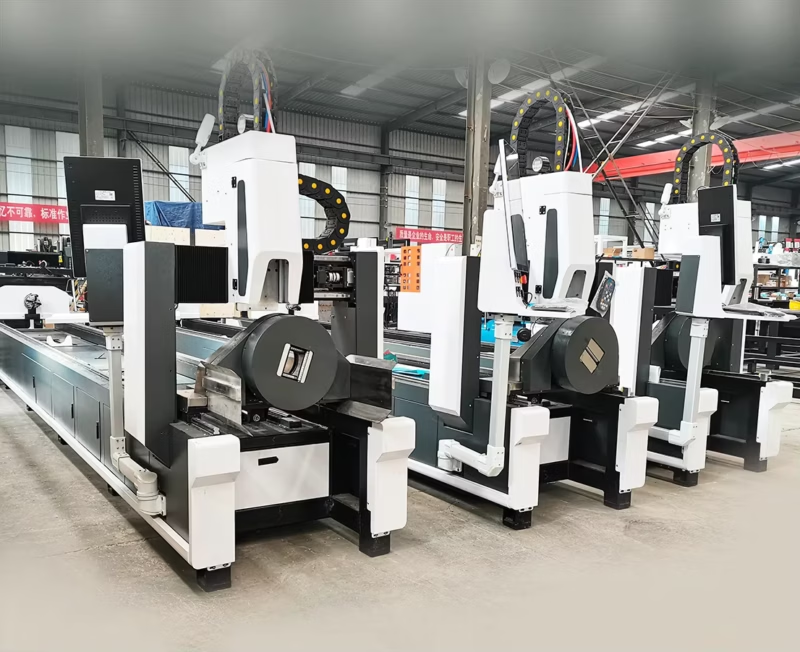
The system excels in high-difficulty intersection cutting. Heavy construction requires “saddle cuts” and complex bevels where multiple tubes meet at varying angles. Achieving the required tolerances for these intersections manually is nearly impossible without significant grinding and gap-filling during welding. The integrated robotic arm provides the necessary degrees of freedom to perform 3D beveling, ensuring a “zero-gap” fit. This precision directly reduces the volume of welding consumables required and significantly shortens the time spent by certified welders on the assembly floor.
Technical Performance and Maintenance Reliability
To handle the weight of large-diameter, thick-walled tubes, the machine utilizes a reinforced CNC rail system. The longevity of these rails is maintained through automated CNC rail lubrication. Manual lubrication is often neglected in harsh industrial environments, leading to friction-induced positioning errors. The automated system delivers precise volumes of lubricant based on the distance traveled by the gantry, ensuring Kinematic Precision remains consistent over years of operation. The integration of a robotic arm for loading and unloading further removes the physical strain from the process, allowing for 24/7 operation with minimal human intervention.
Technical Comparison: Manual vs. Integrated Robotic Tube Laser
| Feature | Conventional Manual Process | Integrated Robotic Laser System |
|---|---|---|
| Processing Lead Time | 72 Hours (Avg. Batch) | 3 Hours (Avg. Batch) |
| Material Utilization | ~80% | >95% |
| Cutting Accuracy | +/- 1.5mm to 3.0mm | +/- 0.1mm to 0.3mm |
| Labor Requirement | 1 Semi-Skilled Operator | |
| Operational Safety | High Exposure (Saws/Dust) | Fully Enclosed (Low EHS Risk) |
EHS Compliance and Workforce Integration
Environmental, Health, and Safety (EHS) standards are increasingly stringent in the heavy construction sector. Traditional tube cutting is a significant source of high-frequency noise and airborne metallic dust. The integrated laser system is housed in a full safety enclosure equipped with a high-capacity Dust Extraction system. This reduces the factory noise floor to levels below OSHA’s hearing conservation thresholds and eliminates the inhalation risk of metal particulates.
The transition to automation also addresses the demographic shift in the industrial workforce. Heavy construction often struggles to recruit young talent due to the perceived physical hardship of the work. The modern CNC interface simplifies the operation of complex machinery. With an intuitive HMI (Human-Machine Interface), a new operator can be fully trained in just two days. The role shifts from heavy manual lifting to digital system monitoring, making the profession more attractive to a tech-literate generation and ensuring the continuity of production capacity.
Conclusion: The Economic Imperative
Investing in an automatic tube laser machine with a robotic arm is no longer an optional upgrade; it is a fundamental requirement for heavy construction firms seeking to maintain profitability. The combination of 95% material utilization, the drastic reduction in lead times, and the ability to meet strict EHS guidelines provides a measurable ROI within the first 18-24 months of operation. By automating the most difficult aspects of tube fabrication, manufacturers can ensure structural consistency while drastically reducing the cost per part.
-

LT240S tube laser cutting machine
-
LT120S tube laser cutting machine
-
Sale

Tank Fillet Welding Machine
Original price was: $1,000.00.$900.00Current price is: $900.00. -
Sale

MAK100 tube laser cutting machine
Original price was: $5,500.00.$5,000.00Current price is: $5,000.00. -

portable plasma air cutting machine
$1,200.00 -

2in1 fiber laser cutting machine
-

Air cooling Laser welding machine
-

HF h beam laser cutting machine
-

LT240 laser cutting machine
-

Laser welding machine
-

Cobot Welding Station
-

Gantry welding robot solution
-

Tracked Wheeled AGV Welding robot
-

LFH6020 Fiber laser cutting machine
-
LFP6020
-

robotic welidng machine
Advanced Fiber Laser Tube Processing Technology
Our CNC Fiber Laser Tube Cutting systems revolutionize metal fabrication by integrating high-precision cutting, punching, and profiling into a single automated workflow. Designed for versatility, this technology handles a wide array of profiles including Round, Square, Rectangular, and Oval tubes, as well as complex L-shaped and U-shaped channels.
- Precision Punching: High-speed hole punching with micron-level accuracy, eliminating the need for mechanical drilling or die-stamping.
- Complex Profiling: Advanced 3D pathing allows for intricate interlocking joints and specialized notch cuts, ideal for structural frames.
- High Material Efficiency: Intelligent nesting software minimizes scrap, reducing raw material costs across large production runs.
- Clean Finish: Delivers oxide-free, burr-free edges that require zero secondary grinding before welding.

Seamlessly processing multiple profiles with consistent precision.
Global Delivery & Logistics



From our high-tech manufacturing facility directly to your global site. PCL WeldCut ensures secure packaging, professional handling, and reliable international logistics to safeguard your equipment throughout the entire journey.
