Automatic Girth Seam Welder with Laser Seam Tracking for Pressure Vessels

In this article
- Strategic Implementation of Automatic Girth Seam Welding
- Technical Mechanism of MAG Welding in Girth Seams
- Laser Seam Tracking: Precision Path Correction
- Labor ROI and Economic Throughput Analysis
- Maintenance Protocols for Robotic Welding Cells
- Safety and Quality Compliance
- Conclusion for Industrial Strategy
Strategic Implementation of Automatic Girth Seam Welding
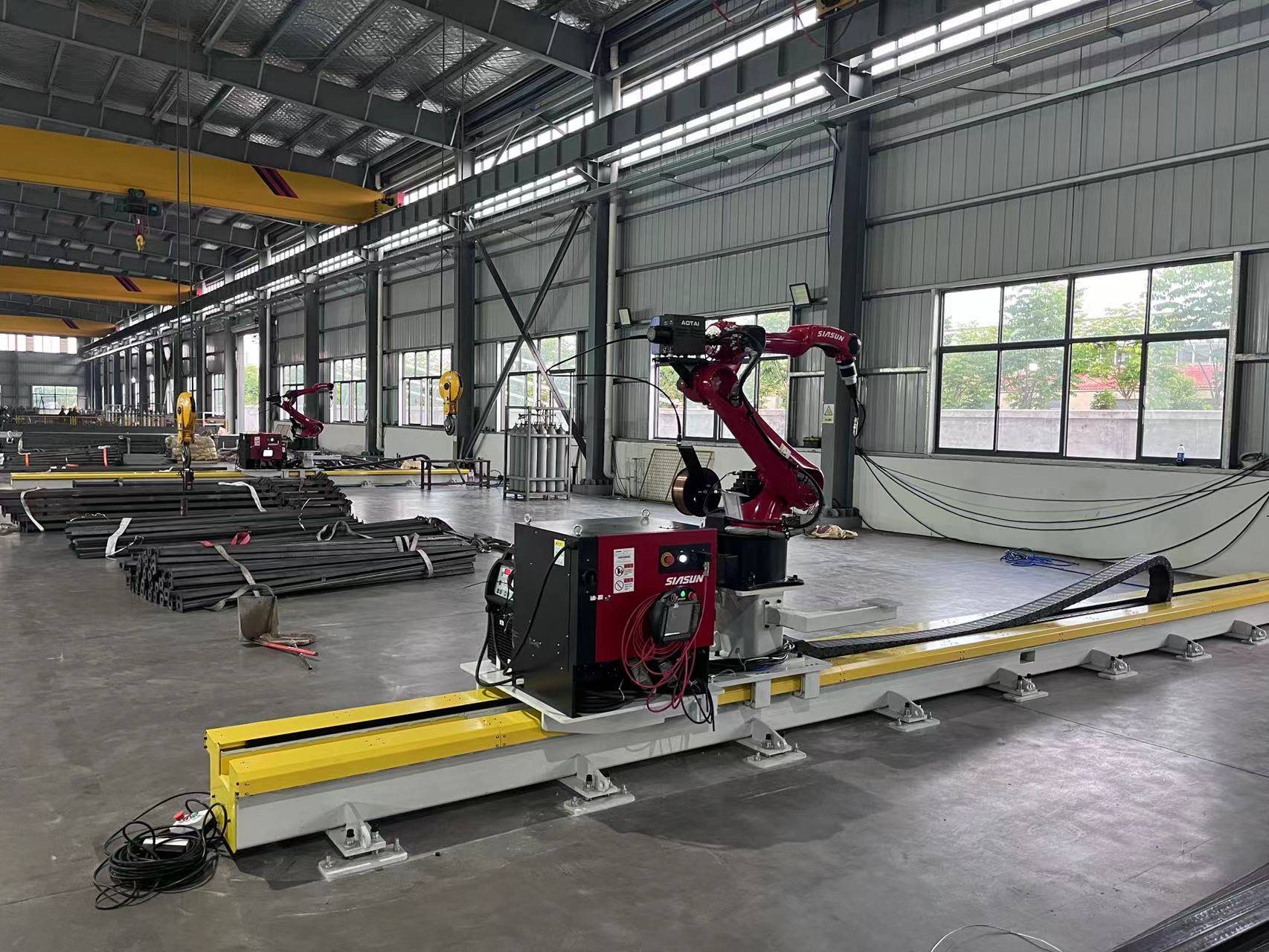
In the high-stakes environment of pressure vessel fabrication, the transition from manual or semi-automatic processes to fully integrated Robotic Welding systems is no longer a luxury but a fundamental requirement for operational scaling. Pressure vessels, governed by strict codes such as ASME Section VIII, demand absolute consistency in weld penetration and bead profile. The girth seam—the circumferential weld joining vessel shells or heads—presents unique challenges including heat build-up, gravity-induced puddle sag, and fit-up inconsistencies. Utilizing an Automatic Girth Seam Welder with Laser Seam Tracking addresses these variables with mathematical precision.
Technical Mechanism of MAG Welding in Girth Seams
The core of this robotic application is the Metal Active Gas (MAG) process. Unlike manual applications where the operator must adjust for arc length and travel speed variations, the robotic MAG system maintains a constant voltage and wire feed speed. For thick-walled pressure vessels, the system typically employs a multi-pass strategy. The first pass, or root pass, is the most critical. By using laser seam tracking, the robot can detect the precise center of the V-groove or U-groove preparation, adjusting the torch position in real-time to compensate for deviations in the shell’s roundness or alignment.
MAG welding offers high deposition rates, particularly when utilizing pulse spray transfer modes. This mode reduces spatter and optimizes the heat-affected zone (HAZ), which is vital for maintaining the metallurgical integrity of the vessel steel. The integration of automatic girth seam welder technology ensures that the torch angle remains perpendicular to the tangent of the cylinder at all times, preventing defects such as undercut or lack of side-wall fusion that are common in manual circumferential welding.
Laser Seam Tracking: Precision Path Correction
The primary failure point in traditional automated welding is “drift.” Even with a precision-machined vessel shell, small thermal expansions during the welding process can shift the joint geometry. Laser seam tracking utilizes a triangulation sensor mounted ahead of the welding torch. This sensor projects a laser line across the joint, capturing the profile and feeding data back to the robot controller at frequencies exceeding 60Hz.
The controller processes this data to perform three-dimensional corrections. If the gap narrows or widens, the system can dynamically adjust travel speed or weave amplitude to ensure the weld volume remains constant. This level of adaptation is physically impossible for a human welder to maintain over an 8-hour shift, especially when dealing with the intense radiant heat generated by high-amperage MAG processes.
Labor ROI and Economic Throughput Analysis
The justification for investing in robotic girth seam welding is rooted in the Labor ROI. A standard manual welding operation for a large-diameter pressure vessel often yields an arc-on time of approximately 25% to 35% due to operator fatigue, repositioning, and cleaning. In contrast, a robotic cell achieves arc-on times of 75% to 85%.
Consider the following economic factors:
- Deposition Rate: Manual MAG typically delivers 2-3 kg/hr, while robotic systems optimized for girth seams can exceed 6-8 kg/hr through high-duty cycle configurations.
- Rework Rates: Manual rework on X-ray quality welds often hovers around 5-10%. Robotic systems with laser tracking frequently reduce this to under 1%, significantly lowering the cost of grinding and re-welding.
- Operator Allocation: One skilled technician can oversee two or three robotic stations simultaneously. This shifts the labor cost from “hands-on-torch” time to “process-supervision” time, effectively tripling the output per man-hour.
When calculating the payback period, industrial engineers must account for the reduction in consumable waste. Precise wire delivery and optimized shielding gas flow controlled by the robot’s PLC minimize the over-welding that often occurs in manual processes, where operators may leave excess reinforcement that requires secondary machining.
Maintenance Protocols for Robotic Welding Cells
System reliability is contingent upon a rigorous preventive maintenance (PM) schedule. Because robotic MAG welding operates at high duty cycles, consumable wear is accelerated compared to manual welding. The torch liner, contact tip, and gas nozzle are the primary wear items. In a high-volume girth seam environment, contact tips should be replaced at the start of every shift or every 10,000 meters of wire to prevent arc instability caused by “keyholing” of the tip orifice.
The laser seam tracking sensor requires specific attention. While designed for harsh environments, the protective lens of the sensor can accumulate weld spatter or fume residue. Utilizing an air knife or a motorized clear-shield roll is essential to maintain the clarity of the laser profile. Furthermore, the drive rolls in the wire feeder must be inspected weekly for groove wear to ensure consistent wire tension, which directly impacts the stability of the MAG arc.
Key Maintenance Checkpoints:
| Component | Frequency | Action |
|---|---|---|
| Contact Tip | Daily | Inspect for wear/replace |
| Laser Lens | Every 4 hours | Clean with approved solvent |
| Wire Liner | Weekly | Blow out with compressed air |
| Coolant Level | Weekly | Check for torch cooling efficiency |
Safety and Quality Compliance
Beyond the financial and technical gains, robotic integration enhances workplace safety. Welding girth seams on large vessels often requires operators to work in awkward ergonomic positions or at heights. Automating the process removes the worker from the immediate vicinity of the arc, reducing exposure to ultraviolet (UV) radiation and hazardous hexavalent chromium fumes common in stainless steel vessel fabrication. The consistency provided by the robotic welding system also ensures that every vessel produced meets the specific heat input requirements defined in the Welding Procedure Specification (WPS), simplifying the path to ISO and ASME certification.
Conclusion for Industrial Strategy
Transitioning to an automatic girth seam welder with laser tracking is a strategic move that aligns with Industry 4.0 principles. By focusing on the MAG process’s efficiency and the precision of laser-guided pathing, manufacturers can decouple their growth from the scarcity of high-level manual welders. The resulting increase in throughput, combined with a drastic reduction in weld defects, provides a sustainable competitive advantage in the global pressure vessel market. The ROI is realized not just in speed, but in the total elimination of variability in the production cycle.






