Automatic Girth Seam Welder with 5-Axis Beveling for Pressure Vessels

In this article
- Optimizing Pressure Vessel Throughput with Robotic Girth Seam Integration
- Technical Advantages of 5-Axis Beveling Kinematics
- MAG Welding Parameters and Metallurgical Integrity
- Maintenance Protocols for High-Availability Systems
- Labor ROI and Economic Impact Analysis
- Conclusion: Scalability through Technical Precision
Optimizing Pressure Vessel Throughput with Robotic Girth Seam Integration
In the high-stakes sector of pressure vessel manufacturing, the transition from manual submerged arc or manual stick welding to automated systems is no longer a luxury—it is a requirement for maintaining global competitiveness. The Girth Seam Welding process represents the most critical path in the assembly of cylindrical tanks, reactors, and heat exchangers. When these systems are integrated with 5-axis robotic manipulation, the engineering focus shifts from basic joinery to high-precision orbital control. This transition allows for the handling of variable groove geometries and complex beveling requirements that manual operators struggle to maintain over long shifts.
Industrial engineers must view the Automatic Girth Seam Welder not merely as a machine, but as a centralized production cell. The core advantage lies in the consistency of the Metal Active Gas (MAG) application. Unlike manual processes where travel speed and torch angle fluctuate with operator fatigue, a robotic system maintains a constant feed rate and stick-out distance, ensuring the heat-affected zone (HAZ) remains within the narrow parameters defined by the Welding Procedure Specification (WPS).
Technical Advantages of 5-Axis Beveling Kinematics
The addition of 5-axis movement to a girth seam welder provides the necessary degrees of freedom to perform 5-Axis Beveling and multi-pass welding on heavy-wall vessels. In standard 2-axis or 3-axis systems, the torch is often limited to a perpendicular or fixed-angle approach. However, pressure vessels frequently require J-grooves or compound V-grooves to ensure full penetration without excessive weld metal volume.
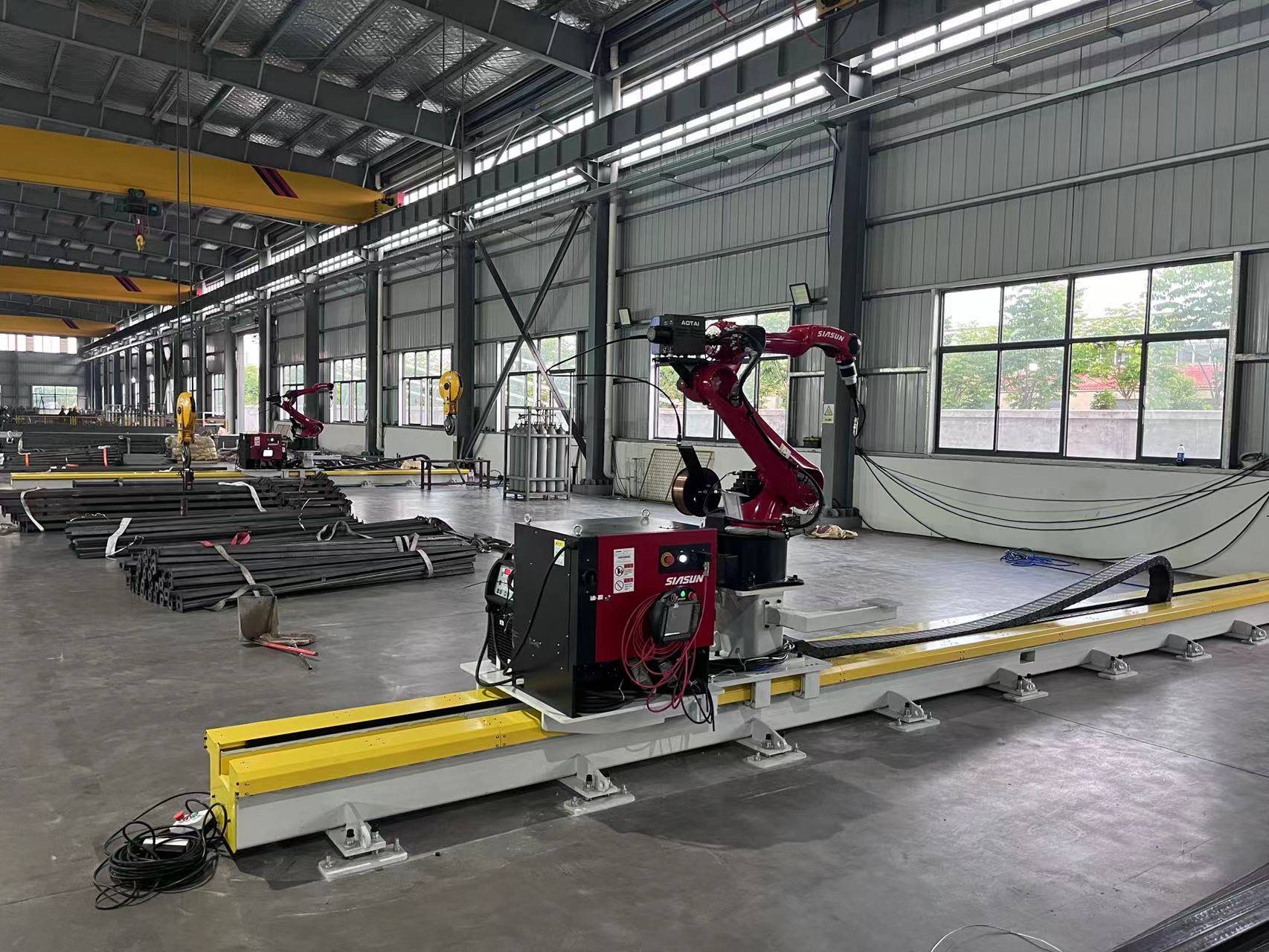
The 5-axis robotic head facilitates “weaving” patterns and torch oscillation that are synchronized with the rotation of the vessel. By dynamically adjusting the lead and lag angles, the system can compensate for gravity-induced puddle sag, which is a common defect in horizontal-position girth welding. For engineers, this means the ability to program variable bevel compensation directly into the controller, allowing the robot to “track” the seam even if the vessel shell has slight out-of-roundness tolerances. This level of adaptive control reduces the reliance on perfect fit-up, though high-quality fit-up remains a best practice for maximizing OEE (Overall Equipment Effectiveness).
MAG Welding Parameters and Metallurgical Integrity
The Robotic MAG Welding process is preferred in these automated cells due to its high deposition rates and lack of slag, which eliminates the need for inter-pass chipping. When welding carbon steel or stainless steel pressure vessels, the gas mixture (typically an Argon/CO2 blend) is tuned to provide a stable spray transfer mode. This minimizes spatter and ensures deep penetration into the root of the bevel.
From an industrial engineering perspective, the transition to MAG allows for continuous wire feeding, which significantly increases the “arc-on” time. While a manual welder might achieve a 30-40% duty cycle, a robotic girth welder can easily exceed 80%. The system’s ability to maintain a consistent volumetric flow of weld metal ensures that the mechanical properties of the seam—such as tensile strength and Charpy V-notch toughness—are uniform throughout the entire circumference of the vessel.
Maintenance Protocols for High-Availability Systems
To sustain the ROI of an automated welding cell, a rigorous preventive maintenance (PM) schedule is mandatory. Industrial robots operating in high-heat MAG environments are subject to fine particulate dust and thermal cycling. The maintenance strategy must focus on three primary subsystems: the wire drive assembly, the torch consumables, and the 5-axis kinematic alignment.
Consumable Management
The contact tip is the most frequent point of failure. Variations in the internal diameter of the tip due to erosion can cause arc instability. Automated cells should be equipped with “nozzle cleaning stations” that perform mechanical reaming and anti-spatter injection every X meters of weld. This reduces downtime and prevents mid-seam stops, which are detrimental to the integrity of a Pressure Vessel Fabrication project.
Wire Feed Path Integrity
The conduits and liners must be inspected weekly for metal shavings and kinking. Any friction in the wire feed path will manifest as “stuttering” in the arc, leading to porosity or lack of fusion. Engineers should implement a torque-monitoring system on the wire feeder to detect increases in friction before they lead to a system fault.
Calibration and Zeroing
Over time, the mechanical vibrations of the rotating vessel can shift the robot’s base or the rotators. Quarterly calibration of the 5-axis head ensures that the TCP (Tool Center Point) remains accurate within +/- 0.1mm. This precision is vital when performing narrow-gap welding where the margin for error in torch placement is non-existent.
Labor ROI and Economic Impact Analysis
The financial justification for an automatic girth seam welder is rooted in the “Cost per Pound of Weld Metal” metric. In a manual environment, the labor cost per pound is high due to the slow travel speeds and the necessity of highly skilled (and highly paid) certified welders. By automating the MAG process, the factory can reassign these skilled assets to more complex tacking and fit-up tasks, while the robot handles the repetitive, high-volume fill passes.
Reduction in Rework and Scrap
In pressure vessel manufacturing, a single failed X-ray on a girth seam can cost thousands of dollars in gouging, re-welding, and re-testing. Robotic systems provide a level of repeatability that virtually eliminates human-error defects like slag inclusions or erratic travel speeds. Calculating the reduction in the “Repair Rate” is a primary component of the ROI model. If the repair rate drops from 5% to less than 0.5%, the system often pays for itself within the first 12 to 18 months of operation.
Labor Displacement vs. Upskilling
While the robot replaces the physical act of welding, it creates a need for “Robotic Technicians.” This shift allows the plant to increase its total output without a linear increase in headcount. In a labor market where certified pressure vessel welders are in short supply, automation provides a hedge against labor shortages. The ROI is further bolstered by the reduction in Health, Safety, and Environment (HSE) costs, as operators are removed from the immediate vicinity of welding fumes and intense UV radiation.
Conclusion: Scalability through Technical Precision
For the industrial engineer, the implementation of an automatic girth seam welder with 5-Axis Beveling is a strategic move toward a “smart factory” environment. By focusing on the nuances of MAG welding parameters, maintaining the mechanical integrity of the 5-axis head, and leveraging the data for continuous ROI improvement, manufacturers can achieve a level of throughput and quality that manual processes simply cannot match. The future of pressure vessel production lies in this synergy of heavy-duty kinematics and precision welding control.






