Intelligent Robotic Welder with Zero-tailing technology for Bridge Trusses

In this article
Engineering Precision in Heavy Infrastructure Welding
Bridge truss fabrication represents one of the most demanding sectors in structural engineering, requiring deep-penetration welds capable of weathering decades of cyclic loading and environmental stress. Traditionally, these trusses are joined using manual or semi-automatic Metal Active Gas (MAG) welding. However, the sheer volume of weld metal required for thick-plate gussets and chords introduces significant variables in quality and consistency. The integration of MAG welding automation through intelligent robotics addresses these variables by providing a stabilized arc environment and repeatable travel speeds that human operators cannot maintain over an eight-hour shift.
The core challenge in bridge truss work is the scale. Chords can exceed twenty meters, and the complexity of the geometry often results in restricted access for human welders. Robotic systems equipped with multi-axis gantries allow for continuous welding across these long spans. By utilizing advanced sensor fusion—combining tactile sensing with arc voltage monitoring—the robot can compensate for minor deviations in fit-up or thermal distortion in real-time. This ensures that the weld bead remains perfectly centered in the joint, maintaining the required throat thickness and leg length without the need for constant manual intervention.
Understanding Zero-Tailing Technology in MAG Processes
In the context of industrial welding, “tailing” refers to the wasted wire and the inconsistent crater formation that occurs at the start and end of a weld path. In massive bridge trusses, where there may be hundreds of individual weld starts and stops, the cumulative waste of wire and the time spent grinding down “tails” or “pigtails” represents a significant drain on efficiency. Zero-tailing technology utilizes high-speed wire retract and burn-back control algorithms to ensure the wire tip is perfectly prepped for the next arc ignition.
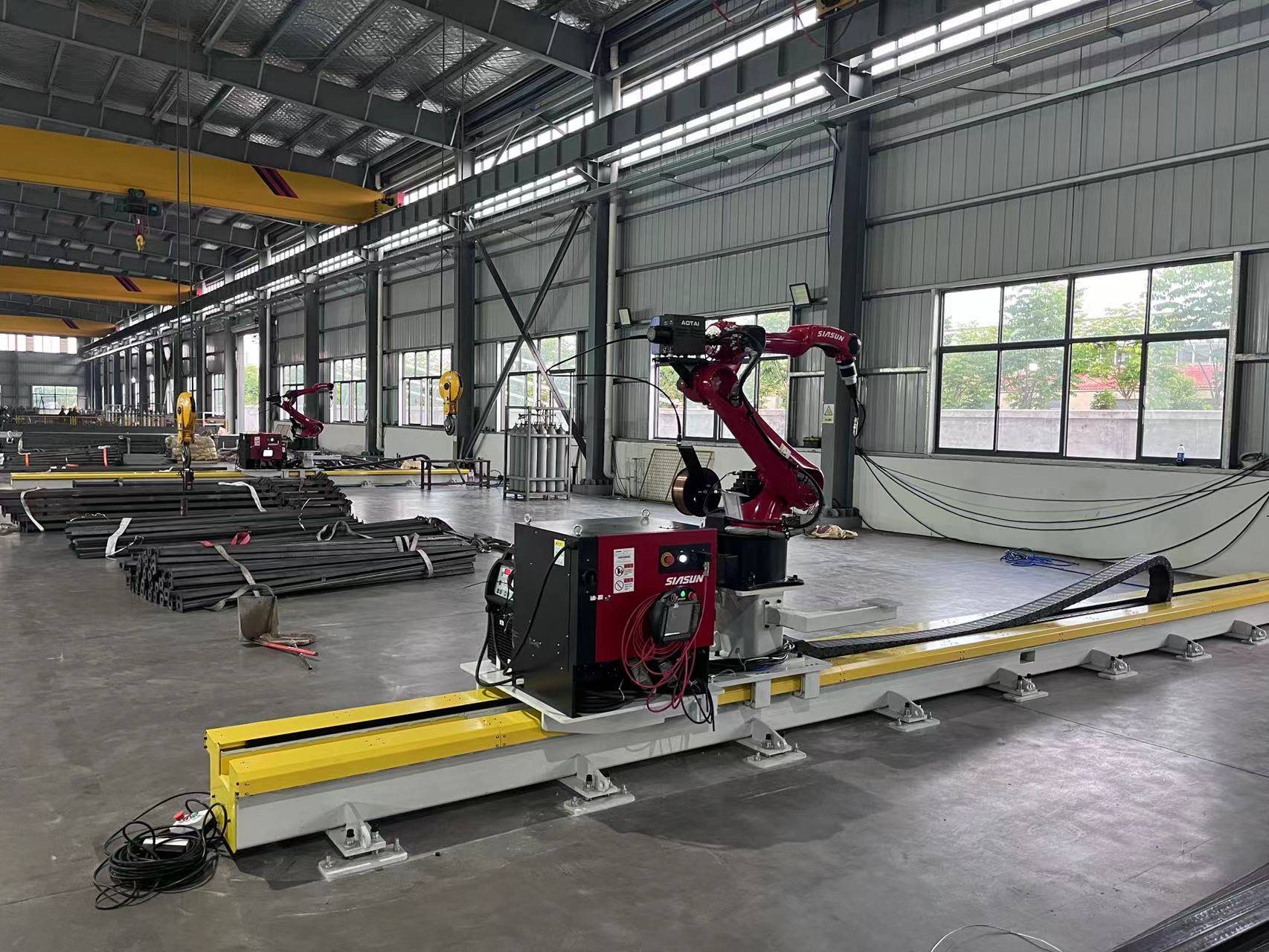
When the robot reaches the end of a weld segment, the controller executes a precision pulse sequence that collapses the molten pool without leaving a protrusion. Simultaneously, the wire is retracted a specific distance into the contact tip. This prevents the wire from sticking to the cooling puddle—a common issue in high-amperage MAG welding. For the bridge engineer, this means the end of each weld pass is structurally sound, reducing the risk of crater cracks which are notorious points of fatigue failure in infrastructure. Furthermore, the elimination of manual “sniping” of the wire between welds increases the “arc-on” time, directly impacting the daily throughput of the fabrication shop.
Optimization of Metal Active Gas (MAG) Parameters
for Bridge Trusses, the MAG process typically employs a shielding gas mixture of Argon and CO2 to balance penetration depth with bead appearance. Robotic integration allows for the use of “Modified Pulse” or “Spray Transfer” modes that operate at the high end of the voltage spectrum. Because the robot maintains a constant contact-to-work distance (CTWD), the system can run at significantly higher deposition rates than manual processes. While a manual welder might achieve 3-4 kg of weld metal per hour, a robotic system can consistently reach 8-12 kg per hour depending on the wire diameter and power source capabilities.
The intelligence of the system lies in its ability to adjust wire feed speed and travel speed dynamically. As the robot senses a change in the gap width of a V-groove joint, it can widen its weave pattern and slow its travel speed to ensure full fusion. This level of control is critical for bridge trusses where AWS D1.5 (Bridge Welding Code) compliance is mandatory. The robotic controller logs every parameter—current, voltage, gas flow, and speed—providing a digital birth certificate for every joint, which simplifies the non-destructive testing (NDT) and inspection process.
Maintenance Protocols for High-Duty Cycle Robotics
From an industrial engineering perspective, the reliability of the robotic cell is measured by its Mean Time Between Failures (MTBF). In a bridge truss environment, the primary maintenance concerns are the welding torch consumables and the wire delivery system. High-amperage MAG welding generates intense radiant heat, which can degrade contact tips and gas nozzles rapidly. Automated torch cleaning stations are integrated into the cell to perform “reaming” and anti-spatter injection every few cycles. This prevents spatter build-up that could disrupt gas flow and cause porosity in the weld.
Preventative maintenance schedules must focus on the wire liners and feed rollers. Given the high volume of wire consumed in structural steel fabrication, even minor friction in the liner can lead to “bird-nesting” at the feeder, resulting in hours of downtime. Implementing a scheduled replacement of liners based on the total weight of wire pulled is a standard best practice. Furthermore, the robotic arm itself requires periodic calibration of its Tool Center Point (TCP) to ensure that the zero-tailing logic remains accurate to within tenths of a millimeter. Regular inspections of the cable harness are also vital, as the constant motion of the arm can cause internal fatigue in the power leads.
Labor ROI and Economic Impact Analysis
The Return on Investment for an intelligent Robotic Welding system in bridge fabrication is not merely a matter of replacing one welder with one machine. It is a fundamental shift in labor utilization. In a manual environment, a significant portion of a welder’s time is spent on non-value-added activities: positioning, cleaning spatter, changing electrodes, and waiting for cranes. A robotic cell changes the role of the skilled welder from a manual laborer to a “Robotic Technician” or “Cell Operator.”
Consider the following ROI metrics:
First, the deposition efficiency. A robot can maintain an arc-on time of 75-85%, compared to 25-30% for a manual welder on heavy trusses. This effectively triples the output per shift. Second, the reduction in rework. Because the robot follows a programmed path with sensor-based corrections, the incidence of UT (Ultrasonic Testing) or RT (Radiographic Testing) failures drops by up to 90%. In bridge work, where repairing a deep-seated defect can cost ten times the original weld cost, this saving is massive.
Furthermore, the labor shortage in the welding industry is particularly acute for heavy structural work. Finding welders capable of producing X-ray quality multi-pass welds in awkward positions is increasingly difficult. A robotic system allows a single technician to oversee two or three welding cells, effectively multiplying the available workforce capacity without increasing headcount. When factoring in the reduction in consumable waste provided by zero-tailing technology and the decreased need for post-weld grinding, most bridge truss facilities see a full capital recovery within 18 to 24 months of commissioning.
Strategic Integration and Future Scalability
Implementing an Intelligent Robotic Welder is a strategic move toward Industry 4.0. The data collected by the system—ranging from gas consumption rates to arc stability indices—allows management to identify bottlenecks in the upstream fit-up process. If the robot frequently slows down to compensate for wide gaps, it indicates that the previous fitting or tacking stage requires adjustment. This feedback loop creates a culture of precision throughout the entire production line.
In conclusion, for bridge truss manufacturers, the transition to intelligent robotic MAG welding is no longer optional for those wishing to remain competitive in large-scale infrastructure projects. The combination of high-deposition throughput, the precision of zero-tailing technology, and the massive ROI from labor optimization provides a clear path to increased profitability and superior structural quality. By focusing on the mechanics of the weld and the efficiency of the robotic lifecycle, industrial engineers can ensure that the bridges of tomorrow are built with a level of consistency and integrity that manual processes simply cannot match.






