Intelligent Robotic Welder with Laser Seam Tracking for Bridge Trusses

In this article
Advanced Robotic MAG Welding in Infrastructure Fabrication
The structural steel industry, particularly in the context of bridge truss fabrication, faces a dual challenge: increasingly stringent quality standards and a diminishing pool of highly skilled certified welders. From an industrial engineering perspective, the integration of Robotic Welding automation into the production line is no longer an optional upgrade but a strategic necessity for maintaining throughput. Unlike traditional manual setups, an intelligent robotic cell provides the consistency required for multi-pass welds on heavy-gauge steel, ensuring that the structural integrity of bridge components meets AASHTO and AWS D1.5 requirements without the variability inherent in human performance.
The Mechanics of Laser Seam Tracking for Heavy Trusses
Large-scale bridge trusses often present fit-up challenges. Despite precision jigging, thermal expansion and slight material deviations in long-span steel members can result in joint gaps that vary by several millimeters. Manual adjustment during welding is slow and prone to error. Intelligent laser seam tracking technology solves this by mounting a high-resolution optical sensor ahead of the MAG torch. This sensor scans the joint geometry in real-time, providing the robot controller with high-speed data feedback.
The system adjusts the torch position and welding parameters—such as wire feed speed and travel speed—on the fly. This “look-ahead” capability ensures that the arc remains perfectly centered in the root of the joint, even if the truss member has slight warping. By maintaining a constant stick-out and optimal torch angle, the robotic system eliminates the risk of lack of fusion or undercut, which are common failure points in structural inspections.
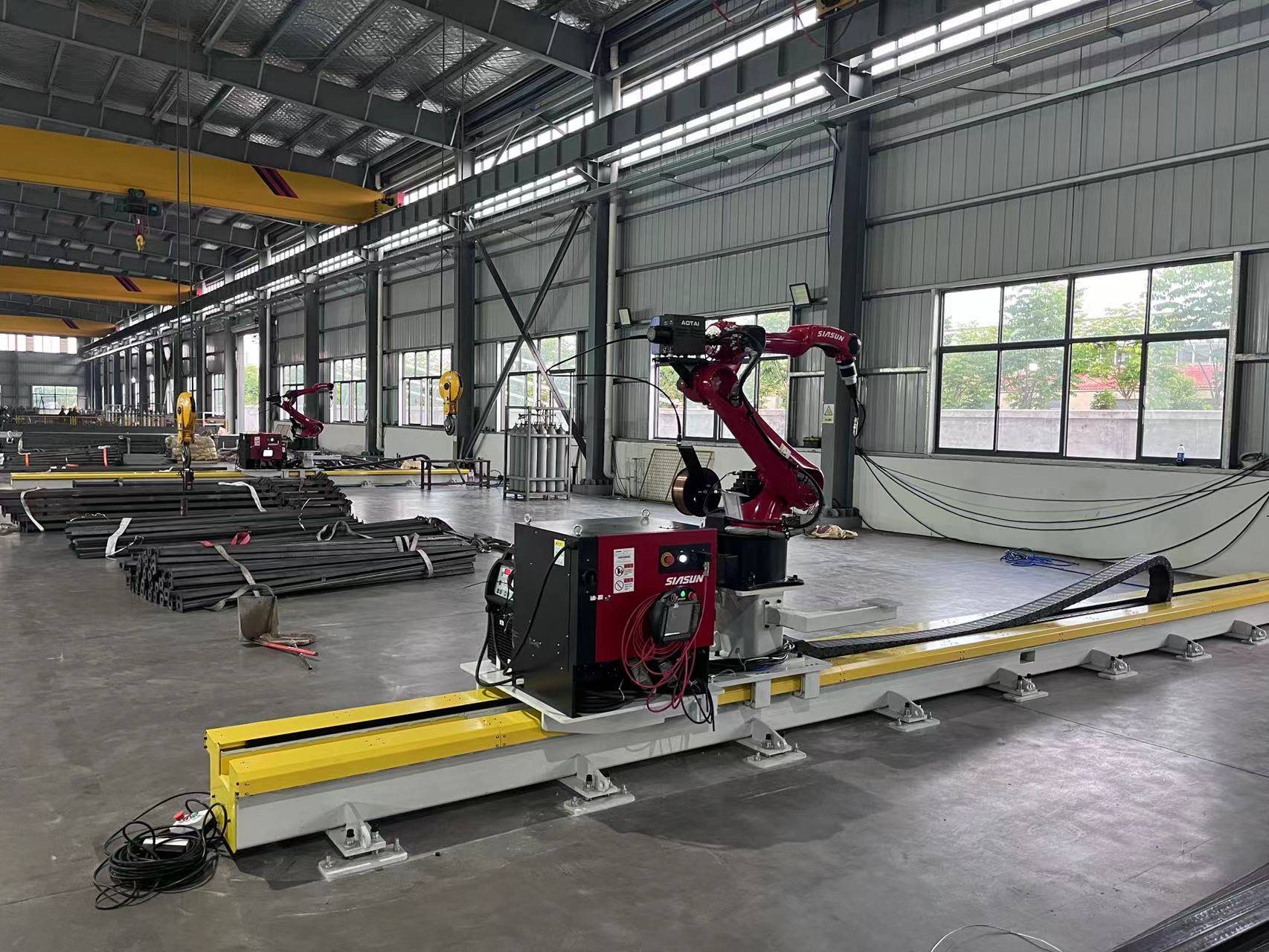
Calculating Labor ROI and Throughput Capacity
When evaluating the labor return on investment for robotic systems, industrial engineers must look beyond simple hourly wage comparisons. A manual welder typically operates at a 20-30% duty cycle, factoring in breaks, setup, and repositioning. A robotic cell, conversely, can achieve duty cycles exceeding 85%. In a typical two-shift operation, a single robotic welder can replace the output of three to four manual welding stations.
The ROI calculation includes the reduction in “arc-off” time and the substantial decrease in post-weld rework. In bridge fabrication, a single failed NDT (Non-Destructive Testing) report can cost thousands of dollars in gouging, re-welding, and re-inspection. By achieving first-pass yields of nearly 99%, the robotic system minimizes these hidden costs. Furthermore, by delegating the physically demanding and hazardous MAG welding tasks to a robot, the existing workforce can be upskilled to operate the cells, improving employee retention and reducing long-term workers’ compensation claims related to repetitive strain or fume exposure.
Optimizing the MAG Welding Process for Deep Penetration
The Metal Active Gas (MAG) process is preferred for Bridge Trusses due to its high deposition rates and ability to handle thick-plate steel. In an automated environment, engineers can utilize pulsed spray transfer modes that would be difficult for a manual welder to maintain over long durations. This results in deeper penetration and a smaller Heat Affected Zone (HAZ), which is critical for the fatigue life of bridge components.
The MAG welding process parameters—including voltage, amperage, and gas flow—are digitally synchronized with the robot’s motion profile. This synchronization allows for the implementation of “weaving” patterns that are mathematically optimized to fill wide grooves in bridge chords. The result is a weld bead with superior aesthetic quality and mechanical properties that consistently exceed the minimum tensile strength requirements of structural steel grades like A709.
Preventive Maintenance and System Uptime
To maintain the high ROI of an automated cell, a rigorous maintenance framework must be established. Robotic welding systems are precision instruments that operate in harsh, spatter-heavy environments. Industrial engineering protocols should prioritize the “Front-End” of the torch. This includes the regular inspection and replacement of contact tips, nozzles, and liners.
Advanced robotic controllers now offer predictive maintenance alerts based on wire feed motor torque. If the torque increases, it typically indicates a clog in the liner or a worn contact tip, allowing maintenance teams to intervene before a failure occurs during a critical truss weld. Automated torch cleaning stations, which include a reamer and anti-spatter spray applicator, should be programmed into the cycle every 30 to 60 minutes of arc time. This ensures that the gas shroud remains clear, preventing porosity in the weld metal.
Operational Synergy: Hardware and Software Integration
The true “intelligence” of the system lies in the integration between the Offline Programming (OLP) software and the physical robot. OLP allows engineers to simulate the welding of a complex bridge truss in a virtual environment, identifying potential collisions and optimizing the sequence of welds to manage thermal distortion. Once the program is verified, it is uploaded to the controller, where the laser seam tracker compensates for the “real-world” differences between the CAD model and the physical workpiece.
This synergy reduces the setup time for new truss designs, making automation viable even for low-volume, high-complexity infrastructure projects. The ability to log every weld’s parameters provides a “digital birth certificate” for the bridge component, which is increasingly requested by government transport agencies for long-term asset management and traceability.
Strategic Conclusion for Industrial Implementation
The transition to intelligent robotic welding for bridge trusses is a fundamental shift in how we approach infrastructure durability. By leveraging MAG processes optimized by laser feedback, fabricators can produce welds that are superior to manual efforts in both speed and quality. The labor ROI is substantiated not just by headcount reduction, but by the elimination of errors and the massive increase in total tonnage output per square foot of shop space. As the industry moves toward more complex, accelerated bridge construction (ABC) techniques, the precision and reliability of robotic cells will be the primary driver of competitive advantage in the structural steel sector.






