Tank Fillet Welding Machine with Magnetic Crawler for Bridge Trusses – Labor Cost Reduction
In the contemporary landscape of heavy industrial fabrication, the construction of large-scale infrastructure such as petroleum storage tanks and complex bridge trusses demands a level of precision and efficiency that manual processes can no longer sustain economically. As a professional industrial engineer, the focus is increasingly directed toward the integration of semi-automated and fully automated systems to mitigate the rising costs of skilled labor and the inherent variability of human performance. The magnetic crawler fillet welding machine represents a pivotal advancement in this sector, providing a robust solution for long-distance, continuous welding in challenging orientations.
Technical Foundations of Magnetic Adhesion and Mobility
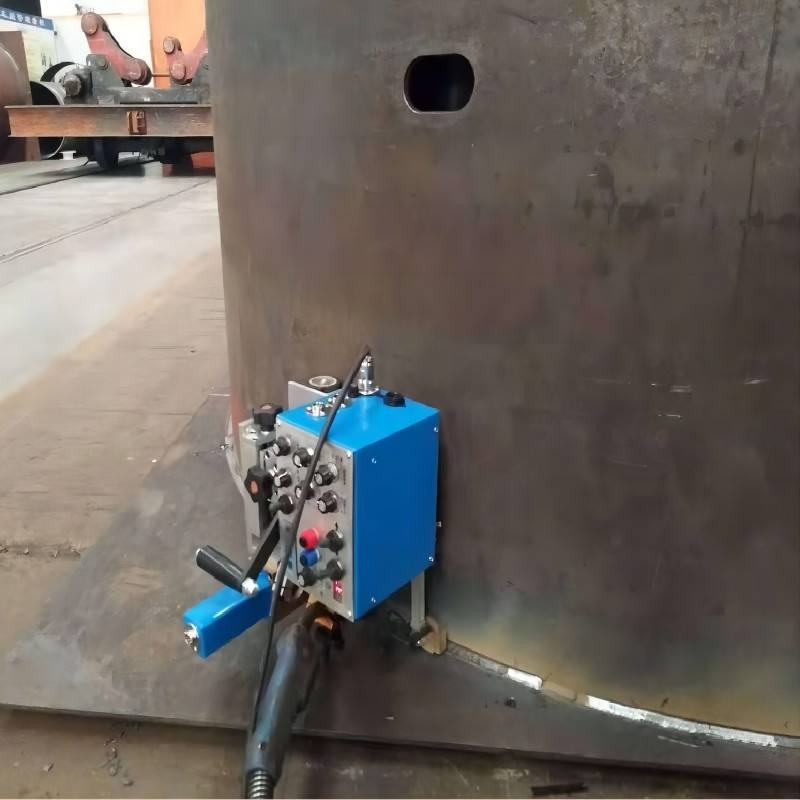
The primary challenge in welding large vertical surfaces or overhead bridge truss components is maintaining a consistent torch position relative to the workpiece. Traditional manual welding requires scaffolding, fall protection, and constant repositioning, all of which contribute to significant non-productive time. The magnetic crawler utilizes high-energy permanent magnets or switchable electromagnets integrated into its chassis or drive wheels. These magnets generate a powerful adhesive force, allowing the machine to track along carbon steel surfaces with high stability, even when defying gravity on vertical shell plates or the undersides of bridge flanges.
The traction system is typically driven by high-torque DC stepper or servo motors, ensuring that the travel speed remains constant regardless of the weight of the welding lead or the orientation of the machine. This constancy is critical for fillet welding, where the heat input and travel speed directly dictate the leg length and throat thickness of the weld bead. By automating the movement, the machine eliminates the “stop-and-start” irregularities common in manual welding, which are frequent sites for porosity and slag inclusions.
Applications in Large-Scale Infrastructure
In the construction of storage tanks (specifically API 650/653 standards), the fillet welds between the tank floor and the first shell course, as well as the vertical seams between plates, are high-volume tasks. A magnetic crawler can be deployed to run the internal and external fillet welding seams with minimal supervision. For bridge trusses, where long longitudinal fillets connect the web plates to the flanges, the crawler provides a steady path that manual operators simply cannot replicate over distances exceeding several meters.
These machines are designed to accommodate various welding processes, most commonly Gas Metal Arc Welding (GMAW) and Flux-Cored Arc Welding (FCAW). The crawler carries the welding torch on an adjustable arm, often equipped with a motorized oscillation unit. This oscillation allows for the creation of wider weave beads, which are essential for thicker structural sections where a single-pass stringer bead would be insufficient for the required structural integrity.
Quantifying Labor Cost Reductions
The implementation of automated crawler systems is driven by a clear economic imperative: the reduction of total man-hours per linear meter of weld. To understand the labor cost reduction, we must analyze the components of a typical welding shift.
Arc-on Time Optimization
In manual welding operations, the “arc-on” time—the actual time spent depositing metal—typically fluctuates between 25% and 35% of a welder’s shift. The remainder of the time is consumed by repositioning, cleaning, changing electrodes, and fatigue-related breaks. A magnetic crawler increases the duty cycle to 70% or higher. Because the machine does not suffer from physical fatigue and can maintain a continuous arc over the entire length of a 12-meter plate, the productivity per operator is effectively doubled or tripled.
Personnel Reallocation
Automation allows for a shift in labor dynamics. A single technician can oversee the operation of two or even three crawlers simultaneously. Instead of requiring three highly skilled welders to perform manual fillets, a project can utilize one technician to manage the automation units. This reduces the headcount required on-site, lowering the costs associated with insurance, site housing, and safety oversight.
Reduction in Post-Weld Rework
Rework is one of the most significant “hidden” costs in industrial fabrication. Manual fillet welds are prone to undercut, overlap, and inconsistent penetration, especially in the vertical-up position. Each defect requires grinding and re-welding, which can cost three to five times more than the initial weld. The precision of a magnetic crawler ensures that parameters remain within the qualified Welding Procedure Specification (WPS) at all times, leading to a first-time pass rate for NDT (Non-Destructive Testing) that often nears 99%.
Engineering Design for Field Stability
Industrial environments, particularly bridge sites and tank farms, are far from the controlled conditions of a laboratory. Field stability is achieved through several engineering features:
- Self-Tracking Mechanisms: Most crawlers utilize guide rollers that hug the joint geometry, ensuring the torch stays centered in the root of the fillet even if the plate has slight curvatures.
- Environmental Shielding: The control units are usually IP-rated to withstand dust, moisture, and the extreme heat generated during continuous high-amperage welding.
- Remote Control Interfaces: Operators can adjust travel speed, oscillation width, and voltage via a remote pendant. This keeps the operator at a safe distance from fumes and heat, further improving working conditions and reducing health-related downtime.
Drive Systems and Traction Control
The drive system must account for the weight of the “umbilical” (the cables and hoses). High-end crawlers utilize 4-wheel drive systems with specialized high-friction coatings on the magnetic wheels to prevent slipping on mill scale or primed surfaces. This ensures that the labor cost reduction isn’t negated by machine failures or the need for constant manual intervention.
Integrated Oscillation and Torch Positioning
For bridge truss applications, the fillet size may vary. The integration of a motorized slide allows the operator to perform multi-pass welds without detaching the machine. By simply adjusting the torch offset and repeating the path, the machine maintains perfect interpass alignment, which is critical for the fatigue resistance required in bridge structures.
Conclusion
The transition from manual to semi-automated fillet welding using magnetic crawler technology is no longer an optional upgrade for competitive firms; it is a structural necessity. By focusing on the magnetic crawler as the primary vehicle for deposition, industrial projects can achieve a level of consistency and speed that is unattainable by human hands alone. The resulting labor cost reduction is realized not just through faster travel speeds, but through the systemic elimination of rework, the optimization of arc-on time, and the ability to operate with a leaner, more specialized workforce. As bridge trusses and storage tanks continue to grow in scale and complexity, the reliance on these high-stability, automated systems will remain the hallmark of efficient industrial engineering.
-


LT240S tube laser cutting machine
-
LT120S tube laser cutting machine
-
Sale

Tank Fillet Welding Machine
Original price was: $1,000.00.$900.00Current price is: $900.00. -
Sale

MAK100 tube laser cutting machine
Original price was: $5,500.00.$5,000.00Current price is: $5,000.00. -

portable plasma air cutting machine
$1,200.00 -

2in1 fiber laser cutting machine
-

Air cooling Laser welding machine
-

HF h beam laser cutting machine
-

LT240 laser cutting machine
-

Laser welding machine
-


Cobot Welding Station
-

Gantry welding robot solution
-

Tracked Wheeled AGV Welding robot
-

LFH6020 Fiber laser cutting machine
-
LFP6020
-

robotic welidng machine
Advanced Fiber Laser Tube Processing Technology
Our CNC Fiber Laser Tube Cutting systems revolutionize metal fabrication by integrating high-precision cutting, punching, and profiling into a single automated workflow. Designed for versatility, this technology handles a wide array of profiles including Round, Square, Rectangular, and Oval tubes, as well as complex L-shaped and U-shaped channels.
- Precision Punching: High-speed hole punching with micron-level accuracy, eliminating the need for mechanical drilling or die-stamping.
- Complex Profiling: Advanced 3D pathing allows for intricate interlocking joints and specialized notch cuts, ideal for structural frames.
- High Material Efficiency: Intelligent nesting software minimizes scrap, reducing raw material costs across large production runs.
- Clean Finish: Delivers oxide-free, burr-free edges that require zero secondary grinding before welding.

Seamlessly processing multiple profiles with consistent precision.
Global Delivery & Logistics



From our high-tech manufacturing facility directly to your global site. PCL WeldCut ensures secure packaging, professional handling, and reliable international logistics to safeguard your equipment throughout the entire journey.