Engineering Review: Single Pulse MAG Cobot Welder – Rotterdam, Netherlands
In this article
- Field Technical Report: Implementation of Single Pulse MAG Cobot Welder in Rotterdam…
- 1. Site Context and Equipment Specification
- 2. Practical Application: Mild Steel Welding Parameters
- 3. Synergy Between MAG Cobot Welder and Arc Welding Solutions
- 4. Lessons Learned: The Rotterdam Field Observations
- 5. Technical Deep Dive: Heat-Affected Zone (HAZ) Control
- 6. The Economic Impact of Automated Arc Welding Solutions
- 7. Final Technical Summary and Recommendations
Field Technical Report: Implementation of Single Pulse MAG Cobot Welder in Rotterdam Maritime Fabrication
This report details the operational deployment and performance analysis of a Single Pulse MAG Cobot Welder system at a heavy-duty fabrication facility in the Waalhaven area of Rotterdam, Netherlands. The objective was to integrate automated Arc Welding Solutions into a workflow dominated by high-volume Mild Steel welding, specifically targeting S355J2+N structural components used in offshore secondary steel structures.
1. Site Context and Equipment Specification
The Rotterdam facility operates under typical North Sea climatic conditions, where ambient humidity and temperature fluctuations significantly impact gas shielding integrity and wire surface oxidation. The transition from manual GMAW (Gas Metal Arc Welding) to a collaborative framework required a system that could handle the rigors of a drafty workshop while maintaining ISO 5817 Level B quality standards.
1.1 System Hardware
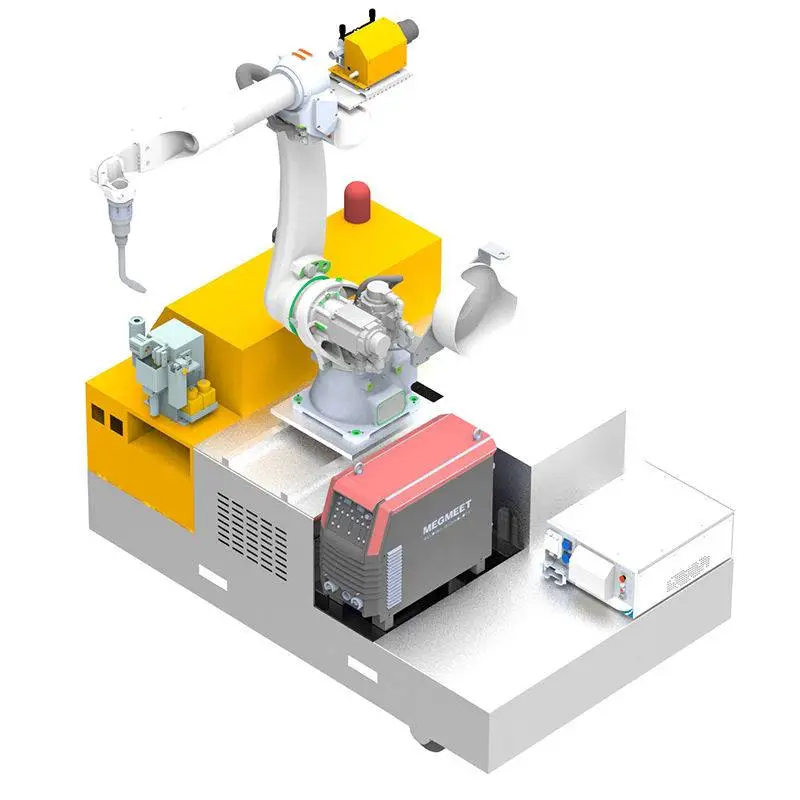
The deployed unit consists of a 6-axis collaborative arm integrated with a high-speed inverter power source. Unlike traditional industrial robots, this MAG Cobot Welder utilizes lead-through programming, allowing our senior welders to “teach” the path without deep knowledge of RAPID or KRL coding. The power source was configured for Single Pulse MAG to mitigate the common issues of spatter and excessive heat input associated with standard globular or spray transfer modes on Mild Steel welding.
2. Practical Application: Mild Steel Welding Parameters
The primary focus was the fabrication of 8mm to 12mm fillet welds on structural brackets. Mild Steel welding in these thicknesses often suffers from burn-through if travel speeds are inconsistent or lack of fusion if the arc is too cold. The Single Pulse functionality provides a controlled droplet-per-pulse transfer, which is critical for out-of-position welds (specifically PF and PD positions) frequently encountered in maritime assemblies.
2.1 Pulse Profile Optimization
During the Rotterdam trials, we established a baseline pulse frequency of 120Hz to 180Hz. By adjusting the “Trim” (voltage equivalent in pulse mode), we achieved a flat bead profile with distinct wetting at the toes of the weld. This is a significant improvement over manual MAG, where operator fatigue often leads to slight undercut or overlap at the end of a long longitudinal seam.
3. Synergy Between MAG Cobot Welder and Arc Welding Solutions
The term Arc Welding Solutions encompasses more than just the power source; it involves the holistic integration of the wire delivery system, the shielding gas chemistry, and the digital feedback loops of the cobot. In a real-world Rotterdam workshop, this synergy is what prevents downtime.
3.1 Digital Integration and Feedback
Our Arc Welding Solutions included an Ethernet/IP communication bridge between the cobot controller and the welder. This allows for “on-the-fly” adjustments. If the cobot detects a change in torch-to-workpiece distance (stick-out), the power source compensates current levels instantaneously to maintain a constant arc length. In Mild Steel welding, particularly on large plates that may have slight thermal warping, this “Sense and Follow” capability is indispensable.
3.2 Gas Shielding and Consumables
We utilized an 82% Argon / 18% CO2 gas mixture. While 100% CO2 is cheaper for Mild Steel welding, the Single Pulse MAG Cobot Welder performs optimally with Argon-rich mixes to stabilize the pulse transition. In the Rotterdam port environment, we also implemented a high-performance torch cooling system to ensure the contact tip longevity during 100% duty cycle runs.
4. Lessons Learned: The Rotterdam Field Observations
Technical implementation is rarely as clean as a laboratory data sheet. Several site-specific challenges emerged during the first 30 days of operation.
4.1 Surface Contamination and Pre-cleaning
Rotterdam’s proximity to the North Sea means salt spray and high humidity are constant factors. Even with Mild Steel welding, which is relatively forgiving, we found that “shop primer” or light oxidation significantly destabilized the pulse arc. The MAG Cobot Welder is more sensitive to surface impedance than a manual welder who can “work the puddle.” Lesson learned: Mechanical cleaning of the weld zone (30mm from the joint) is non-negotiable for automated pulse applications.
4.2 Wire Feed Consistency
We initially experienced arc “stuttering.” Upon inspection, the 250kg bulk drums of G3Si1 wire were absorbing moisture at the surface layer. By moving to a climate-controlled wire feeding station—part of our upgraded Arc Welding Solutions—we eliminated hydrogen-induced porosity and arc instability. For Mild Steel welding in maritime climates, wire storage is as critical as the welding parameters themselves.
5. Technical Deep Dive: Heat-Affected Zone (HAZ) Control
One of the primary advantages of the Single Pulse MAG Cobot Welder is the reduction in total heat input compared to conventional spray transfer. In the Rotterdam facility, we were welding S355 steel, which is sensitive to grain growth in the HAZ if the cooling rate is too slow.
5.1 Comparative Analysis
- Conventional MAG: High heat input, wide HAZ, higher risk of plate distortion on 6mm stiffeners.
- Single Pulse MAG Cobot: Focused arc, 15-20% lower heat input, significantly reduced post-weld straightening requirements.
By leveraging the precision of the cobot’s travel speed (set at a constant 4.5 mm/s for an 8mm fillet), we maintained a consistent cooling rate (t8/5 time), ensuring the mechanical properties of the Mild Steel welding joints met the Charpy V-notch impact requirements at -20°C.
6. The Economic Impact of Automated Arc Welding Solutions
In the Dutch labor market, skilled welders are increasingly scarce. The MAG Cobot Welder does not replace the welder; it augments them. Our “Rotterdam Model” involved a senior welder setting the parameters and the “Master Path,” while a junior technician loaded the jigs and oversaw the cobot’s execution. This increased arc-on time from 30% (manual) to 75% (cobot).
6.1 Spatter Reduction and Post-Weld Processing
The use of Single Pulse technology nearly eliminated spatter. In Mild Steel welding, post-weld cleaning (grinding/chipping) can account for 20% of total labor costs. With the MAG Cobot Welder, the “as-welded” finish was clean enough for immediate NDT (Non-Destructive Testing) and painting. This is where the ROI of high-end Arc Welding Solutions becomes apparent.
7. Final Technical Summary and Recommendations
The implementation of the MAG Cobot Welder in the Rotterdam sector has proven that Arc Welding Solutions are no longer reserved for high-volume automotive lines. For structural Mild Steel welding, the system provides a level of repeatability and metallurgical control that manual processes cannot match.
Key Recommendations for Future Deployments:
- Mandatory Pre-heat: Even for mild steel, a 50°C pre-heat is recommended in high-humidity Rotterdam winters to drive off surface moisture before the cobot begins its cycle.
- Torch Geometry: Use a 45-degree neck for better accessibility in tight corner joints, which are common in ship-block assemblies.
- Software Updates: Regularly update the pulse library of the power source to match specific wire brands, as chemistry variations between manufacturers can affect the “pinch” effect in the pulse cycle.
In conclusion, the synergy between the robotic precision of the MAG Cobot Welder and the advanced electronics of modern Arc Welding Solutions has set a new benchmark for Mild Steel welding in the Netherlands’ maritime industry. The reduction in rework and the stabilization of weld quality justify the shift toward collaborative automation.
Report End.
Senior Welding Engineer, Rotterdam Field Office







