Engineering Review: Multi-pass Welding All-in-one Cobot Station – Bologna, Italy
In this article
- Field Report: Implementing Multi-pass Automation in Bologna’s Heavy Fabrication Sector
- The Architecture of the All-in-one Cobot Station
- Operational Synergy: Collaborative Robotics on the Shop Floor
- Technical Deep-Dive: Multi-pass Mild Steel Welding Parameters
- Lessons Learned: Practical Field Observations
- Synergy and Economic Impact in the Bologna Workshop
- Conclusion
Field Report: Implementing Multi-pass Automation in Bologna’s Heavy Fabrication Sector
This report summarizes the technical deployment and performance evaluation of the All-in-one Cobot Station at a mid-sized structural steel facility in Bologna, Italy. The objective was to transition high-volume mild steel welding—specifically thick-walled S355JR plate joints—from manual GMAW (Gas Metal Arc Welding) to a semi-automated workflow leveraging Collaborative Robotics.
Bologna’s industrial landscape is characterized by high-precision engineering but often suffers from the “small-shop footprint” constraint. Traditional industrial robots, requiring extensive light curtains and physical fencing, are frequently non-viable. The deployment of an All-in-one Cobot Station was selected to address this spatial limitation while maintaining the duty cycle required for multi-pass heavy fillets.
The Architecture of the All-in-one Cobot Station
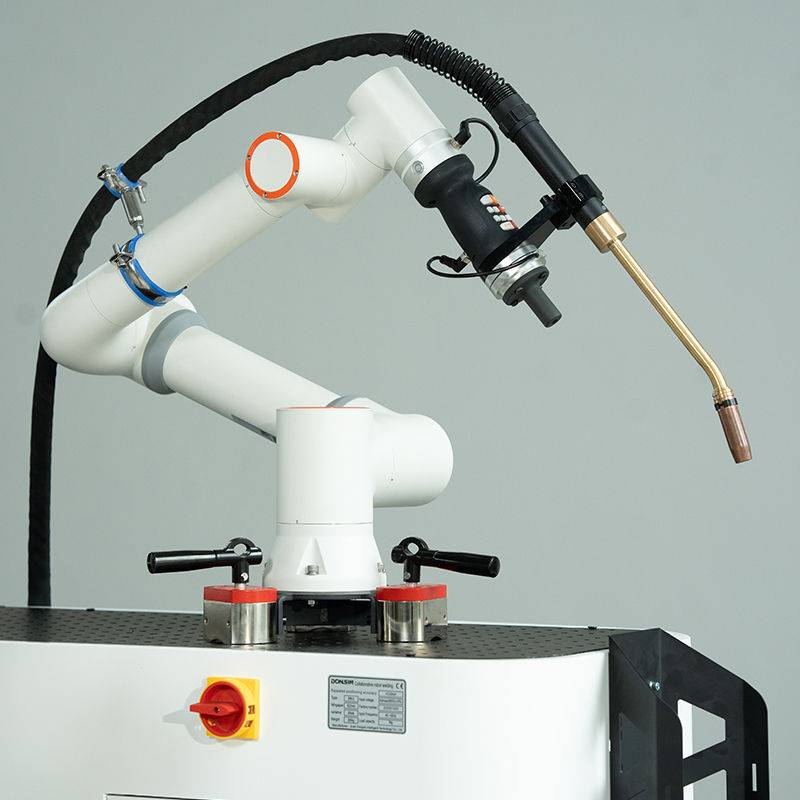
The unit deployed is a self-contained cell integrating a high-payload collaborative arm, a 500A water-cooled power source, and an intuitive touchscreen HMI. Unlike modular setups where the power source and robot controller are disparate units, the “all-in-one” configuration ensures that communication latencies between the arc ignition sequence and robot motion are minimized to the millisecond range.
Footprint and Integration
In the Bologna workshop, floor space is at a premium. The station occupies roughly 1.5 x 1.5 meters. Because it utilizes collaborative robotics, we bypassed the need for bulky safety cages. The internal force-torque sensors are calibrated to detect any impedance exceeding 150N, triggering a Category 0 stop. This allowed us to place the station directly within the existing manual welding line, enabling the operator to prep one part while the cobot completes the multi-pass sequence on another.
Operational Synergy: Collaborative Robotics on the Shop Floor
The core success of this deployment lies in the synergy between the operator’s metallurgical intuition and the cobot’s mechanical consistency. Collaborative robotics in this context does not mean the robot works alone; it means the welder acts as a process supervisor.
During the mild steel welding trials, we utilized the “lead-through” programming feature. For a 15mm fillet weld, the senior welder manually guided the robot arm to define the root pass trajectory. The software then calculated the necessary offsets for the subsequent three fill passes and the final cap. This “teach-by-hand” method reduced setup time for new geometries from four hours (standard industrial coding) to under fifteen minutes.
The “All-in-one” Advantage in Process Stability
Because the station integrates the wire feeder directly onto the cobot’s upper arm, we eliminated the common issue of wire feeding fluctuations found in long-conduit setups. In mild steel welding, consistent wire tension is critical for maintaining a stable spray transfer mode, particularly when navigating the corners of a boxed section. The integrated nature of the All-in-one Cobot Station provided a constant feed force, which was visible in the uniform ripple pattern of the weld beads.
Technical Deep-Dive: Multi-pass Mild Steel Welding Parameters
The project focused on S355JR mild steel plates with a thickness of 20mm, requiring a multi-pass fillet (minimum throat thickness a=10). We utilized a 1.2mm solid wire (G4Si1 / ER70S-6) with an 82% Argon / 18% CO2 shielding gas mix.
Pass Sequence and Heat Input Management
- Root Pass: Executed in short-circuit transfer to ensure deep penetration without burn-through. Travel speed was clocked at 35 cm/min with a wire feed speed of 6.5 m/min.
- Fill Passes (2-3): Switched to spray transfer via the cobot’s pre-programmed pulse settings. Here, collaborative robotics proved superior to manual welding, as the arm maintained a consistent 15mm stick-out, preventing the inclusions that usually occur when a manual welder fatigues.
- Cap Pass: A slight weave pattern was introduced. The All-in-one Cobot Station HMI allows for “on-the-fly” adjustments. If the operator noticed a slight undercut due to plate heat buildup, they could dial down the voltage by 0.5V via the pendant without pausing the program.
One of the primary “lessons learned” in Bologna was the management of interpass temperature. Collaborative systems allow the operator to stay close to the work. We implemented a laser-thermometer check between passes. If the plate exceeded 200°C, the operator utilized the “Hold” function on the cobot, allowing for air cooling to preserve the Grain-Refined Zone (GRZ) properties of the mild steel.
Lessons Learned: Practical Field Observations
1. Surface Preparation is Non-Negotiable
While mild steel welding is often forgiving, collaborative robotics are literal. A manual welder will subconsciously adjust for a patch of mill scale or rust. The cobot will not. We found that a quick abrasive clean of the joint area was mandatory to prevent porosity. The All-in-one Cobot Station works best when the material is “robot-ready”—consistent fit-up is more important than the absolute quality of the steel.
2. The “Collaborative” Safety Paradox
In the Bologna facility, we initially encountered skepticism regarding the lack of cages. However, once the staff saw the cobot react to a soft touch, confidence grew. The lesson: safety is a psychological barrier as much as a technical one. Training the welders to trust the sensors of the collaborative robotics system was as important as training them on the software interface.
3. Torch Angle Consistency
In multi-pass applications, the torch angle (work angle and travel angle) must change slightly for each pass to avoid “wagging” or cold-lapping against the vertical member. The All-in-one Cobot Station software simplifies this through a “relative offset” feature. We learned to program the root pass and then let the software auto-calculate the 45-degree and 60-degree inclinations for the fill passes. This resulted in a 40% reduction in post-weld grinding time compared to manual multi-pass work.
Synergy and Economic Impact in the Bologna Workshop
The integration of the All-in-one Cobot Station has shifted the workshop’s bottleneck from the welding bay to the assembly bay. Previously, a 20mm fillet joint took a skilled welder approximately 45 minutes of arc time, plus fatigue breaks. The cobot completes the same joint in 22 minutes with 100% duty cycle capability.
Furthermore, the mild steel welding consumables’ waste dropped by 15%. This is attributed to the cobot’s precise start-stop sequences, which eliminate the “over-welding” common in manual starts where welders tend to dwell too long in the corner to ensure penetration.
The Role of Collaborative Robotics in Labor Shortages
Bologna, like much of Northern Italy, faces a shortage of certified high-pressure welders. By using collaborative robotics, we have effectively “up-skilled” junior operators. A technician who has only been welding for six months can now produce X-ray quality multi-pass welds by managing the All-in-one Cobot Station, while the master welder focuses on complex tacking and non-linear joint design.
Conclusion
The field test in Bologna demonstrates that the All-in-one Cobot Station is not just a tool for light-gauge sheet metal; it is a robust solution for heavy mild steel welding. The success of the multi-pass operation hinges on the seamless communication between the integrated power source and the collaborative arm.
For senior engineers looking to implement similar systems, the focus must remain on joint consistency and operator training. Collaborative robotics does not replace the welder; it removes the physical burden of the arc-on time, allowing the human to focus on the metallurgy and the quality of the finished product. The Bologna deployment stands as a successful template for high-mix, low-volume heavy fabrication where space and precision are the primary constraints.