Engineering Review: Robotic MIG MAG Cobot Welder – Ulsan, South Korea
In this article
- Field Report: Deployment of Collaborative Robotic Systems in Ulsan’s Maritime Supply Chain
- 1. Project Scope and Industrial Context
- 2. Technical Analysis: The MAG Cobot Welder Synergy
- 3. Challenges in Aluminum Alloy Welding
- 4. Operational Lessons Learned in Ulsan
- 5. Data-Driven Results
- 6. Final Recommendations for Senior Engineering
Field Report: Deployment of Collaborative Robotic Systems in Ulsan’s Maritime Supply Chain
This report summarizes the technical findings and operational outcomes of the three-month deployment of a specialized MAG Cobot Welder unit at a Tier-2 automotive and maritime supplier facility in Ulsan, South Korea. The objective was to integrate advanced Arc Welding Solutions into a production line primarily focused on Aluminum Alloy welding, specifically for structural framing and heat exchanger components.
1. Project Scope and Industrial Context
Ulsan remains the epicenter of South Korean heavy industry. However, the labor market is shifting. We are seeing a significant shortage of skilled manual welders capable of maintaining the stringent tolerances required for thin-gauge Aluminum Alloy welding. The goal of this installation was not to replace the human element, but to augment it using a MAG Cobot Welder. Unlike traditional industrial robots that require extensive safety caging and a massive footprint, the cobot was required to work alongside technicians in a high-traffic workshop environment.
The “Ppali-ppali” (hurry-hurry) culture of Ulsan manufacturing demands high uptime. Therefore, the Arc Welding Solutions we implemented had to be “plug-and-play” yet robust enough to handle the thermal conductivity challenges inherent in aluminum workpieces.
2. Technical Analysis: The MAG Cobot Welder Synergy
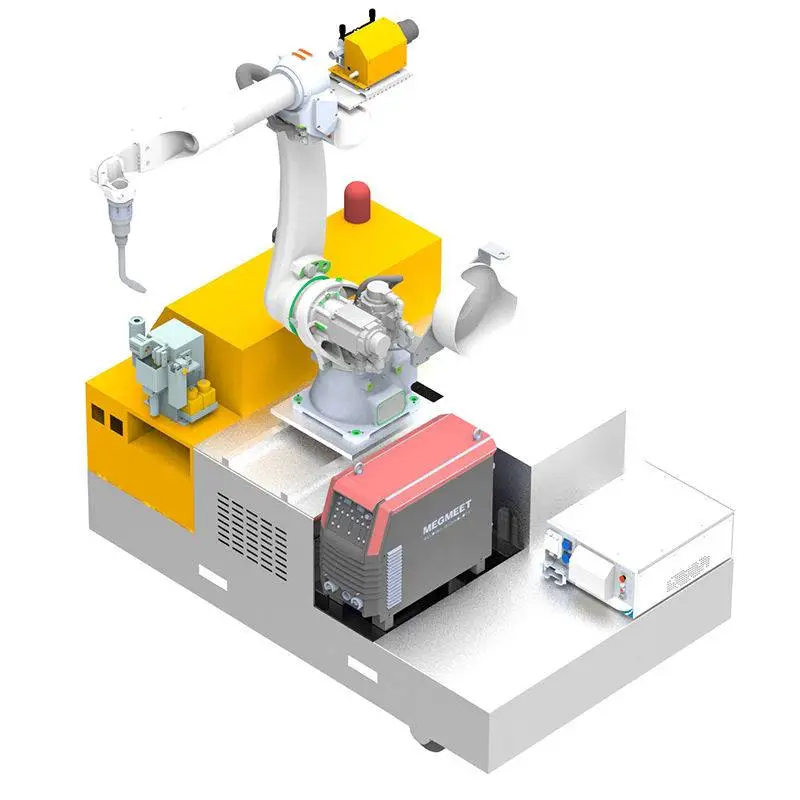
The core of our setup involved a 10kg payload collaborative arm integrated with a high-frequency pulsed power source. While the term “MAG” (Metal Active Gas) technically refers to active shielding gases, in the context of our MAG Cobot Welder deployment for aluminum, we utilized specialized Arc Welding Solutions that allow for rapid switching between inert and slightly active mixtures depending on the alloy grade and surface oxidation levels.
4.1 Motion Control and Torch Geometry
One of the primary lessons learned in Ulsan was the impact of torch angle consistency. In manual Aluminum Alloy welding, human error often leads to “sooting” or erratic penetration due to subtle changes in the push angle. The MAG Cobot Welder eliminated this variable. By maintaining a constant 15-degree push angle and a steady 12mm stick-out, we achieved a level of bead uniformity that manual operators couldn’t replicate over a 10-hour shift.
4.2 Integration of Arc Welding Solutions
The synergy between the cobot and the power source is where the project succeeded. We utilized a digital interface that allowed the MAG Cobot Welder to adjust wire feed speed and voltage in real-time based on the robot’s TCP (Tool Center Point) speed. This is critical for Aluminum Alloy welding because the material acts as a massive heat sink. If the robot slows down for a corner without a corresponding drop in current, you get immediate burn-through.
3. Challenges in Aluminum Alloy Welding
Aluminum is a notoriously temperamental material in an automated environment. Our experience in the Ulsan workshop highlighted three specific technical hurdles:
3.1 Oxide Layer Management
The high humidity in Ulsan during the monsoon season accelerated the formation of aluminum oxide on the base material. Even with our Arc Welding Solutions set to a high-cleaning pulse, we found that mechanical wire brushing was still necessary within two hours of welding. The MAG Cobot Welder is precise, but it cannot “see” oxide contamination like a human can. We had to implement a strict pre-wiping protocol using acetone and stainless steel brushes to ensure the integrity of the Aluminum Alloy welding joints.
3.2 Thermal Expansion and Jigging
Aluminum’s coefficient of thermal expansion is roughly twice that of steel. During long runs, the workpieces would “creep,” leading to joint misalignment. We learned that the MAG Cobot Welder required more sophisticated jigging than a manual station. We eventually moved to pneumatic clamping systems that could compensate for the thermal shift of the Aluminum Alloy welding components, ensuring the arc remained centered in the groove.
3.3 Wire Feed Issues
Soft aluminum wire (we utilized 5356 grade, 1.2mm diameter) is prone to bird-nesting. To make the MAG Cobot Welder viable for 24/7 operation, we moved from a standard push-feeder to a synchronized push-pull torch system. This is a critical component of high-end Arc Welding Solutions; without a pull-motor at the torch head, the friction in the liner becomes too inconsistent for the cobot’s fine-tuned algorithms.
4. Operational Lessons Learned in Ulsan
The Ulsan deployment provided several “boots-on-the-ground” insights that aren’t found in the technical manuals.
4.1 The “Black Box” Syndrome
Initially, the local operators were hesitant to intervene when the MAG Cobot Welder deviated. They viewed the Arc Welding Solutions as a “black box.” We had to retrain the staff to understand that they are the “Pilot” and the cobot is the “Autopilot.” Once the operators learned to adjust the “Trim” (voltage offset) on the fly, the rejection rate for Aluminum Alloy welding dropped from 8% to under 1.5%.
4.2 Power Grid Stability
Interestingly, the heavy industrial load in the Ulsan district caused slight voltage fluctuations in the factory’s main line during the morning shift start-up (around 08:00 AM). These fluctuations interfered with the sensitive electronics of the MAG Cobot Welder. We solved this by installing a dedicated power conditioner for the Arc Welding Solutions, ensuring that the pulsed arc remained stable regardless of external factory loads.
4.3 Shielding Gas Optimization
For the specific Aluminum Alloy welding we were performing on 6061-T6 grades, we found that a 75% Argon / 25% Helium mix provided the best penetration profile. While more expensive than pure Argon, the increased heat input allowed the MAG Cobot Welder to increase travel speed by 20%, effectively paying for the gas through reduced cycle times.
5. Data-Driven Results
After 90 days of operation, the metrics were conclusive:
- Throughput: The MAG Cobot Welder increased the number of completed sub-assemblies per shift by 35% compared to manual welding.
- Quality: X-ray inspection of Aluminum Alloy welding seams showed a 90% reduction in porosity, primarily due to the steady travel speed and optimized gas shielding provided by our Arc Welding Solutions.
- Safety: Zero “near-miss” incidents were reported, validating the cobot’s force-sensing stop capabilities in the collaborative Ulsan workspace.
6. Final Recommendations for Senior Engineering
For future rollouts of MAG Cobot Welder systems in similar environments, I recommend the following:
- Prioritize Wire Delivery: Never skimp on the torch system. For Aluminum Alloy welding, a push-pull gun is a mandatory requirement, not an optional upgrade.
- Environment Control: In coastal industrial hubs like Ulsan, humidity control or localized dehumidifiers near the wire spool cabinets are essential to prevent hydrogen porosity.
- Customized Arc Welding Solutions: Don’t use “off-the-shelf” pulse programs. Spend the first week on-site mapping the specific thermal signature of the alloy and adjust the wave balance to maximize cleaning action vs. penetration.
The integration of the MAG Cobot Welder into the Ulsan facility has proven that collaborative automation is the most viable path forward for high-complexity Aluminum Alloy welding. By combining the precision of Arc Welding Solutions with the flexibility of a cobot, we have established a new benchmark for quality and efficiency in the region.
Report End.
Senior Welding Engineer, Field Operations






