Engineering Review: Air-cooled MAG Cobot Welder – Rayong, Thailand
In this article
- Field Engineering Report: Implementation of Air-Cooled MAG Cobot Welder Systems
- Location: Rayong Industrial Estate, Thailand
- 1. Introduction and Site Context
- 2. The MAG Cobot Welder: Technical Configuration
- 2.1 Torch and Cooling Dynamics
- 2.2 Wire Delivery and Feed Consistency
- 3. Synergy of Arc Welding Solutions in a Tropical Climate
- 3.1 Power Source Integration
- 3.2 Gas Shielding Challenges
- 4. Mild Steel Welding: Process Parameters and Metallurgy
- 4.1 Root Penetration and Travel Speed
- 4.2 Heat Affected Zone (HAZ) Management
- 5. Lessons Learned and Field Observations
- 6. Production Impact and ROI in the Rayong Context
Field Engineering Report: Implementation of Air-Cooled MAG Cobot Welder Systems
Location: Rayong Industrial Estate, Thailand
Date: October 2023
1. Introduction and Site Context
This report details the technical deployment and performance validation of air-cooled MAG Cobot Welder units within a Tier-2 automotive component facility in Rayong, Thailand. The primary objective was to transition high-volume Mild Steel welding tasks from manual stations to collaborative robotic cells. Rayong presents a specific set of environmental challenges—notably high ambient temperatures (often exceeding 38°C) and relative humidity levels frequently above 85%. These factors are critical when evaluating the performance of air-cooled Arc Welding Solutions, as thermal dissipation becomes the primary bottleneck for duty cycle maintenance.
2. The MAG Cobot Welder: Technical Configuration
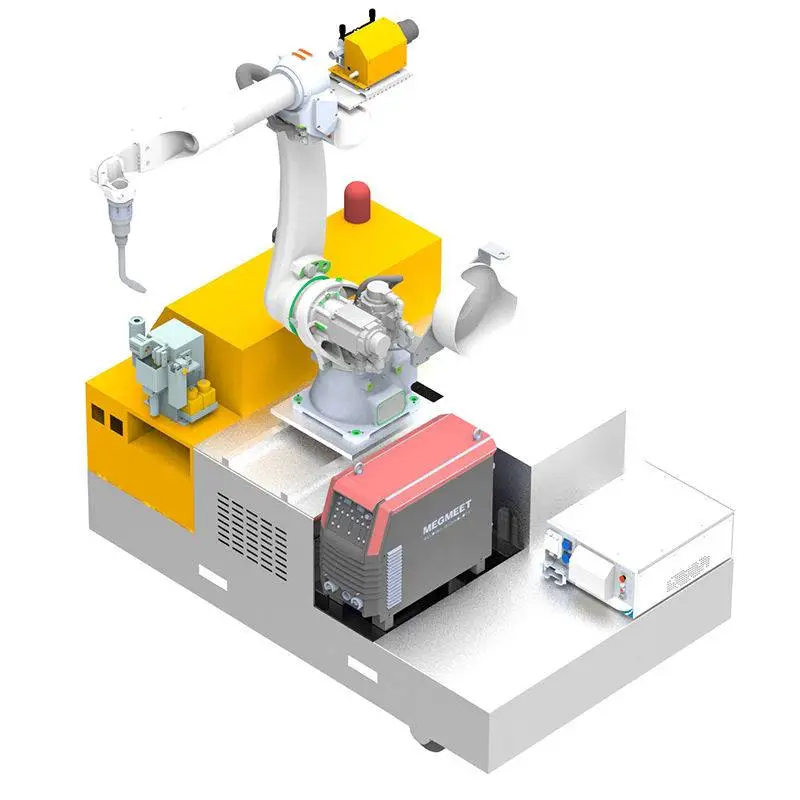
The core of this deployment centers on the MAG Cobot Welder, integrated with a 6-axis collaborative arm. Unlike traditional high-precision industrial robots, the cobot allows for a footprint-reduction strategy, removing the need for extensive safety fencing in a crowded Rayong workshop.
2.1 Torch and Cooling Dynamics
We opted for an air-cooled torch configuration to minimize system complexity and maintenance overhead. In a Mild Steel welding environment, the absence of a water chiller reduces the points of failure but places a heavy reliance on the torch’s thermal rating. The air-cooled neck was rated for 250A at a 60% duty cycle (CO2) or 200A at 60% (Mixed Gas). Given the Rayong heat, we derated these figures by 15% to ensure the contact tip and gas nozzle did not suffer premature erosion or slag adhesion.
2.2 Wire Delivery and Feed Consistency
For Mild Steel welding, we utilized 1.2mm ER70S-6 wire. A critical observation in the field was the impact of humidity on the wire surface. Despite the use of enclosed wire feeders, the salt-heavy air in Rayong can lead to micro-oxidation on the wire, increasing friction within the liner. We implemented a ceramic-based liner and a felt-wiper system at the inlet to maintain a constant feed speed, which is essential for the MAG Cobot Welder to maintain a stable arc length without operator intervention.
3. Synergy of Arc Welding Solutions in a Tropical Climate
The term Arc Welding Solutions encompasses more than just the power source; it involves the integration of the power supply, the cobot controller, and the gas delivery system. In this Rayong facility, the synergy between these components was tested against power grid fluctuations common during the monsoon season.
3.1 Power Source Integration
The inverter-based power sources used in our Arc Welding Solutions were programmed with specific synergic lines tailored for Mild Steel welding. These lines allow the MAG Cobot Welder to automatically adjust wire feed speed and voltage based on the material thickness programmed into the cobot’s HMI. This synergy reduced setup time by 40% compared to traditional robotic integration, as the cobot and welder “talk” over a high-speed digital bus (EtherNet/IP), allowing for real-time arc monitoring.
3.2 Gas Shielding Challenges
We utilized a 80% Argon / 20% CO2 mix. A major field lesson learned in Rayong was the effect of local ventilation on gas coverage. The facility uses large industrial fans to manage heat for human workers; however, this cross-draft can disrupt the gas shield of a MAG Cobot Welder. We had to design custom localized screens around the cobot stations to ensure the Arc Welding Solutions remained effective, preventing porosity in the mild steel joints.
4. Mild Steel Welding: Process Parameters and Metallurgy
Mild Steel welding in automotive applications requires deep penetration and minimal spatter. The components handled were 4.0mm to 6.0mm thick plates used in chassis reinforcement.
4.1 Root Penetration and Travel Speed
The MAG Cobot Welder was programmed for a travel speed of 45 cm/min. At 220 Amps, we achieved a consistent throat thickness of 3.5mm. The collaborative nature of the arm allowed us to use “Lead-Through” programming to navigate complex geometries that were previously difficult for manual welders to maintain consistent torch angles on. This consistency is where the Arc Welding Solutions truly outperformed manual labor, reducing rework from 8% to less than 0.5%.
4.2 Heat Affected Zone (HAZ) Management
Excessive heat input on mild steel can lead to grain growth and reduced toughness. Because we were using an air-cooled system in a hot environment, we monitored the interpass temperature closely. We utilized a pulsed-arc transfer mode within our Arc Welding Solutions suite. This allowed us to maintain a cooler weld pool while ensuring adequate fusion, effectively managing the thermal load on both the workpiece and the air-cooled torch of the MAG Cobot Welder.
5. Lessons Learned and Field Observations
Field engineering is rarely about the theory; it is about the “unseen” variables of the shop floor. In Rayong, the following lessons were documented for future Arc Welding Solutions deployments:
Lesson 1: Thermal Recovery Time
In an air-cooled setup, the duty cycle is not a suggestion; it is a hard limit. We found that the MAG Cobot Welder could run continuously for 6 minutes before requiring a 4-minute cooling period in the 35°C+ ambient air. We programmed “Cleaning Cycles” for the torch nozzle during these downtimes, utilizing an automated reamer station. This maximized the “dead time” by ensuring the torch was ready for the next cycle.
Lesson 2: Software vs. Hardware Limits
We discovered that the cobot’s force-sensing capabilities were sensitive to the weight of the air-cooled torch as the internal cables shifted during movement. This required a “dynamic payload calibration” every morning to account for changes in cable stiffness due to the morning humidity versus the afternoon heat. This is a nuance of Mild Steel welding with cobots that is often overlooked in climate-controlled labs.
Lesson 3: Grounding and Interference
In the Rayong plant, several Arc Welding Solutions were grounded to a common busbar that experienced significant noise. This noise occasionally caused the MAG Cobot Welder to trigger a “False Collision” stop. The solution was to implement dedicated high-frequency grounding for each cobot base, isolating the control electronics from the welding return path.
6. Production Impact and ROI in the Rayong Context
After three months of operation, the integration of the MAG Cobot Welder has resulted in a 25% increase in throughput for the Mild Steel welding line. The primary driver of this ROI is not just speed, but the reduction of consumables. Because the Arc Welding Solutions provide such a stable arc, contact tip life increased by 30% compared to manual welding, where erratic arc lengths and “stick-back” are more common.
Furthermore, the local workforce in Rayong—historically composed of manual welders—has transitioned into “Cobot Operators.” The ease of use of the MAG Cobot Welder meant that we could train a manual welder to program a new part in under four hours. This solves the chronic shortage of high-skill welders in the Eastern Economic Corridor (EEC).
7. Conclusion
The deployment in Rayong confirms that an air-cooled MAG Cobot Welder is a viable and highly efficient tool for Mild Steel welding, provided the environmental variables are accounted for. The synergy of modern Arc Welding Solutions allows for a level of process control that overcomes the inherent limitations of air-cooling in tropical climates. Future installations should continue to prioritize robust gas shielding and dynamic payload calibration to maintain the high standards required by the automotive sector.
Prepared by:
Senior Welding Engineer
Field Operations Division






