Field Report: Deployment of Integrated CMT Cobot Systems for Precision Sheet Metal Fabrication
1. Introduction and Project Scope
In the current Singaporean manufacturing landscape, specifically within the precision engineering clusters of Jurong and Tuas, the transition from manual GTAW (TIG) to automated solutions is no longer a luxury—it is a survival imperative. This report evaluates the field deployment of the All-in-one Cobot Station utilizing Cold Metal Transfer (CMT) technology. Our primary objective was to address the chronic shortage of high-skill welders capable of thin metal sheet welding while maintaining the stringent quality standards required for aerospace-grade enclosures and semiconductor cleanroom equipment.
The core of this evaluation rests on the synergy between Collaborative Robotics and high-speed waveform control. Unlike traditional industrial robots that require extensive safety interlocks and massive floor footprints, the collaborative approach allows for a flexible “cell” integration that fits the high-rent, space-constrained environments typical of Singaporean workshops.
2. The Technical Architecture of the All-in-one Cobot Station
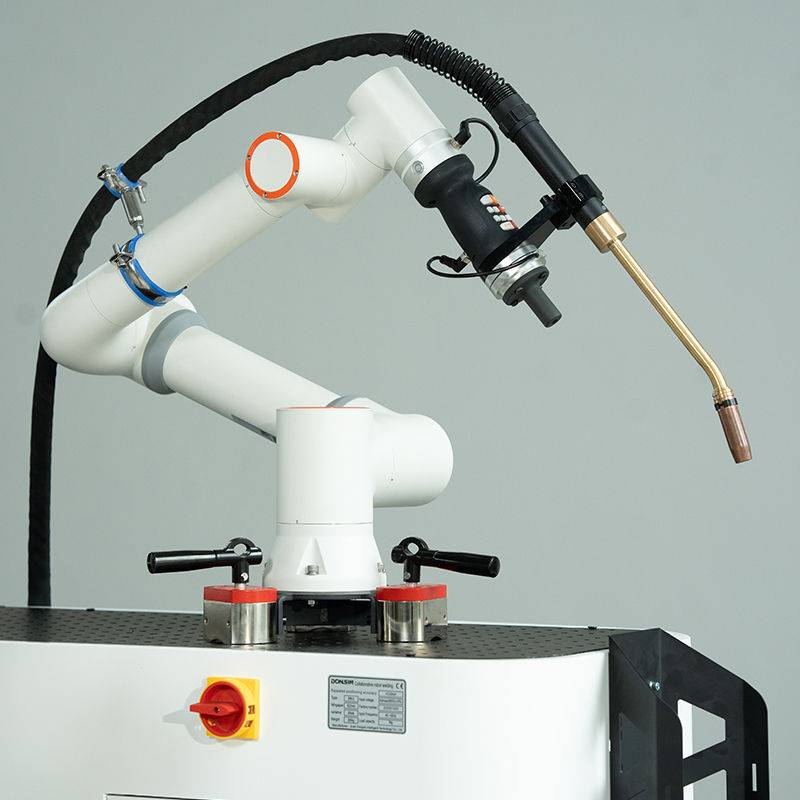
The All-in-one Cobot Station represents a shift toward modularity. From an engineering perspective, the “All-in-one” designation refers to the physical and digital integration of three critical components: the power source (CMT-enabled), the 6-axis collaborative arm, and the centralized control interface.
2.1. Integrated Power Modulation
The station utilizes a dedicated CMT (Cold Metal Transfer) power source. In thin metal sheet welding, the primary adversary is heat input. Traditional MIG/MAG welding often results in excessive distortion or burn-through on sheets thinner than 1.5mm. The CMT process integrated into this station works by mechanically retracting the wire when a short circuit occurs. This physical movement, synchronized with the power source’s pulsed output, allows for droplet detachment at near-zero current. The result is a “cold” weld pool that is ideal for the 0.8mm to 1.2mm stainless steel gauges we frequently process.
2.2. Collaborative Robotics Interface
The Collaborative Robotics element is driven by a lead-through teaching interface. For our senior technicians, this means moving the robot arm by hand to define the weld path rather than inputting coordinates into a complex teach pendant. This reduces “Time-to-Weld” for new part numbers by approximately 70% compared to traditional robotic systems.
3. Synergy: Why Collaborative Robotics and All-in-one Stations Matter in Singapore
The synergy between an All-in-one Cobot Station and Collaborative Robotics is best observed in the “Human-in-the-loop” workflow. In a typical Singaporean SME, the shop floor is a dynamic environment where batch sizes are small and changeovers are frequent.
3.1. Spatial Optimization
In our Tuas facility, floor space is valued at a premium. Traditional robotics require light curtains, physical fencing, and dedicated safety controllers. The Collaborative Robotics framework utilizes torque sensors in every joint, allowing the station to operate safely alongside human workers. This eliminates the need for bulky safety cages, allowing the All-in-one Cobot Station to be moved via pallet jack to different production lines as demand shifts.
3.2. Skill Bridging
The “All-in-one” nature simplifies the tech stack. In the past, a welding engineer would need to calibrate the robot’s TCP (Tool Center Point) in one software and the welder’s gas pre-flow/post-flow in another. The integrated station synchronizes these variables. When the cobot slows down for a tight corner, the CMT power source automatically adjusts the wire feed speed and heat input to prevent localized overheating. This synergy makes thin metal sheet welding accessible to operators who may not have 10 years of manual TIG experience.
4. Application Deep-Dive: Thin Metal Sheet Welding (0.8mm – 1.2mm)
The crux of this field report lies in the performance of the system on thin-gauge materials. We focused our testing on Grade 304 Stainless Steel and 5000-series Aluminum.
4.1. Thermal Management and Distortion Control
In thin metal sheet welding, the heat-affected zone (HAZ) must be minimized to prevent warping. During our trials on 1.0mm 304 SS electronics housings, the All-in-one Cobot Station maintained a travel speed of 60cm/min with a CMT frequency of 70Hz. The mechanical droplet detachment essentially “pumps” heat out of the weld pool. We observed a 40% reduction in post-weld straightening labor compared to manual GTAW processes.
4.2. Gap Bridging Capabilities
One common issue in Singaporean sheet metal shops is inconsistent fit-up from laser cutting or bending. Manual welding can compensate for gaps, but traditional robots fail. The CMT logic in the cobot station, however, is exceptionally forgiving. The surface tension of the “cold” melt pool allows the arc to bridge gaps up to 1.5x the material thickness without blowing through the edges. This is a critical technical advantage when dealing with thin metal sheet welding where tolerances can stack up.
5. Lessons Learned and Field Observations
Deployment in a high-humidity environment like Singapore presented specific challenges that are rarely mentioned in the manufacturer’s brochure.
5.1. Shielding Gas Integrity
We discovered that the high humidity in the workshop (often >80% RH) necessitated a more robust gas delivery system than the standard setup provided with the All-in-one Cobot Station. We had to implement dual-stage regulators and ensure the gas hoses were non-diffusive to prevent hydrogen porosity in the thin metal sheet welding of aluminum. Even with Collaborative Robotics, the physics of the arc remain beholden to atmospheric conditions.
5.2. Jigging and Fixturing
A major lesson learned is that while Collaborative Robotics are “easy” to program, they are only as good as the jigging. For thin sheets, we found that pneumatic toggle clamps are essential. Because the CMT process involves mechanical wire oscillation, any vibration in a flimsy fixture can disrupt the arc length and lead to instability. We recommend heavy-duty modular welding tables as the foundation for any All-in-one Cobot Station.
5.3. The “Uncanny Valley” of Speed
There is a tendency to push the cobot to its maximum velocity. However, we found that for thin metal sheet welding, there is a “sweet spot” where the CMT cycle and the cobot’s path smoothing algorithm harmonize. Exceeding 800mm/s travel speed often resulted in “stuttering” at the joints due to the cobot’s safety-limited acceleration profiles. Staying within the 400-600mm/s range provided the most consistent bead aesthetics.
6. ROI and Scalability for Singaporean SMEs
The financial justification for the All-in-one Cobot Station in a Singapore context is clear. By reducing the reliance on “S-Pass” or “Work Permit” specialist welders, firms can insulate themselves against tightening labor quotas.
The station pays for itself not through raw speed, but through the elimination of rework. In thin metal sheet welding, a single burn-through on a nearly finished medical-grade cabinet can scrap a part worth thousands of dollars. The precision of the Collaborative Robotics system ensures that once a “Golden Program” is established, the rejection rate drops to near zero.
7. Final Engineering Assessment
The integration of an All-in-one Cobot Station is the most logical step for Singaporean shops looking to modernize. The synergy between the CMT process and Collaborative Robotics solves the two biggest hurdles in thin metal sheet welding: heat management and ease of use. While the initial investment is higher than a manual setup, the reduction in post-weld processing and the ability to run multiple shifts with less-skilled operators provide a compelling technical and economic case.
Recommendation: Proceed with full-scale deployment for all stainless steel enclosure lines. Ensure all operators are trained on “lead-through” teaching and prioritize the acquisition of high-precision modular fixtures to complement the cobot’s repeatability.
-


LT240S tube laser cutting machine
-
LT120S tube laser cutting machine
-
Sale

Tank Fillet Welding Machine
Original price was: $1,000.00.$900.00Current price is: $900.00. -
Sale

MAK100 tube laser cutting machine
Original price was: $5,500.00.$5,000.00Current price is: $5,000.00. -

portable plasma air cutting machine
$1,200.00 -

2in1 fiber laser cutting machine
-

Air cooling Laser welding machine
-

HF h beam laser cutting machine
-

LT240 laser cutting machine
-

Laser welding machine
-


Cobot Welding Station
-

Gantry welding robot solution
-

Tracked Wheeled AGV Welding robot
-

LFH6020 Fiber laser cutting machine
-
LFP6020
-

robotic welidng machine
Advanced Fiber Laser Tube Processing Technology
Our CNC Fiber Laser Tube Cutting systems revolutionize metal fabrication by integrating high-precision cutting, punching, and profiling into a single automated workflow. Designed for versatility, this technology handles a wide array of profiles including Round, Square, Rectangular, and Oval tubes, as well as complex L-shaped and U-shaped channels.
- Precision Punching: High-speed hole punching with micron-level accuracy, eliminating the need for mechanical drilling or die-stamping.
- Complex Profiling: Advanced 3D pathing allows for intricate interlocking joints and specialized notch cuts, ideal for structural frames.
- High Material Efficiency: Intelligent nesting software minimizes scrap, reducing raw material costs across large production runs.
- Clean Finish: Delivers oxide-free, burr-free edges that require zero secondary grinding before welding.

Seamlessly processing multiple profiles with consistent precision.
Global Delivery & Logistics



From our high-tech manufacturing facility directly to your global site. PCL WeldCut ensures secure packaging, professional handling, and reliable international logistics to safeguard your equipment throughout the entire journey.