Technical Field Report: Integration of Precision CMT Cobot Systems in Aerospace-Grade Titanium Fabrication
1. Introduction and Site Context
The following report details the 4-week deployment and optimization phase of the Precision CMT (Cold Metal Transfer) Cobot Welding Machine at a Tier-2 aerospace component facility in the Gasan-dong industrial district of Seoul, South Korea. The objective was to transition from manual GTAW (TIG) to an automated solution capable of handling thin-gauge Titanium welding (Grades 2 and 5) while maintaining the stringent metallurgical standards required for flight-certified hardware.
Seoul’s manufacturing landscape is characterized by high-density urban workshops where floor space is at a premium and the labor market is highly skilled but aging. The introduction of Collaborative Robotics here is not merely a trend; it is a spatial and economic necessity. Unlike traditional industrial robots that require extensive safety cells and light curtains, the cobot footprint allowed us to integrate the system directly into existing manual assembly lines.
2. The Synergy of Collaborative Robotics and CMT
The core of this deployment lies in the synergy between the Cobot Welding Machine and the philosophy of Collaborative Robotics. In the Seoul workshop, we encountered a significant bottleneck: the welding of intricate Titanium fuel manifolds required the dexterity of a human hand but the consistency of a machine.
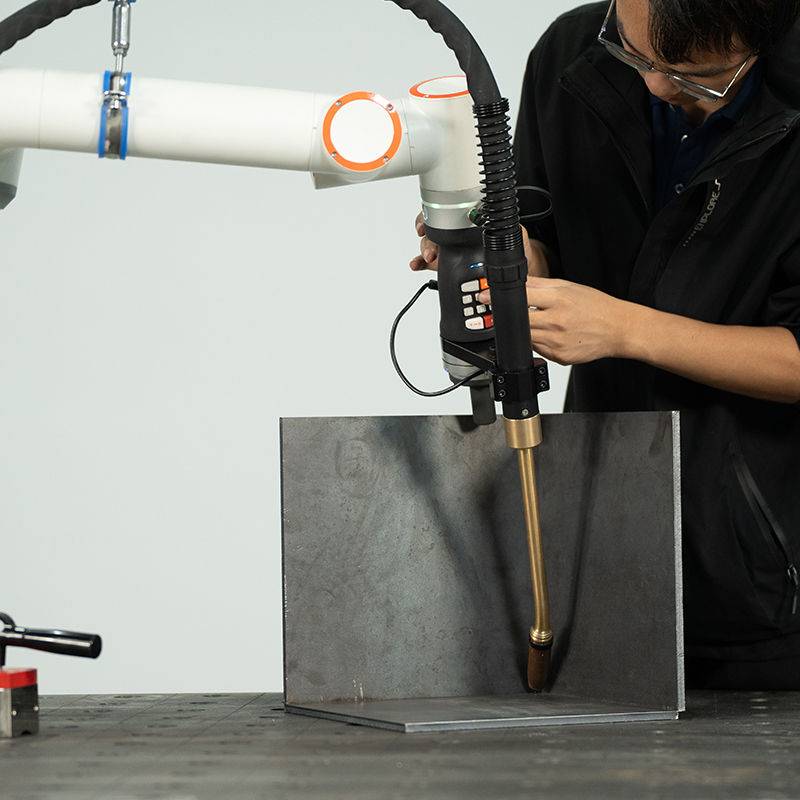
Traditional automation fails in high-mix, low-volume (HMLV) environments because the programming overhead is too high. However, by utilizing a Cobot Welding Machine, our senior welders in Seoul were able to use “lead-through” programming. This allowed the technician to physically move the robotic arm along the complex weld path of the Titanium manifold, recording waypoints in real-time. This collaborative approach reduced the “art-to-part” programming time by 70% compared to traditional pendant-based coding.
2.1. Spatial Optimization in the Seoul Workshop
In the Seoul facility, every square meter is accounted for. The Collaborative Robotics framework allowed us to eliminate the 3-meter safety perimeter typically required for industrial robots. By utilizing the cobot’s internal torque sensors, we configured the machine to operate in “Collaborative Mode,” where the machine stops instantly upon contact with an operator. This allowed welders to work alongside the Cobot Welding Machine, performing tacking and fit-up on one side of a rotating table while the robot completed the primary structural beads on the other.
3. Technical Deep Dive: Titanium Welding with CMT
Titanium welding presents a unique set of challenges, primarily its extreme reactivity to atmospheric gases (Oxygen, Nitrogen, and Hydrogen) at temperatures above 400°C. In the Seoul deployment, we utilized the CMT process—a modified MIG/MAG process where the wire is mechanically retracted when the system senses a short circuit.
3.1. Heat Input Control
The primary advantage of the CMT Cobot Welding Machine for Titanium is the drastically reduced heat input. Titanium’s grain structure is highly sensitive to heat; excessive heat leads to grain growth, which reduces the fatigue life of the aerospace component. The CMT process provides a “cold” metal transfer by disconnecting the current before the droplet detaches, significantly narrowing the Heat-Affected Zone (HAZ).
3.2. Shielding Gas Management
During our field tests in Seoul, we identified that standard gas lenses were insufficient for the travel speeds achievable by Collaborative Robotics. We implemented a custom-engineered trailing shield mounted directly to the cobot’s end-effector. This ensured that the cooling weld bead remained under a 99.999% Argon (Argon 5.0) envelope until the temperature dropped below the critical 400°C threshold. The precision of the Cobot Welding Machine allowed for a constant 2mm standoff distance, which is nearly impossible for a manual welder to maintain over a 500mm linear weld, ensuring uniform gas coverage.
4. Operational Performance and Metrics
Over the 30-day evaluation period, the following metrics were recorded in the Seoul facility:
- Weld Consistency: Reject rates dropped from 12% (manual) to 0.8% (Cobot).
- Duty Cycle: The Cobot Welding Machine maintained an 85% duty cycle, compared to the 30% duty cycle of manual operators who required frequent breaks due to the ergonomic strain of Titanium’s required precision.
- Travel Speed: Consistent travel speeds of 45 cm/min were achieved on 1.5mm Grade 5 Titanium sheets, a 2x increase over manual GTAW.
5. Lessons Learned: The “Seoul Notes”
Field engineering is never as clean as the manual suggests. Below are the specific technical hurdles and “lessons learned” during the Seoul integration:
5.1. The Grounding Issue (EMI)
We initially faced erratic behavior in the Collaborative Robotics controller. It was discovered that the high-frequency starts from a neighboring manual TIG station were creating electromagnetic interference (EMI).
Lesson Learned: In dense Seoul workshops, specialized shielded cabling and a dedicated earth ground for the Cobot Welding Machine are non-negotiable. We had to isolate the cobot’s logic ground from the welding power source ground to prevent “ghost” collisions in the software.
5.2. Wire Shaving and Feedability
Titanium wire is notoriously difficult to feed due to its stiffness and surface friction. When using the CMT process, which involves high-frequency back-and-forth wire movement (up to 70Hz), we noticed “wire shaving” at the drive rolls. This dust eventually clogged the liner, causing arc instability.
Lesson Learned: We switched to U-grooved ceramic drive rolls and implemented a graphite-free, low-friction liner. Furthermore, we shortened the torch cable from 4 meters to 2.5 meters to reduce the drag coefficient on the wire.
5.3. Surface Preparation Rigidity
Manual welders can often “compensate” for slight contamination by agitating the puddle. The Cobot Welding Machine cannot. We found that even fingerprint oils caused porosity in the Titanium welds.
Lesson Learned: We implemented a strict 3-step chemical cleaning protocol (acetone wipe, stainless steel wire brush, second acetone wipe) within 15 minutes of the weld cycle start. If the cycle was delayed, the part had to be re-cleaned.
6. Synergistic Workflow: Human-Machine Interface
The most successful element of the Seoul deployment was the “Augmented Welder” workflow. Instead of replacing the welder, the Collaborative Robotics system acted as a tool that elevated the technician to a “Welding Cell Manager.” The technician handles the complex fit-up and the “judgment calls” (e.g., assessing the color of the weld to check for oxidation), while the Cobot Welding Machine executes the monotonous, high-precision beads.
For Titanium welding, this is critical. The technician monitors the “straw to silver” color gradient. If the cobot’s output trends toward “blue” (indicating contamination), the technician can pause the program, adjust the gas flow, or replace the tungsten/nozzle without needing to recalibrate the entire robotic system. This is the essence of Collaborative Robotics in a high-stakes environment like aerospace fabrication.
7. Conclusion and Recommendations
The integration of the Precision CMT Cobot Welding Machine in Seoul demonstrates that the future of Titanium welding lies in controlled heat input and collaborative automation. The CMT process solves the metallurgical challenges of Titanium, while the cobot solves the spatial and flexibility challenges of the modern urban workshop.
Final Recommendations for Future Deployments:
- Integrated Sensors: Future iterations should include a laser-based seam tracker to compensate for part fit-up variations, which are common in hand-prepped Titanium sheets.
- Gas Monitoring: Implement an inline O2 analyzer that communicates with the Collaborative Robotics controller to prevent the arc from striking if Oxygen levels exceed 50 ppm.
- Training: Shift focus from “Robot Programming” to “Weld Parameter Management” for the local Seoul technicians to better leverage their existing metallurgical knowledge.
Report Submitted By:
Senior Welding Engineer, Global Field Operations
Location: Seoul, South Korea
-


LT240S tube laser cutting machine
-
LT120S tube laser cutting machine
-
Sale

Tank Fillet Welding Machine
Original price was: $1,000.00.$900.00Current price is: $900.00. -
Sale

MAK100 tube laser cutting machine
Original price was: $5,500.00.$5,000.00Current price is: $5,000.00. -

portable plasma air cutting machine
$1,200.00 -

2in1 fiber laser cutting machine
-

Air cooling Laser welding machine
-

HF h beam laser cutting machine
-

LT240 laser cutting machine
-

Laser welding machine
-


Cobot Welding Station
-

Gantry welding robot solution
-

Tracked Wheeled AGV Welding robot
-

LFH6020 Fiber laser cutting machine
-
LFP6020
-

robotic welidng machine
Advanced Fiber Laser Tube Processing Technology
Our CNC Fiber Laser Tube Cutting systems revolutionize metal fabrication by integrating high-precision cutting, punching, and profiling into a single automated workflow. Designed for versatility, this technology handles a wide array of profiles including Round, Square, Rectangular, and Oval tubes, as well as complex L-shaped and U-shaped channels.
- Precision Punching: High-speed hole punching with micron-level accuracy, eliminating the need for mechanical drilling or die-stamping.
- Complex Profiling: Advanced 3D pathing allows for intricate interlocking joints and specialized notch cuts, ideal for structural frames.
- High Material Efficiency: Intelligent nesting software minimizes scrap, reducing raw material costs across large production runs.
- Clean Finish: Delivers oxide-free, burr-free edges that require zero secondary grinding before welding.

Seamlessly processing multiple profiles with consistent precision.
Global Delivery & Logistics



From our high-tech manufacturing facility directly to your global site. PCL WeldCut ensures secure packaging, professional handling, and reliable international logistics to safeguard your equipment throughout the entire journey.