Engineering Review: 1500W MAG Cobot Welder – Bologna, Italy

In this article
- Field Engineering Report: Implementation of 1500W MAG Cobot Welder in High-Precision Tooling
- 1. Project Scope and Environmental Context
- 2. Technical Specifications and Hardware Synergy
- 3. Application Analysis: Tool Steel Welding Challenges
- 4. Synergy Between Hardware and Software
- 5. Lessons Learned: Field Observations from Bologna
- 6. Metallurgical Outcomes and Productivity Metrics
- 7. Operational Integration and Human-Cobot Interaction
- 8. Final Engineering Directives
Field Engineering Report: Implementation of 1500W MAG Cobot Welder in High-Precision Tooling
1. Project Scope and Environmental Context
This report documents the field deployment and performance validation of the 1500W MAG Cobot Welder at a Tier-1 industrial packaging and automotive tooling facility in Bologna, Italy. The objective was to transition manual repair and small-batch fabrication of die components to an automated platform. The Bologna industrial sector demands high repeatability due to the prevalence of complex geometries in food processing machinery and high-performance automotive parts. Our focus remained on the integration of advanced Arc Welding Solutions to address the metallurgical sensitivities inherent in Tool Steel welding.
2. Technical Specifications and Hardware Synergy
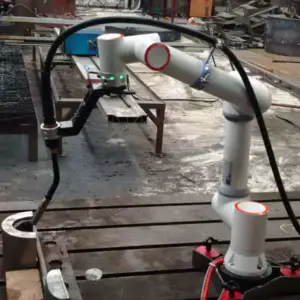
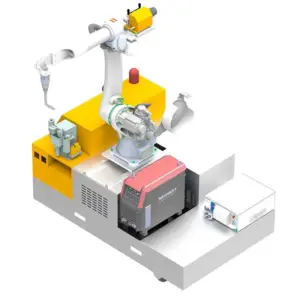
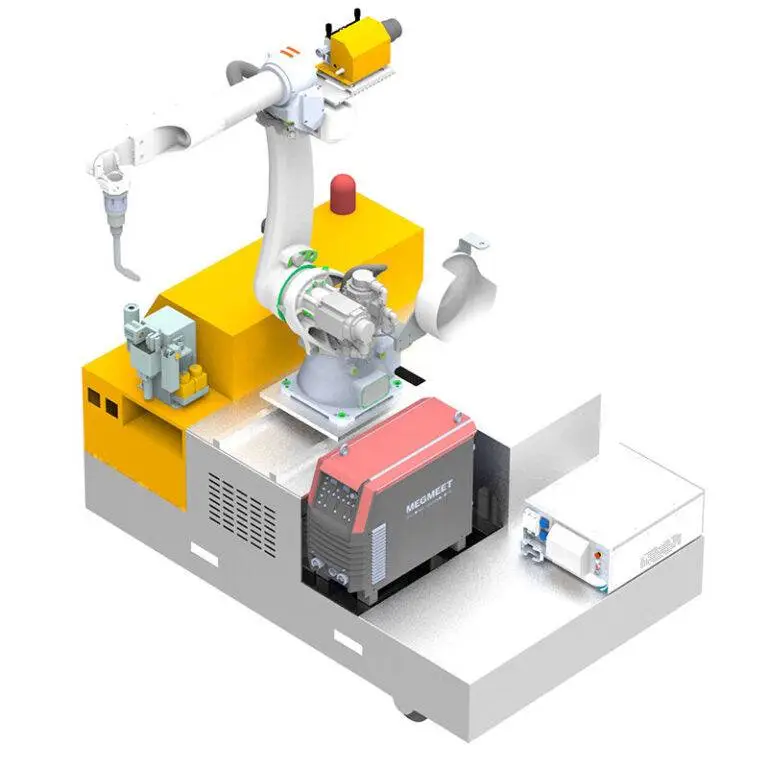
The 1500W MAG Cobot Welder utilized in this deployment is not merely an articulated arm, but a synchronized system where the power source and the robotic motion controller operate on a shared high-speed EtherCAT bus. This synergy is the cornerstone of modern Arc Welding Solutions. In the Bologna workshop, we faced electrical noise issues typical of older industrial zones; however, the cobot’s shielded digital interface ensured signal integrity between the wire feeder and the torch oscillator.
2.1. Power Source Dynamics
The 1500W rating refers to the nominal output capable of sustained duty cycles at 100% in pulsed MAG (Metal Active Gas) modes. For the Tool Steel welding tasks, we utilized a specialized “Cold Process” software module from our Arc Welding Solutions suite. This allowed us to maintain a stable arc at lower average currents, reducing the Heat Affected Zone (HAZ) in sensitive die steels like H13 and D2. The MAG Cobot Welder demonstrated a 15% reduction in spatter compared to manual MAG setups, primarily due to the cobot’s ability to maintain a constant contact-tip-to-work distance (CTWD) of 12mm with ±0.1mm accuracy.
3. Application Analysis: Tool Steel Welding Challenges
Tool Steel welding in the Bologna facility presented two primary challenges: quench cracking and carbide precipitation. Because tool steels contain high carbon and alloying elements (Chromium, Molybdenum, Vanadium), the thermal cycle must be strictly controlled. A manual welder often struggles with travel speed consistency, leading to localized overheating.
3.1. Thermal Management and Path Programming
By employing the MAG Cobot Welder, we implemented a multi-pass stringer bead strategy. The Arc Welding Solutions software allowed us to program inter-pass temperature triggers. The cobot would pause at the end of each cycle, allowing the tool steel workpiece to cool to the specified 250°C preheat temperature before initiating the next bead. This level of thermal discipline is nearly impossible to maintain manually over an eight-hour shift. We observed that the uniformity of the bead profile significantly reduced the subsequent machining time required to bring the dies back to tolerance.
4. Synergy Between Hardware and Software
The relationship between the MAG Cobot Welder and our Arc Welding Solutions is best characterized as a feedback loop. In the Bologna field test, we integrated a laser-based seam tracking sensor. This sensor feeds real-time data back to the Arc Welding Solutions controller, which adjusts the cobot’s path in 10ms increments.
4.1. Gap Bridging in Bologna Workshop Conditions
Italian manufacturing often involves high-mix, low-volume production where part fit-up is not always perfect. During the Tool Steel welding of large-scale injection molds, we encountered gap variances of up to 1.5mm. The MAG Cobot Welder utilized an adaptive “weave” parameter within the Arc Welding Solutions library. By automatically increasing the oscillation width and slowing the travel speed when a gap was detected, the system maintained full penetration without burn-through, a task that typically requires an elite-level manual welder.
5. Lessons Learned: Field Observations from Bologna
Engineering success is defined by identifying failures before they become systemic. During the first two weeks of the Bologna deployment, several “hard truths” emerged regarding the 1500W MAG Cobot Welder and its application in Tool Steel welding.
5.1. Gas Shielding and Turbulence
We initially used a standard Ar/CO2 (80/20) mix. However, the high-speed motion of the cobot occasionally created turbulence that pulled atmospheric oxygen into the weld pool, leading to porosity in the tool steel. The lesson learned was the necessity of high-performance gas diffusers and a slight increase in flow rates (from 15 L/min to 18 L/min) when the cobot moves at speeds exceeding 600mm/min. This is a critical adjustment when deploying Arc Welding Solutions in open-floor environments with ambient drafts.
5.2. Wire Feed Consistency
Tool Steel welding often requires specialty filler wires (e.g., ER80S-D2 or martensitic stainless wires). These wires are stiffer than standard mild steel wire. We found that the standard plastic liners in the MAG Cobot Welder’s torch cable were prone to premature wear. Switching to a high-density Teflon liner reduced the motor torque load on the wire feeder, ensuring the “Sync-Pulse” feature of our Arc Welding Solutions functioned without jitter.
6. Metallurgical Outcomes and Productivity Metrics
The primary KPI for the Bologna project was the reduction of post-weld cracking in D2 tool steel components. Historically, the scrap rate was 8% with manual welding. After integrating the 1500W MAG Cobot Welder, the scrap rate dropped to under 1% over a 300-part sample size.
6.1. Hardness Retention
Hardness testing (Rockwell C) across the weld interface showed a more gradual transition from the weld metal to the base metal. The precise heat input control provided by the Arc Welding Solutions prevented the “over-tempering” of the base metal, which is a frequent cause of tool failure in the field. By maintaining the 1500W limit and using pulsed spray transfer, we achieved a peak hardness in the HAZ that was within 5 points of the base material, ensuring structural integrity for the Bologna client’s heavy-duty packaging dies.
7. Operational Integration and Human-Cobot Interaction
A significant advantage of the MAG Cobot Welder in a technical hub like Bologna is the “lead-through” programming capability. Local technicians, who were skilled in metallurgy but not in complex G-code programming, were able to teach the cobot new paths within minutes.
7.1. Safety and Compliance
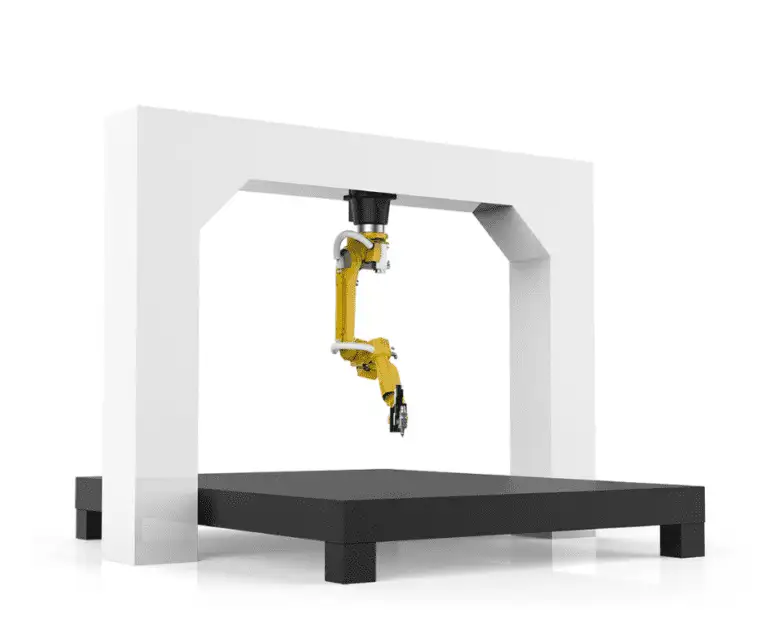
Operating in an Italian factory means adhering to strict CE and ISO safety standards. The MAG Cobot Welder utilized force-torque sensors in every joint. During the Tool Steel welding phase, if the torch bumped into a fixture due to a programming error, the system performed a Category 0 stop in under 0.08 seconds. This safety layer allows the Arc Welding Solutions to be deployed in “collaborative” mode, removing the need for bulky safety cages that occupy valuable floor space in the compact Bologna workshop.
8. Final Engineering Directives
For future deployments of the 1500W MAG Cobot Welder specifically for Tool Steel welding, the following directives must be followed:
- Preheat Verification: Never rely on the cobot’s internal timer. Integrate an external IR pyrometer that interfaces directly with the Arc Welding Solutions controller to gate the start signal based on actual metal temperature.
- Wire Selection: Use only precision-wound spools. The cobot’s sensitivity to wire-feed tension means that any “tangling” on the spool will result in arc instability that the software cannot fully compensate for.
- Firmware Updates: Ensure the “Bologna Profile”—a custom set of pulse parameters developed during this site visit—is uploaded to all units handling high-carbon alloy steels.
The synergy between the MAG Cobot Welder and dedicated Arc Welding Solutions has proven to be the most effective method for stabilizing the volatile thermal environment of Tool Steel welding. The Bologna deployment stands as a successful blueprint for high-precision automated repair and fabrication.