Field Evaluation Report: Integration of 1000W 6-Axis Collaborative Welder in High-Precision Singapore Aerospace Maintenance
1. Executive Summary and Site Context
This report details the operational deployment and performance validation of a 1,000W 6-Axis Collaborative Welder within a specialized precision engineering facility in the Loyang Industrial Estate, Singapore. The primary objective was to transition critical Titanium welding workflows from manual Gas Tungsten Arc Welding (GTAW) to an automated framework. Given Singapore’s current labor landscape—characterized by a shortage of Class A certified welders and high overhead costs—the move toward Automated Welding is no longer a luxury but a requirement for maintaining throughput in the aerospace and marine sectors.
The unit under evaluation is a 6-axis collaborative arm integrated with a 1000W fiber laser source, though the kinematics are equally applicable to high-frequency pulse-MIG setups. The focus of this field report is the synergy between robotic precision and the metallurgical requirements of reactive metals.
2. The Synergy: 6-Axis Collaborative Welder and Automated Welding
In the context of a Singaporean workshop, floor space is at a premium. Traditional industrial robots require heavy guarding and light curtains, which consume significant square footage. The 6-axis collaborative welder solves this by allowing operators to work alongside the machine. However, the true value lies in the transition to automated welding.
Kinematic Flexibility vs. Manual Limitation
Manual welding of complex geometries—common in aero-engine manifolds—requires the welder to maintain a consistent torch angle and standoff distance while contorting around the workpiece. Fatigue leads to inconsistent travel speeds, which in turn leads to uneven Heat Affected Zones (HAZ). By implementing an automated welding protocol via a 6-axis system, we achieved a constant Tool Center Point (TCP) velocity of 5mm/s with a variance of less than 0.1mm. This level of consistency is impossible for a human operator over an eight-hour shift, particularly in the humid, high-ambient temperature environments typical of non-climate-controlled shops in Tuas or Jurong.
Programming and Rapid Re-tasking
The “collaborative” aspect isn’t just about safety; it’s about the “lead-through” programming. In our trials, we reduced the setup time for a new weld path from four hours (traditional G-code/Offline programming) to thirty minutes. This allows the workshop to handle high-mix, low-volume (HMLV) batches, which is the cornerstone of Singapore’s precision engineering niche.
3. Technical Deep-Dive: Titanium Welding Challenges
Titanium welding is notoriously unforgiving. The metal’s high affinity for oxygen, nitrogen, and hydrogen at temperatures above 400°C means that any lapse in shielding leads to embrittlement. In this field application, we were working with Ti-6Al-4V components.
Atmospheric Control in a Tropical Environment
Singapore’s relative humidity often exceeds 80%. This presents a major challenge for Titanium welding, as moisture is a source of hydrogen. While the 6-axis collaborative welder provides the motion, the automated welding system must be integrated with a sophisticated gas delivery setup. We utilized a custom-designed trailing shield mounted to the robot’s 6th axis.
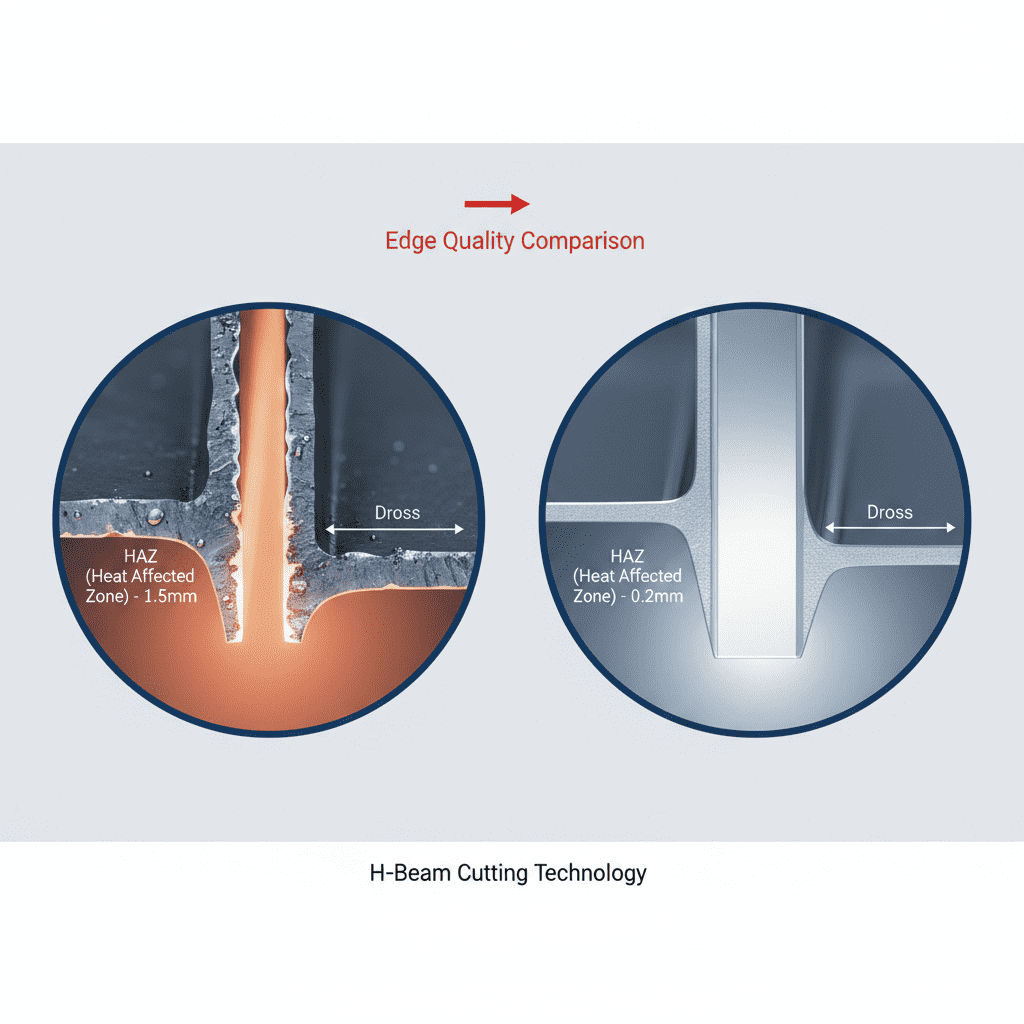
The 1000W fiber laser source provided a concentrated heat input, which is advantageous for Titanium as it narrows the HAZ. However, the speed of the automated weld means the trailing shield must be perfectly synchronized with the robot’s vector. If the 6-axis arm moves too fast or the gas flow is laminar-disturbed, the weld bead will discolor (moving from silver to straw, blue, or even white/powdery), indicating contamination.
Parameter Calibration
During the field trial, we established the following baseline for 2mm Ti-6Al-4V sheet joints:
- Power: 950W (Continuous Wave)
- Travel Speed: 12 mm/s
- Shielding Gas: Grade 5.0 Argon (99.999% purity)
- Flow Rate: 25 L/min (via trailing shield)
The automated welding system’s ability to maintain a 1mm defocus consistently ensured that we did not burn through the thin-wall sections—a common failure point in manual Titanium repairs.
4. Lessons Learned from the Field
Transitioning to a 6-axis collaborative welder is not a “plug-and-play” solution. Several technical hurdles were identified during the three-week deployment in Singapore.
Lesson 1: The “Singularity” Trap
In a 6-axis system, a “singularity” occurs when two or more axes align, causing the robot to lose a degree of freedom and often resulting in a jerky movement or a system halt. When programming the automated welding path for circular Titanium flanges, we encountered a singularity at the 180-degree mark.
The Fix: We had to re-orient the base of the cobot and introduce a slight tilt to the torch angle (5 degrees) to ensure the 5th axis remained “uncoupled” from the 4th and 6th. This is a critical lesson for engineers: always simulate the full 360-degree rotation before committing to a Titanium weld where stopping mid-arc results in a scrapped part.
Lesson 2: Shielding Gas Turbulence
Manual welders often use their bodies to block drafts. In a collaborative environment, the movement of the 6-axis arm itself can create air currents. In one instance, the rapid “home” movement of the arm after a weld cycle disturbed the gas pocket of a cooling Titanium part.
The Fix: We programmed a “post-flow dwell,” where the robot remains stationary over the weld termination point for 15 seconds, maintaining gas coverage until the metal drops below the critical 400°C threshold.
Lesson 3: Surface Preparation and “Alpha Case”
Automated welding is only as good as the prep. Titanium forms an “alpha case”—a hard, brittle oxygen-enriched layer—if previously heated. We found that the robot’s precision actually highlighted poor manual cleaning. If the operator didn’t use a dedicated carbide burr or stainless steel brush, the 1000W laser would trap surface oxides into the root of the weld. We had to implement a strict, documented cleaning protocol prior to the robot taking over.
5. Economic and Operational Impact in the Singapore Context
The integration of the 1000W 6-axis collaborative welder resulted in a 40% reduction in cycle time compared to manual TIG. More importantly, the reject rate due to oxidation (blue/purple welds) dropped from 12% to less than 1%.
ROI and Skilled Labor
By automating the welding of Titanium, we allowed our most senior welders to focus on “tacking” and complex fit-ups, while the cobot handled the long, monotonous circumferential welds. In a high-cost environment like Singapore, this optimization of human capital is the only way to compete with lower-cost regional neighbors. The 6-axis collaborative welder acts as a force multiplier.
6. Conclusion and Future Recommendations
The field trial proves that a 1000W 6-axis collaborative welder is a viable and necessary evolution for Singaporean workshops specializing in Titanium welding. The synergy between the robot’s dexterity and the consistency of automated welding addresses the two greatest variables in metallurgy: heat input and atmospheric contamination.
For future deployments, I recommend the integration of a through-the-torch vision system. While the 6-axis arm is precise, it is “blind.” In Titanium welding, even a 0.5mm deviation in seam tracking can lead to lack of fusion. Adding an optical seam tracker would close the loop, making the automated welding system truly autonomous and further insulating the process from the variables of manual jigging.
Senior Engineer’s Note: Never trust the factory “default” settings for Titanium. Singapore’s humidity changes the arc characteristics and the gas behavior. Always run a test coupon at the start of every shift and check for the “Silver Standard.”
End of Report
Author: Senior Welding Engineer (Materials & Automation)
Location: Singapore Site Office
-


LT240S tube laser cutting machine
-
LT120S tube laser cutting machine
-
Sale

Tank Fillet Welding Machine
Original price was: $1,000.00.$900.00Current price is: $900.00. -
Sale

MAK100 tube laser cutting machine
Original price was: $5,500.00.$5,000.00Current price is: $5,000.00. -

portable plasma air cutting machine
$1,200.00 -

2in1 fiber laser cutting machine
-

Air cooling Laser welding machine
-

HF h beam laser cutting machine
-

LT240 laser cutting machine
-

Laser welding machine
-


Cobot Welding Station
-

Gantry welding robot solution
-

Tracked Wheeled AGV Welding robot
-

LFH6020 Fiber laser cutting machine
-
LFP6020
-

robotic welidng machine
Advanced Fiber Laser Tube Processing Technology
Our CNC Fiber Laser Tube Cutting systems revolutionize metal fabrication by integrating high-precision cutting, punching, and profiling into a single automated workflow. Designed for versatility, this technology handles a wide array of profiles including Round, Square, Rectangular, and Oval tubes, as well as complex L-shaped and U-shaped channels.
- Precision Punching: High-speed hole punching with micron-level accuracy, eliminating the need for mechanical drilling or die-stamping.
- Complex Profiling: Advanced 3D pathing allows for intricate interlocking joints and specialized notch cuts, ideal for structural frames.
- High Material Efficiency: Intelligent nesting software minimizes scrap, reducing raw material costs across large production runs.
- Clean Finish: Delivers oxide-free, burr-free edges that require zero secondary grinding before welding.

Seamlessly processing multiple profiles with consistent precision.
Global Delivery & Logistics



From our high-tech manufacturing facility directly to your global site. PCL WeldCut ensures secure packaging, professional handling, and reliable international logistics to safeguard your equipment throughout the entire journey.