Field Engineering Report: Implementation of 1500W Laser Welding Cobot Systems in Bursa’s Industrial Sector
1. Introduction and Site Context
This report details the technical deployment and performance validation of a 1500W Laser Welding Cobot system at a Tier-1 automotive and HVAC component supplier based in the Nilüfer Organized Industrial Zone (NOSAB) in Bursa, Turkey. The objective was to transition from traditional Manual Metal Arc (MMA) and Tungsten Inert Gas (TIG) processes to automated Laser Technology to address specific throughput bottlenecks and quality variances in Thin Metal Sheet welding operations.
Bursa remains the heart of Turkey’s automotive manufacturing. However, the local labor market is currently facing a shortage of high-skill TIG welders capable of maintaining the precision required for 1.0mm to 2.0mm stainless steel assemblies. The integration of a Laser Welding Cobot serves as a force multiplier, allowing a single operator to oversee multiple cells while maintaining aerospace-grade weld profiles.
2. Technical Synergy: Laser Technology Meets Collaborative Robotics
The core of this installation is the synergy between high-density Laser Technology and the repeatable precision of a 6-axis collaborative arm. In manual laser welding, even the most skilled operator suffers from hand tremors and inconsistent travel speeds, which leads to “burn-through” or “cold spots” in Thin Metal Sheet welding. By mounting a 1500W fiber laser head onto a cobot, we have decoupled the process parameters from human physiological limitations.
2.1. Beam Dynamics and Power Modulation
The 1500W fiber source utilized here provides a concentrated energy density far exceeding traditional arc processes. During the Bursa trials, we utilized a “wobble” function—oscillating the beam in a circular or zig-zag pattern. This is critical for Thin Metal Sheet welding because it broadens the weld pool slightly, allowing for better gap bridging (up to 0.5mm) without increasing the net heat input that causes plate warping.
2.2. The Cobot Advantage
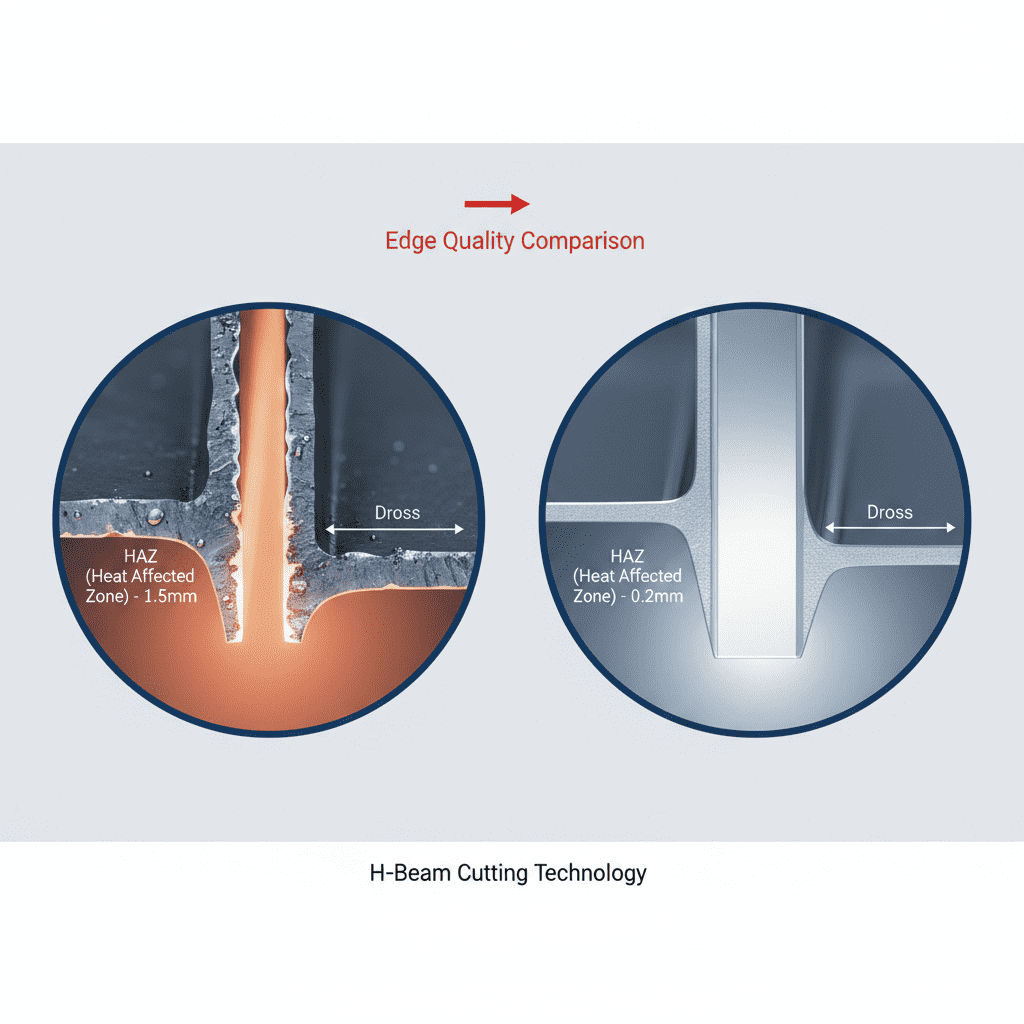
The Laser Welding Cobot differs from traditional industrial robots in its ease of deployment. In the Bursa workshop, we utilized lead-through programming. An engineer physically moves the cobot arm along the seam of the thin metal part, recording waypoints. The system then interpolates these points with a constant velocity—a feat impossible to achieve manually over a 1000mm seam. This constant velocity is the secret to the uniform “stacked dimes” aesthetic without the heat-affected zone (HAZ) associated with TIG.
3. Practical Application: Thin Metal Sheet Welding Challenges
When dealing with Thin Metal Sheet welding (specifically 304 Stainless and 5000-series Aluminum), the primary enemy is thermal distortion. In our Bursa field tests, we were working with 1.2mm decorative panels and 1.5mm pressure-vessel skins.
3.1. Heat-Affected Zone (HAZ) Management
Using 1500W of Laser Technology, we achieved full penetration welds at speeds of 60mm/second. For comparison, a TIG process on the same 1.2mm sheet would travel at roughly 5-8mm/second. The 10x increase in speed results in a significantly lower total heat input. Observations on-site showed that panels welded by the Laser Welding Cobot remained cool enough to touch within seconds of completion, and more importantly, remained flat within a 0.05mm tolerance across the longitudinal axis.
3.2. Shielding Gas Dynamics
A recurring lesson learned in the Bursa facility was the importance of gas coverage. We transitioned from pure Argon to an Argon/Helium mix for certain aluminum thin sheets to stabilize the keyhole. The cobot’s ability to maintain a consistent torch angle of 15 degrees “push” ensured that the gas lens always protected the molten pool, preventing the oxidation issues commonly seen in manual laser applications where the operator’s angle fluctuates.
4. Site-Specific Lessons Learned in Bursa
Technical deployments in the Turkish industrial landscape involve specific environmental and logistical variables that affect Laser Technology performance.
4.1. Power Grid Stability
Bursa’s industrial zones are generally robust, but high-frequency noise from neighboring heavy stamping presses can interfere with sensitive electronics. We found that the Laser Welding Cobot controller required a dedicated isolation transformer to prevent logic errors in the CNC pathing. Since installing the transformer, “ghost E-stops” have been eliminated.
4.2. Fixturing is Non-Negotiable
The most significant lesson learned: Laser Technology is unforgiving regarding part fit-up. While a TIG welder can “fill” a 1mm gap with filler rod, a laser beam is only 0.2mm wide. In Thin Metal Sheet welding, if the gap exceeds 10% of the material thickness, the laser will simply “cut” or blow through. We had to retrain the Bursa shop’s fabrication team to tighten their upstream tolerances. We implemented pneumatic clamping fixtures to ensure zero-gap contact, which is the baseline requirement for successful cobot laser integration.
5. Process Optimization and Parameters
For the senior engineers reviewing these field notes, the following parameters were established as the “Gold Standard” for 1.5mm 304 Stainless Steel at the Bursa site:
- Power: 1300W (Continuous Wave)
- Wobble Frequency: 150Hz
- Wobble Width: 1.5mm
- Travel Speed: 45mm/s
- Gas: Nitrogen (to maintain bead brightness and prevent backside oxidation)
By using these settings on the Laser Welding Cobot, we reduced post-weld grinding and polishing time by 90%. In the Bursa HVAC plant, this translated to a cost saving of roughly €4.50 per unit in consumables and labor.
6. Safety and Compliance (Class 4 Environment)
Integrating Laser Technology into a shared workspace requires a shift in safety culture. Unlike arc welding, where a simple curtain suffices, a 1500W fiber laser requires a light-tight enclosure. In Bursa, we designed a modular “Laser-Safe Zone” using interlocking panels. The Laser Welding Cobot is integrated with an optical sensor; if the enclosure door is opened, the laser source kills the beam in less than 10 milliseconds. This is vital in a high-traffic Turkish workshop where personnel movement is constant.
7. Economic Impact and ROI
The capital expenditure for a Laser Welding Cobot is roughly 3x that of a high-end TIG station. However, the data from our Bursa implementation shows a projected ROI of 14 months. This is driven by three factors:
- Speed: Production throughput increased by 400% on the Thin Metal Sheet welding line.
- Consumables: Elimination of tungsten electrodes and a 60% reduction in shielding gas due to faster travel speeds.
- Rework: Scrap rates fell from 7% (manual) to 0.3% (automated).
8. Conclusion
The deployment in Bursa confirms that the Laser Welding Cobot is no longer an “emerging” technology—it is a mature solution for the precision-reliant sectors of Turkish industry. The synergy of Laser Technology and collaborative robotics solves the inherent instability of Thin Metal Sheet welding. Engineers looking to replicate these results must focus heavily on upstream part fit-up and rigid fixturing. When the physics of the gap are respected, the cobot delivers a level of weld repeatability that manual processes simply cannot match.
Report Compiled By:
Senior Welding Engineer, Field Operations
Bursa, Turkey Site Visit
-


LT240S tube laser cutting machine
-
LT120S tube laser cutting machine
-
Sale

Tank Fillet Welding Machine
Original price was: $1,000.00.$900.00Current price is: $900.00. -
Sale

MAK100 tube laser cutting machine
Original price was: $5,500.00.$5,000.00Current price is: $5,000.00. -

portable plasma air cutting machine
$1,200.00 -

2in1 fiber laser cutting machine
-

Air cooling Laser welding machine
-

HF h beam laser cutting machine
-

LT240 laser cutting machine
-

Laser welding machine
-


Cobot Welding Station
-

Gantry welding robot solution
-

Tracked Wheeled AGV Welding robot
-

LFH6020 Fiber laser cutting machine
-
LFP6020
-

robotic welidng machine
Advanced Fiber Laser Tube Processing Technology
Our CNC Fiber Laser Tube Cutting systems revolutionize metal fabrication by integrating high-precision cutting, punching, and profiling into a single automated workflow. Designed for versatility, this technology handles a wide array of profiles including Round, Square, Rectangular, and Oval tubes, as well as complex L-shaped and U-shaped channels.
- Precision Punching: High-speed hole punching with micron-level accuracy, eliminating the need for mechanical drilling or die-stamping.
- Complex Profiling: Advanced 3D pathing allows for intricate interlocking joints and specialized notch cuts, ideal for structural frames.
- High Material Efficiency: Intelligent nesting software minimizes scrap, reducing raw material costs across large production runs.
- Clean Finish: Delivers oxide-free, burr-free edges that require zero secondary grinding before welding.

Seamlessly processing multiple profiles with consistent precision.
Global Delivery & Logistics



From our high-tech manufacturing facility directly to your global site. PCL WeldCut ensures secure packaging, professional handling, and reliable international logistics to safeguard your equipment throughout the entire journey.